Introduction: A Tense Calm Before the Storm?
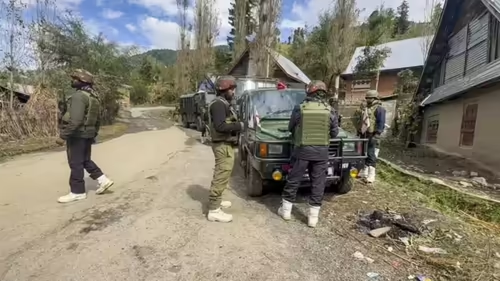
The usually serene, snow-clad mountains of Kishtwar in Jammu and Kashmir have been transformed into a high-alert combat zone. Operation Trashi-I, a massive counter-terrorism drive, is now in its second week, following a fierce gunfight that has left the nation on edge. This isn’t just another routine operation; it’s a stark reminder of a disturbing trend where militancy appears to be making a strategic shift from the Kashmir Valley into the Jammu region.
Table of Contents
- The Operation Trashi-I Breakdown
- Why Kishtwar? A Historical and Strategic Perspective
- The Human Cost of the Conflict
- Broader Implications for Jammu and Kashmir
- Conclusion: A Region on a Knife-Edge
- Sources
The Operation Trashi-I Breakdown
Launched in the dense forests of the Chatroo belt near Sonnar village, Operation Trashi-I was initiated on January 18, 2026, after intelligence inputs pointed to the presence of a group of terrorists, suspected to be from Jaish-e-Mohammad [[7]]. The operation quickly escalated into a violent confrontation. In the ensuing gunfight, eight Indian Army personnel were injured, with most suffering from splinter wounds caused by a grenade blast [[8]].
The search operation has been relentless. Security forces have cordoned off a vast area, conducting door-to-door checks and combing through treacherous, snow-covered terrain. The operation has seen multiple re-engagements, with a fresh encounter reported as recently as January 25th, indicating that the terrorists remain holed up and are fiercely resisting capture [[14]].
Who Are They Targeting?
Initial reports and intelligence suggest the group comprises at least two to three highly trained Jaish-e-Mohammad (JeM) operatives [[23]]. The JeM, a Pakistan-based terrorist organization, has a long history of orchestrating attacks in India. Their presence in Kishtwar is particularly alarming given the district’s proximity to critical infrastructure and major highways.
Why Kishtwar? A Historical and Strategic Perspective
Kishtwar isn’t a stranger to violence. The district has a painful history, including the 1993 and 2001 massacres that targeted the minority Hindu community [[21], [25]]. However, for much of the last decade, the region had seen a relative decline in militant activity compared to the Kashmir Valley.
So, why the sudden resurgence? Experts point to several factors:
- Strategic Shift by Terror Groups: With increased pressure and surveillance in the Valley, terror outfits are looking for softer, more remote targets in the Jammu region to regroup and plan future strikes [[28]].
- Over-Ground Worker (OGW) Network: A report from early January 2026 revealed that over 150 OGWs—local sympathizers who provide logistical support, shelter, and intelligence—are active in Kishtwar alone [[12]]. This network is a critical enabler for any militant group trying to establish a foothold.
- Challenging Terrain: The dense, forested, and mountainous landscape of Kishtwar provides an ideal hideout for militants, making it extremely difficult for security forces to track and neutralize them.
The Human Cost of the Conflict
Beyond the strategic implications, this conflict has a profound human cost. The eight injured soldiers are a sobering reminder of the daily risks faced by our armed forces. Their bravery in the face of a grenade attack deserves our deepest respect.
For the local population of Kishtwar, life has been thrown into disarray. Movement is restricted, markets are closed, and a pervasive sense of fear has replaced the usual calm. The security forces have ramped up identity checks and inspections across the district to prevent any escape or reinforcement for the terrorists [[15]]. While necessary, these measures add to the civilian burden during an already tense time.
Broader Implications for Jammu and Kashmir
The events in Kishtwar are not happening in a vacuum. They are part of a larger, worrying pattern of increasing militant activity across the Jammu region. Just a few months prior, in November 2025, another major operation, ‘Operation Chhatru,’ was conducted in the same area [[20]]. This suggests a concerted effort by terror groups to destabilize Jammu.
This shift poses a significant challenge to the administration’s narrative of normalcy and development in the Union Territory. It also underscores the need for a multi-pronged strategy that goes beyond military operations. Tackling the OGW network through community policing and intelligence-led actions is now more critical than ever. For more on the complex security dynamics of the region, see our deep dive on [INTERNAL_LINK:jammu-kashmir-security-challenges].
Conclusion: A Region on a Knife-Edge
Operation Trashi-I is far more than a localized search mission. It is a critical test of the security apparatus’s ability to adapt to the evolving tactics of terror groups. The successful neutralization of the holed-up terrorists is essential, but it is only the first step. The long-term solution lies in dismantling the support ecosystem that allows these groups to operate in the first place. As the operation continues, the eyes of the nation are on Kishtwar, hoping for a swift resolution and a return to peace for its resilient people.
Sources
- The Hindu: Massive search operation to hunt down terrorists enters day 3 in J&K’s Kishtwar
- NewsOnAir: Eight soldiers injured in gunfight with terrorists in Kishtwar district
- SATP: Over 150 OGWs of terror outfits operating in Kishtwar District, J&K
- Wikipedia: 2001 Kishtwar massacres
- India Today: Operation Chhatru underway in J&K’s Kishtwar
- The Hindu: Fresh encounter breaks out between security forces and terrorists in Kishtwar