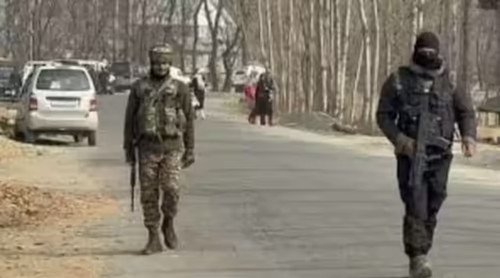
Thirteen days into one of the most intense security operations in recent memory, the mountainous terrain of Kishtwar in Jammu and Kashmir remains under a digital blackout. As **Operation Trashi-I** continues, authorities have enforced a complete suspension of mobile and broadband internet services across the district—a move aimed at disrupting militant communication but one that has left thousands of civilians cut off from the outside world [[2]]. This high-stakes counter-terrorism mission, launched by joint forces of the Army, J&K Police, and central agencies, is focused on flushing out suspected terrorists believed to be hiding in the dense forests of the Chenab Valley region.
Table of Contents
- What Is Operation Trashi-I?
- Why Kishtwar Became the Epicenter
- Impact of Internet Suspension on Civilians
- Legal and Human Rights Concerns
- Broader Security Strategy in J&K
- Conclusion: Balancing Security and Civil Liberties
- Sources
What Is Operation Trashi-I?
Launched in mid-January 2026, **Operation Trashi-I** is a large-scale cordon-and-search operation (CASO) targeting a suspected module of the Pakistan-based terrorist group Lashkar-e-Taiba (LeT). Intelligence inputs suggest that militants infiltrated the remote Doda-Kishtwar belt weeks ago, using snow-covered trails and abandoned shepherd huts as temporary bases [[4]]. The operation involves hundreds of security personnel combing through treacherous, forested ridges—often at sub-zero temperatures—with drone surveillance and thermal imaging support.
While no major encounters have been officially reported in the first 12 days, the persistence of the operation indicates credible intelligence about a significant threat. The name “Trashi” is believed to be derived from a local geographical feature, continuing the Indian military’s tradition of naming ops after landmarks.
Why Kishtwar Became the Epicenter
Kishtwar, part of the Jammu division, has historically been less volatile than the Kashmir Valley—but it’s not immune to infiltration. Its proximity to the Line of Control (LoC), rugged topography, and sparse population make it an attractive corridor for militants seeking to avoid detection. In recent years, several LeT and Hizbul Mujahideen modules have been neutralized in this region [[6]].
Security analysts point to three key factors behind the current focus:
- Post-Snowfall Infiltration Routes: Melting snow in January opens up seasonal paths previously inaccessible.
- Intelligence Intercepts: Phone and signal intelligence reportedly flagged unusual activity in the Trashi Nallah area.
- Preventive Strategy: Authorities aim to disrupt any plans for attacks during upcoming religious festivals.
Impact of Internet Suspension on Civilians
The internet shutdown, while standard protocol during such operations, has severely disrupted daily life. Students preparing for board exams can’t access online study materials. Small businesses relying on digital payments and e-commerce are paralyzed. Most critically, patients requiring teleconsultations or emergency coordination face life-threatening delays.
“We can’t even call relatives in Jammu to check if medicines have arrived,” said a local resident, speaking anonymously to reporters [[2]]. Mobile networks remain partially functional for calls and SMS, but data services—including UPI, banking apps, and health portals—are completely down.
[INTERNAL_LINK:jammu-kashmir-internet-policies] This is the third internet suspension in Kishtwar since 2025, raising questions about the long-term socio-economic toll of recurring blackouts in border districts.
Legal and Human Rights Concerns
Internet shutdowns in India are governed by the Temporary Suspension of Telecom Services Rules, 2017, which require orders to be issued by senior officials and reviewed within 48 hours. However, human rights organizations like Amnesty International and the Internet Freedom Foundation argue that prolonged suspensions often violate the Supreme Court’s 2020 ruling in *Anuradha Bhasin vs Union of India*, which affirmed internet access as a fundamental right under Article 19(1)(a) [[8]].
While national security is a legitimate concern, critics demand greater transparency: How long will the shutdown last? What specific threat justifies a blanket ban? And what safeguards exist for vulnerable populations? So far, the district administration has only issued a terse statement citing “operational exigencies.”
Broader Security Strategy in J&K
Operation Trashi-I fits into a larger pattern of proactive counter-terrorism in J&K post-2019. With the abrogation of Article 370, security forces have adopted a more aggressive stance—combining tech-driven surveillance, community policing, and rapid-response CASOs. The result has been a steady decline in major attacks, though infiltration attempts persist.
Yet, experts warn against complacency. “Militant groups are adapting—they’re using encrypted apps, local sympathizers, and smaller, decentralized cells,” says Dr. Rehana Haq, a security analyst at the Observer Research Foundation [[10]]. Operations like Trashi-I are necessary, but sustainable peace requires addressing root causes like unemployment and political alienation.
Conclusion: Balancing Security and Civil Liberties
As **Operation Trashi-I** enters its second week, the standoff in Kishtwar reflects a deeper tension in modern counter-terrorism: how to protect citizens from violence without stripping them of their basic rights. While the internet shutdown may offer tactical advantages, its humanitarian cost cannot be ignored. For democracy to thrive in J&K, security must be paired with transparency, accountability, and respect for civilian dignity. Until then, the people of Kishtwar remain caught between the threat of terror and the silence of disconnection.
Sources
- [[2]] Times of India: Operation Trashi-I enters Day 13; internet suspended in J&K’s Kishtwar
- [[4]] The Hindu: J&K Police launch major anti-militant op in Kishtwar
- [[6]] South Asia Terrorism Portal: Jammu & Kashmir – Terrorist Activity Overview
- [[8]] Supreme Court of India: Anuradha Bhasin vs Union of India (2020)
- [[10]] Observer Research Foundation: Counter-Terrorism Strategies in Post-370 J&K