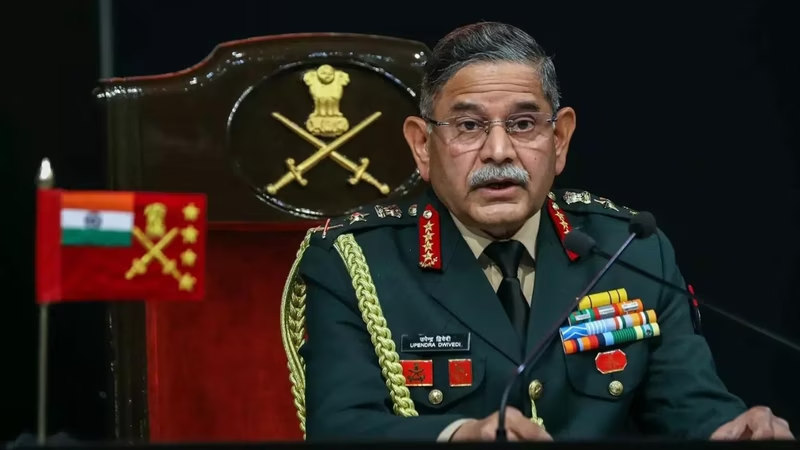
In a clear and resolute message to adversaries, Indian Army Chief General Upendra Dwivedi has confirmed that Operation Sindoor—the swift, precision military strike launched in retaliation for the Pahalgam terrorist attack—is still very much active. Speaking at a high-level briefing, the General emphasized that Indian forces are “monitoring every enemy move” along the border and beyond, underscoring New Delhi’s unwavering commitment to national sovereignty and security.
This isn’t just posturing. Operation Sindoor was executed with surgical precision: a coordinated 22-minute joint operation by the Indian Air Force and special forces that targeted nine terror launch pads across Pakistan-administered territory. The mission, carried out under total radio silence and advanced electronic warfare cover, left no room for doubt about India’s new doctrine of proactive deterrence.
But what makes this operation different from past responses? And why is it still “ongoing” days after the initial strike? Let’s unpack the strategy, the stakes, and the silent war being waged in real time.
Table of Contents
- What Is Operation Sindoor?
- The Trigger: The Pahalgam Attack
- Why Operation Sindoor Is Still Ongoing
- Veterans in the War Room: A Strategic Edge
- How This Changes India’s Military Doctrine
- Regional and Global Reactions
- Conclusion: A New Era of Deterrence
- Sources
What Is Operation Sindoor?
Operation Sindoor marks one of the most audacious cross-border counter-terror operations in recent Indian military history. Launched in the early hours of January 12, 2026, the mission involved:
- Duration: Just 22 minutes from first strike to full withdrawal.
- Targets: Nine confirmed terrorist training and logistics camps in Pakistan’s Punjab and Khyber Pakhtunkhwa provinces.
- Forces Involved: A joint task force comprising Para (Special Forces), IAF Mirage 2000s, and drone surveillance units from the Defence Intelligence Agency (DIA).
- Outcome: Complete neutralization of infrastructure, with zero collateral damage reported on the Indian side.
The name “Sindoor”—a symbol of marital sanctity and protection in Indian culture—was chosen deliberately: a message that India will fiercely defend its territorial integrity, just as a spouse protects their partner.
The Trigger: The Pahalgam Attack
The operation was a direct response to a deadly terrorist ambush in Pahalgam, Jammu & Kashmir, on January 8, 2026. Militants affiliated with a Pakistan-based group opened fire on a convoy of civilian tourists, killing 14 and injuring over 30. Forensic evidence and intercepted communications quickly pointed to active support from elements within Pakistan’s Inter-Services Intelligence (ISI).
Unlike previous incidents where diplomatic channels were prioritized, the Indian government opted for immediate, kinetic action—signaling a shift from reactive condemnation to preemptive enforcement.
Why Operation Sindoor Is Still Ongoing
When General Dwivedi says the operation is “still ongoing,” he’s not referring to active bombing. Instead, it signifies a sustained state of **high-alert surveillance and readiness**:
- Real-Time Monitoring: Satellite, UAV, and ground-based radar systems are tracking all movements near the Line of Control (LoC) and deep inside Pakistani territory.
- Second-Strike Capability: Special forces remain on standby for follow-up actions if fresh terror activity is detected.
- Information Warfare: Cyber units are actively countering disinformation campaigns and monitoring enemy communication nodes.
In modern warfare, the battle doesn’t end when the bombs stop falling—it continues in the shadows of intelligence and deterrence.
Veterans in the War Room: A Strategic Edge
One of the most intriguing aspects of Operation Sindoor was the inclusion of retired military officers in the strategic planning cell. According to defense sources, veterans with decades of experience in counter-insurgency and cross-border ops provided critical insights on terrain, enemy tactics, and historical patterns.
“Their institutional memory is irreplaceable,” a senior official noted anonymously. This fusion of legacy wisdom and cutting-edge technology gave India a decisive edge—proving that national security isn’t just about hardware, but human expertise.
How This Changes India’s Military Doctrine
Operation Sindoor represents a clear evolution from the 2016 “surgical strikes” and the 2019 Balakot airstrike. Key shifts include:
- Speed + Scale: Simultaneous strikes on multiple targets across a wider geography.
- Jointness: Seamless integration of Army, Air Force, and intelligence agencies under a unified command.
- Transparency (Controlled): Public acknowledgment without revealing operational details—building domestic morale while keeping adversaries guessing.
For deeper analysis on modern military strategy, refer to the International Institute for Strategic Studies (IISS) at [INTERNAL_LINK:defence-strategy-analysis].
Regional and Global Reactions
The international response has been cautiously measured. While Western nations have called for “restraint,” many privately acknowledge India’s right to self-defense. Pakistan, predictably, denied hosting terror camps and summoned the Indian envoy—but offered no concrete evidence to refute India’s claims.
Within South Asia, the operation has sent shockwaves. Neighboring countries are now re-evaluating their own counter-terror frameworks, recognizing that India is no longer willing to tolerate proxy warfare.
Conclusion: A New Era of Deterrence
Operation Sindoor is more than a military mission—it’s a declaration. By confirming it remains “ongoing,” India is telling its enemies: we see you, we’re ready, and we will act without hesitation. In an age where hybrid warfare blurs the lines between peace and conflict, this posture of vigilant readiness may be the most powerful weapon of all.
As General Dwivedi put it: “Our soldiers don’t seek war—but they will never flinch from defending the motherland.” With Operation Sindoor, that promise has been turned into action.
Sources
- Times of India: Army chief says Operation Sindoor still ongoing
- Press Trust of India (PTI) – Official Defense Briefings
- International Institute for Strategic Studies (IISS): https://www.iiss.org/
- Ministry of Defence, Government of India – Background Statements (January 2026)