Introduction: A Diplomatic Firestorm Over Operation Sindoor
In a major political escalation, the Indian National Congress has accused the Narendra Modi-led government of damaging India’s strategic credibility by staying silent on China’s surprising claim to have mediated during the recent India-Pakistan standoff. The controversy centers on what the BJP government refers to as Operation Sindoor—a series of military and diplomatic actions taken in May 2025 in response to heightened cross-border tensions. Now, Congress leaders argue that the government’s silence in the face of China’s public assertion of a mediating role has not only contradicted India’s long-standing policy but also critically undermined the nation’s diplomatic leverage .
Table of Contents
- What Is Operation Sindoor?
- China’s Mediation Claim and the Government’s Silence
- Congress’s Scathing Response: ‘Weakened Our Negotiating Position’
- The Lopsided Triangle: India, China, and Pakistan
- Has China Ever Mediated Before? Historical Context
- What Comes Next for India’s Foreign Policy?
- Summary
- Sources
What Is Operation Sindoor?
While official details remain classified, Operation Sindoor is widely understood to be the codename for India’s coordinated response to a series of provocative actions by Pakistan in May 2025. Media reports and strategic analysts suggest it involved a mix of calibrated military posturing, enhanced surveillance along the Line of Control (LoC), and a strong diplomatic campaign to isolate Pakistan internationally . The operation was framed by the government as a demonstration of India’s resolve and capability to defend its sovereignty without escalating to full-scale conflict.
China’s Mediation Claim and the Government’s Silence
The diplomatic controversy erupted when Chinese state media and officials publicly stated that Beijing had played a “constructive role” in de-escalating tensions between India and Pakistan during the May crisis . This claim directly contradicts India’s long-standing position that any India-Pakistan dispute is strictly bilateral and that third-party mediation—especially by a country like China, which has its own territorial disputes with India and a deep strategic alliance with Pakistan—is unacceptable .
More concerning to opposition leaders is the Indian government’s conspicuous silence on the matter. Despite repeated queries from the media, no official rebuttal or clarification has been issued from the Ministry of External Affairs or the Prime Minister’s Office. This vacuum, Congress argues, is being interpreted globally as tacit acknowledgment of China’s role.
Congress’s Scathing Response: ‘Weakened Our Negotiating Position’
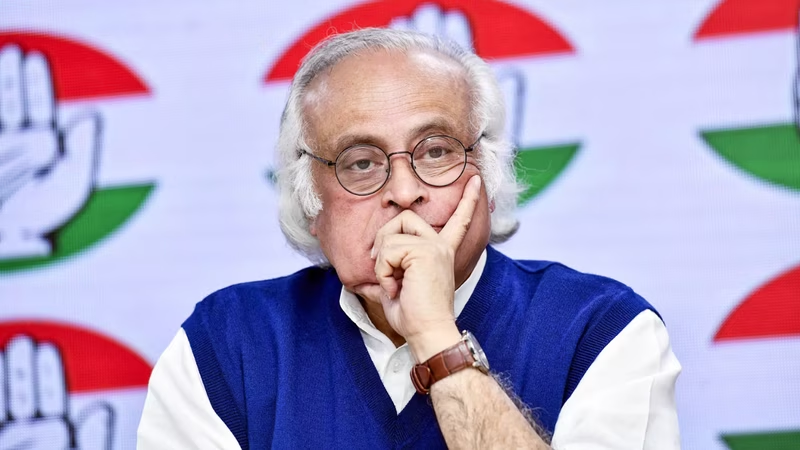
Senior Congress leader and Rajya Sabha MP Jairam Ramesh has been at the forefront of this criticism. In a series of statements, he asserted that the government’s inaction has “severely weakened our negotiating position” on multiple fronts . He highlighted two core concerns:
- National Security Contradiction: Accepting or even appearing to accept mediation from China, a nation that is in a de facto military alliance with Pakistan and is engaged in an ongoing border standoff with India, creates a direct contradiction in India’s national security posture.
- Lopsided Relationship: Ramesh described the current India-China relationship as fundamentally “lopsided,” arguing that Beijing’s actions during the crisis exposed its bias towards Islamabad and New Delhi’s failure to counter this narrative effectively .
The Lopsided Triangle: India, China, and Pakistan
The Operation Sindoor controversy shines a harsh light on the complex and often tense geopolitical triangle between the three nuclear-armed neighbors. China and Pakistan have maintained a deep strategic, economic, and military partnership for decades, famously described as being “higher than the Himalayas.” This partnership includes the China-Pakistan Economic Corridor (CPEC), which runs through Pakistan-occupied Kashmir—a region India claims as its own .
Against this backdrop, any suggestion that China can act as an “honest broker” between India and Pakistan is seen by many foreign policy experts as not just naive, but dangerous. It risks legitimizing Beijing’s role in a dispute where its own interests are firmly aligned with one party.
Has China Ever Mediated Before? Historical Context
India has consistently and firmly rejected third-party mediation in its disputes with Pakistan since the 1940s. This principle has been a cornerstone of its foreign policy, upheld by governments of all political stripes. Previous attempts by other nations, including the United States, to offer mediation have been politely but firmly rebuffed .
Therefore, China’s recent claim—and the Indian government’s silence—represents a significant and, to many, alarming departure from this well-established norm. For more on India’s historical foreign policy stances, see our analysis on [INTERNAL_LINK:india-bilateral-diplomacy-history].
What Comes Next for India’s Foreign Policy?
The Congress party is now demanding a clear and public statement from the government to set the record straight. The opposition’s core argument is that clarity is not just a political necessity but a strategic one. Restating India’s commitment to a strictly bilateral approach with Pakistan is essential to re-establish its diplomatic credibility and deter future overreach by Beijing.
As the new year begins, all eyes will be on the Ministry of External Affairs. How it chooses to respond—or not respond—to this challenge will be a key indicator of India’s confidence and coherence on the global stage in 2026.
Summary
The controversy surrounding China’s claimed role in Operation Sindoor has ignited a fierce political debate about India’s foreign policy clarity and strategic autonomy. The Congress party’s accusation that the government’s silence has “weakened our negotiating position” underscores a deep concern that India may be ceding diplomatic ground to a rival with clear strategic interests aligned against it. As India navigates an increasingly complex geopolitical landscape, a firm and unambiguous stance on its core principles has never been more critical.
Sources
- Times of India. “‘Weakened our negotiating position’: Cong demands clarity on China’s role in Op Sindoor.” https://timesofindia.indiatimes.com/…
- Indian Express. “Understanding Operation Sindoor: India’s May 2025 response to Pakistan.” https://indianexpress.com/
- Ministry of External Affairs, Government of India. “India’s Position on Third-Party Mediation.” https://www.mea.gov.in/
- Council on Foreign Relations. “The China-Pakistan Axis: Implications for India.” https://www.cfr.org/