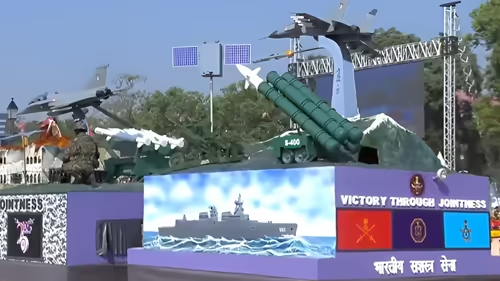
The drums on Kartavya Path weren’t just for ceremony this year. They were a thunderous echo of a recent, decisive victory. The 77th Republic Day parade of 2026 transformed into a rolling showcase of India’s newfound confidence, a direct visual narrative of Operation Sindoor—the audacious counter-terror mission that neutralized over 100 enemy combatants and sent a clear message across the border . This wasn’t just about tradition; it was about demonstrating the very tools that secured a strategic win.
Table of Contents
- Operation Sindoor: A Strategic Masterstroke
- The Stars of the Show: BrahMos and S-400
- BrahMos: The Supersonic Fist of Indian Might
- S-400 Triumf: The Ultimate Air Shield
- Beyond the Headliners: A Full-Spectrum Display
- Conclusion: A New Era of Deterrence
- Sources
Operation Sindoor: A Strategic Masterstroke
Launched in May 2025 in response to a major terror attack, Operation Sindoor marked a significant shift in India’s defense posture—from reactive to proactive and precise . The operation involved coordinated strikes on nine key sites in Pakistan and Pakistan-administered Kashmir, showcasing a new level of integrated warfare capability . The Army Chief has confirmed that the operation is still ongoing, with 2026 declared the ‘Year of Networking, Data Centricity’ to further enhance this multi-domain approach . The Republic Day parade served as the perfect platform to translate this operational success into a public demonstration of national strength and resolve.
The Stars of the Show: BrahMos and S-400
While the parade featured a stunning array of indigenous platforms like the new hypersonic glide vehicle and the ‘Suryastra’ rocket launcher , two systems stood out as the undeniable symbols of Operation Sindoor‘s success: the BrahMos supersonic cruise missile and the S-400 Triumf air defence system. Their presence was no accident; they represent the offensive and defensive pillars of India’s modern military doctrine.
BrahMos: The Supersonic Fist of Indian Might
The BrahMos missile, a product of the formidable Indo-Russian partnership, is a game-changer. Capable of flying at nearly three times the speed of sound (Mach 2.8-3.0) throughout its entire flight, it gives adversaries almost no time to react . With a range of up to 290 km and a massive 200-300 kg conventional warhead, its precision strike capability is devastating . What makes it truly versatile is its ability to be launched from land, sea, air, and even submarines, providing the Indian Armed Forces with an unmatched first-strike option. During Operation Sindoor, the BrahMos would have been a critical asset for surgically eliminating high-value, heavily fortified targets deep inside hostile territory, a fact implicitly celebrated by its prominent parade placement .
S-400 Triumf: The Ultimate Air Shield
If the BrahMos is the sword, the S-400 Triumf is the shield. This Russian-made system is one of the most sophisticated long-range surface-to-air missile systems in the world. India’s $5.43 billion deal for five S-400 regiments is nearing completion, with the final units expected by mid-2026 [[26], [30]]. Its true power was revealed during the May 2025 conflict when it made its combat debut, successfully intercepting a barrage of Pakistani missiles and drones, effectively creating an impenetrable ‘Sudarshan Chakra’ over Indian airspace [[29], [31]]. With a reported engagement range of up to 400 km, the S-400 provides a protective umbrella that deters any aerial aggression, allowing India’s own offensive assets, like the BrahMos, to operate with greater security. Its appearance at the parade was a stark reminder to any potential aggressor of the formidable cost of any aerial adventurism.
Beyond the Headliners: A Full-Spectrum Display
The parade was a comprehensive inventory of India’s growing self-reliance in defense. Alongside the BrahMos and S-400, spectators witnessed a host of other advanced systems that contribute to a networked, multi-domain force:
- Akash & MRSAM: Indigenous and joint-venture medium-range surface-to-air missile systems that form the layered air defence grid .
- Dhanush & ATAGS: Powerful 155mm artillery guns that provide the backbone of the Army’s fire support, capable of delivering precision firepower over long distances [[10], [16]].
- Arjun Main Battle Tank & NAMIS-II: Showcasing the Army’s armored and anti-tank capabilities on the ground .
This holistic display emphasized that Operation Sindoor wasn’t won by a single weapon, but by the seamless integration of a vast, technologically advanced ecosystem.
Conclusion: A New Era of Deterrence
The 2026 Republic Day parade was far more than a ceremonial event. It was a masterclass in strategic communication. By placing the BrahMos and S-400—the very instruments of Operation Sindoor‘s success—at the forefront, India sent an unambiguous message to the world: its military is not only capable of decisive action but is also backed by cutting-edge, combat-proven technology. This display of integrated, multi-domain warfare capability marks a new chapter in India’s defense strategy, one built on credible deterrence and unwavering resolve. For anyone looking to understand the future of India’s security posture, the answer was rolling down Kartavya Path in all its formidable glory. To explore more about India’s indigenous defense projects, check out our deep dive on [INTERNAL_LINK:make-in-india-defence].
Sources
- Al Jazeera: India launches Operation Sindoor
- Press Information Bureau (PIB): Operation SINDOOR
- RUSI: Calibrated Force: Operation Sindoor
- Economic Times: Republic Day 2026 Parade
- BrahMos Aerospace: Official Missile Specifications
- Times of India: How India used S-400 Sudarshan Chakra
- Bulgarian Military: India’s S-400 debuts in combat