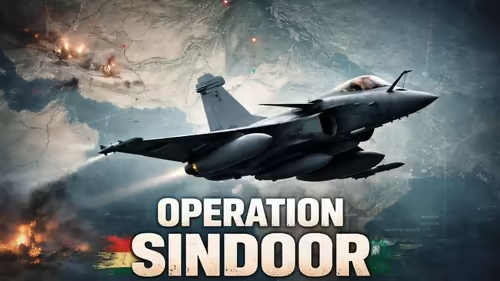
In the high-stakes game of modern warfare, control of the skies is often the ultimate decider. Now, a new report from a respected European military think tank has confirmed what many had suspected: India’s Operation Sindoor air superiority was so overwhelming that it directly forced Pakistan to call for a truce after just 88 hours of intense combat in May 2025 [[9]].
This revelation sheds light on a critical, yet often underreported, chapter in recent South Asian history—a conflict that pushed the region to the brink but ultimately showcased India’s rapidly maturing integrated air defence and offensive capabilities.
Table of Contents
- What Was Operation Sindoor?
- The European Think Tank Report: Key Findings
- How India Achieved Air Superiority
- The Cost of Victory: The Rafale Loss
- Why Pakistan Called for a Truce
- Conclusion: Strategic Implications for the Future
- Sources
What Was Operation Sindoor?
Operation Sindoor was a swift and precise military response by India to a major terrorist attack in Pahalgam in early May 2025 [[1]]. The operation, which began on May 7, involved coordinated missile strikes and deep penetration air raids targeting terror launch pads and command-and-control infrastructure inside Pakistan [[4]]. It marked a significant evolution in India’s “counter-terror” doctrine, moving beyond symbolic strikes to a sustained campaign of escalation dominance [[6]].
The European Think Tank Report: Key Findings
The analysis, reportedly from a Swiss-based defence research group, concludes that by May 10, the Indian Air Force (IAF) had effectively established air superiority over the entire theatre of operations [[15]]. This wasn’t just about shooting down enemy planes; it was about achieving a state where the IAF could operate with near impunity, conducting long-range precision strikes while neutralizing Pakistan’s air defence network [[10]].
The report highlights the effectiveness of India’s integrated air defence system, which seamlessly combined data from AWACS, ground-based radars, and fighter jets to create a comprehensive and real-time picture of the airspace [[9]]. This technological edge allowed the IAF to dictate the terms of engagement.
How India Achieved Air Superiority
India’s success wasn’t accidental. It was the result of years of strategic investment and doctrinal refinement. Key factors included:
- Network-Centric Warfare: The IAF’s ability to fuse intelligence from multiple platforms gave it a decisive information advantage over the Pakistan Air Force (PAF).
- Advanced Platform Mix: The deployment of a potent mix of aircraft, including Sukhoi Su-30MKIs, Mirage 2000s, and the newly inducted Rafales, created a multi-layered and versatile strike force [[14]].
- Suppression of Enemy Air Defences (SEAD): Dedicated missions were flown to locate, target, and destroy or degrade Pakistani radar and surface-to-air missile sites, clearing the way for follow-on strike packages [[13]].
The Cost of Victory: The Rafale Loss
Despite its overall success, the operation came at a cost. It has been confirmed that the IAF lost at least one of its prized French-made Rafale fighter jets—the first such combat loss for this advanced platform globally [[16]]. While the IAF officially acknowledged losses as “part of combat,” it maintained that all pilots returned safely [[17]].
This loss, however, does not diminish the broader achievement. In any high-intensity conflict against a capable adversary like Pakistan, some attrition is expected. The fact that the IAF maintained its operational tempo and strategic objectives even after this loss is a testament to its depth and resilience [[19]].
Why Pakistan Called for a Truce
Faced with the reality of losing control of its own airspace, Pakistan found itself in an untenable position. The European analysis makes it clear: the primary reason for Islamabad’s urgent request for a ceasefire was the coercive pressure exerted by India’s Operation Sindoor air superiority [[14]].
With its ability to project power or defend its territory severely compromised, Pakistan’s leadership realized that continued escalation would only lead to greater losses without a clear path to victory. The IAF’s dominance had effectively achieved what diplomacy could not: a rapid de-escalation on India’s terms [[13]].
Conclusion: Strategic Implications for the Future
Operation Sindoor stands as a watershed moment in the India-Pakistan military balance. It demonstrated that India’s investments in a modern, integrated air force are yielding tangible strategic results. The ability to achieve and sustain air superiority in a short, sharp conflict is now a core component of India’s deterrence posture.
For Pakistan, the event is a stark reminder of the growing capability gap. For the wider world, it’s a case study in how modern air power, when wielded with precision and backed by a robust network, can be a decisive instrument of national policy. The lessons from those 88 hours in May 2025 will undoubtedly shape military planning in the region for decades to come.
Sources
- Times of India: India’s air superiority during Operation Sindoor made Pakistan call for truce: European think-tank [[9]]
- The Hindu: IAF achieved air superiority over Pakistan in Operation Sindoor, says Swiss defence think tank [[15]]
- CSDR Online: Operation Sindoor: A Timeline [[1]]
- Wikipedia: 2025 India–Pakistan conflict [[4]]
- Euro-S&D: First Rafale lost in combat appears confirmed amid latest India-Pakistan clashes [[16]]
- NDTV: India’s Air Superiority Forced Pak To Seek Ceasefire During Op Sindoor: Swiss Think Tank [[11]]