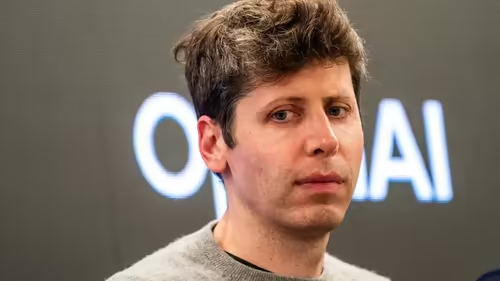
The AI world is holding its breath. Just months after being hailed as the undisputed leader of the generative AI revolution, OpenAI is now facing a storm of existential questions. In a move that screams both urgency and ambition, CEO Sam Altman has reportedly embarked on a high-stakes mission to the Middle East, seeking a staggering $50 billion in fresh capital . This isn’t just another funding round; it’s a potential lifeline thrown to a company that some insiders claim is “falling apart in real time” .
Table of Contents
- The $50 Billion Lifeline
- Signs of Trouble: Is OpenAI Really Falling Apart?
- Why the Middle East?
- The Competition Heats Up
- What This Means for the Future of AI
- Conclusion: A Pivotal Moment for OpenAI
- Sources
The $50 Billion Lifeline
According to reports, Sam Altman is in serious talks with sovereign wealth funds in the United Arab Emirates and other Gulf nations to secure this unprecedented investment . The goal is clear: to supercharge OpenAI’s development of its next-generation AI models and, crucially, to build out its own massive computing infrastructure. The current reliance on Microsoft’s Azure cloud is seen as a bottleneck and a strategic vulnerability.
This proposed round, which could close as early as Q1 2026, would be one of the largest private funding deals in history. It would fundamentally reshape OpenAI’s balance sheet, giving it the war chest needed to compete in an increasingly expensive and cutthroat AI race. For the Middle East, it’s a golden opportunity to position itself as a global hub for the most transformative technology of our era.
Signs of Trouble: Is OpenAI Really Falling Apart?
The timing of this desperate fundraising push is telling. Veteran investor George Noble has issued a stark warning, claiming the company is in deep trouble . His concerns are backed by several alarming trends:
- Internal “Code Red” Alerts: Reports suggest internal communications at OpenAI have been marked with urgent “Code Red” warnings, signaling a state of crisis among leadership .
- Declining ChatGPT Traffic: After an explosive start, web traffic to ChatGPT has shown signs of plateauing and even declining in key markets, raising questions about user retention and engagement .
- Staggering Financial Losses: Despite its fame, OpenAI is hemorrhaging money. Its path to profitability remains distant and uncertain, with costs for compute and talent soaring.
- Talent Exodus: Key engineers and researchers have been lured away by competitors like Google DeepMind and Anthropic, who are offering competitive salaries and, in some cases, a less chaotic work environment.
- Elon Musk’s Lawsuit: The ongoing legal battle with co-founder Elon Musk, who is demanding more transparency and open-source practices, continues to be a major distraction and a source of negative publicity .
Why the Middle East?
The choice of the Middle East as a funding source is strategic. Nations like the UAE and Saudi Arabia have made it a national priority to diversify their economies away from oil and into future-facing technologies like AI. They have vast pools of capital and a long-term investment horizon that traditional Silicon Valley VCs often lack. For them, a stake in OpenAI isn’t just a financial bet; it’s a geopolitical and technological coup.
However, this partnership isn’t without its risks. Questions about data sovereignty, ethical AI governance, and the potential for increased surveillance capabilities in these regions are significant concerns that OpenAI will need to navigate carefully.
The Competition Heats Up
OpenAI’s stumbles have created a massive opening for its rivals. Google, with its DeepMind and Gemini models, is aggressively closing the gap. Meta’s Llama series has become the de facto standard for open-source AI, fostering a huge developer community. And well-funded startups like Anthropic and Mistral are making rapid progress with their own safety-focused and efficient models. The AI market is no longer a one-horse race; it’s a full-blown derby, and OpenAI can no longer afford to coast on its early lead.
What This Means for the Future of AI
If successful, this OpenAI funding round could cement its position as the dominant force in proprietary AI for years to come. It would allow the company to build its own AI supercomputers, accelerate its research, and potentially launch new, revenue-generating products. However, if the deal falls through or the internal issues aren’t resolved, the company could face a rapid and painful decline, fragmenting the AI landscape and accelerating the rise of its competitors.
Conclusion: A Pivotal Moment for OpenAI
Sam Altman’s trip to the UAE is more than a business meeting; it’s a referendum on OpenAI’s future. The company stands at a crossroads between becoming a self-sustaining AI powerhouse or succumbing to the very pressures it helped create. The $50 billion question isn’t just about money—it’s about whether the magic that once defined OpenAI can be recaptured before it’s too late. The entire tech world is watching.
Sources
- Times of India: As OpenAI is about to fall apart, predictions make headlines; Sam Altman goes to Middle East
- Bloomberg: OpenAI in Crisis Mode as Altman Seeks $50 Billion Bailout
- Similarweb Data (via TechCrunch): Analysis of ChatGPT’s traffic trends shows a worrying plateau
- [INTERNAL_LINK:ai-funding-trends-2026]
- [INTERNAL_LINK:major-players-in-the-ai-race]