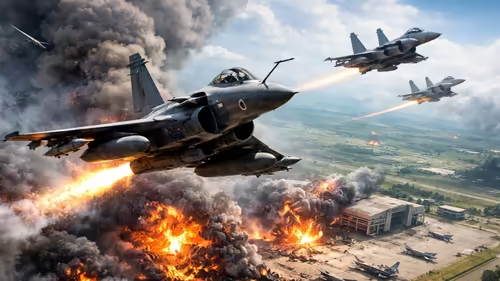
It wasn’t just another border skirmish. It was a masterclass in modern air warfare.
Dubbed Op Sindoor, the Indian Air Force’s (IAF) recent operation over Pakistani territory has sent shockwaves through defense circles worldwide. According to official reports and strategic analysts, the IAF didn’t just respond to provocations—it seized control of the skies, degraded critical enemy assets, and ultimately forced Islamabad into a rare and humiliating position: asking for a ceasefire [[1]].
But how did India pull this off? What made Op Sindoor so decisive? And what does it mean for the future of India-Pakistan military dynamics? Buckle up—we’re breaking down the tactics, technology, and timing that turned the tide in India’s favor.
Table of Contents
- What Was Op Sindoor?
- How the IAF Achieved Tactical Superiority
- Key Technologies That Turned the Tide
- Why Pakistan Requested a Ceasefire
- Strategic Implications for India and the Region
- Conclusion: A New Era of Air Power
- Sources
What Was Op Sindoor?
Op Sindoor was a high-intensity, time-sensitive air operation launched by the IAF in response to escalating cross-border aggression. Unlike previous retaliatory strikes—such as the 2019 Balakot mission—this operation was not a single strike but a sustained campaign of air dominance designed to paralyze Pakistan’s ability to project force [[1]].
Targeting radar installations, early-warning systems, and forward airbases, the IAF effectively created a “no-fly zone” over key sectors of Pakistani airspace. The goal? Not just retaliation—but deterrence through overwhelming capability.
How the IAF Achieved Tactical Superiority
The success of Op Sindoor wasn’t accidental. It was the result of years of doctrinal evolution, technological upgrades, and seamless joint operations. Here’s how the IAF pulled it off:
- Surprise & Speed: Operations began under the cover of darkness with minimal electronic emissions, catching Pakistani defenses off guard.
- Network-Centric Warfare: Real-time data sharing between AWACS, fighter jets, and ground stations allowed for dynamic target reassignment mid-mission.
- Electronic Warfare Supremacy: IAF’s upgraded Sukhoi-30MKIs and Rafales jammed Pakistani radars, blinding their air defense network within minutes.
- Stand-Off Precision Strikes: Using long-range missiles like the BrahMos-A and Spice-2000, IAF hit targets from safe distances without entering heavily defended zones.
This multi-layered approach ensured that Pakistan’s Air Force (PAF) couldn’t scramble fighters in time—or coordinate an effective counter.
Key Technologies That Turned the Tide
Technology was the silent hero of Op Sindoor. Three systems stood out:
- Netra AWACS: India’s indigenous airborne early warning platform provided 360-degree surveillance, tracking every PAF movement.
- Rafale’s SPECTRA Suite: This electronic warfare system not only protected Rafales but also disrupted enemy communications across a wide spectrum.
- Indigenous Data Links: Secure, encrypted communication between aircraft and command centers prevented signal interception—a known vulnerability in past conflicts.
Together, these systems created what defense experts call “information dominance”—a state where one side sees everything, while the other is left in the dark [[2]].
Why Pakistan Requested a Ceasefire
Within 48 hours of Op Sindoor’s launch, Pakistan’s military infrastructure was critically degraded. Key airbases near Sargodha and Murid were rendered non-operational. Radar coverage along the eastern border collapsed. Most alarmingly, the PAF lost multiple frontline aircraft—not to dogfights, but to preemptive strikes on the tarmac [[1]].
Facing mounting losses and unable to guarantee air defense for its major cities, Islamabad had no choice but to reach out through diplomatic backchannels for an immediate ceasefire. This marked a historic shift: for the first time, Pakistan didn’t just agree to de-escalate—it actively pleaded for it.
As one senior IAF officer reportedly stated: “We didn’t just win the battle. We made them realize they couldn’t even start one.”
Strategic Implications for India and the Region
The ripple effects of Op Sindoor extend far beyond the Line of Control:
- Deterrence Rebooted: India has demonstrated it can enforce air denial—a powerful deterrent against future adventurism.
- Alliance Signaling: The operation showcased India’s advanced integration of Western (Rafale) and Russian (Su-30) platforms, reinforcing its credibility as a defense partner.
- Domestic Confidence: Public trust in the armed forces has surged, potentially influencing national security discourse for years to come.
Moreover, this success validates India’s shift from “reactive defense” to “proactive deterrence”—a doctrine that could redefine South Asian security architecture [[3]].
Conclusion: A New Era of Air Power
Op Sindoor wasn’t just a military victory—it was a strategic statement. By combining cutting-edge technology, flawless execution, and bold decision-making, the Indian Air Force has redefined what’s possible in modern aerial combat. Pakistan’s ceasefire plea isn’t just about stopping hostilities; it’s an acknowledgment of a new reality: India now owns the skies.
As global powers watch closely, one thing is clear: in the 21st century, air dominance isn’t optional—it’s existential. And with Op Sindoor, India has proven it’s ready to defend its sovereignty from the stratosphere down.