Introduction: A Bridge Beyond Concrete and Steel
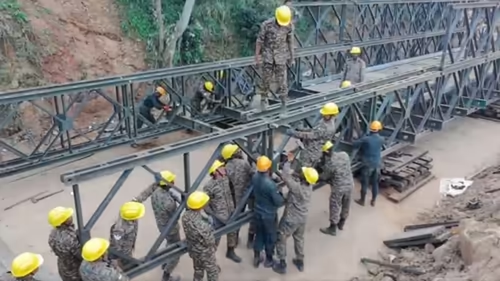
In the rain-soaked, landslide-scarred hills of central Sri Lanka, a new 120-foot structure now stands as a lifeline. This isn’t just any bridge—it’s the third Bailey bridge constructed by the Indian Army as part of Op Sagar Bandhu, a mission launched in the wake of the devastating Cyclone Ditwah. On the surface, it’s a textbook example of humanitarian aid: a powerful neighbor stepping in to help a friend in need. But is that the whole story?
As we delve deeper, we uncover a narrative woven with threads of historical obligation, geopolitical chess, and genuine human compassion. Let’s explore what Op Sagar Bandhu really means for both nations.
Table of Contents
- The Devastation of Cyclone Ditwah
- Op Sagar Bandhu: A Mission of Mercy
- The Engineering Feat of the Bailey Bridge
- Beyond the Bridge: The Geopolitics of Aid
- Conclusion: Friendship or Strategy?
- Sources
The Devastation of Cyclone Ditwah
Cyclone Ditwah, which struck Sri Lanka in late November 2025, was no ordinary storm. It triggered the worst flooding and landslides the island nation had seen in decades . The human cost was staggering: over 565 homes were completely destroyed, and more than 20,000 were partially damaged . The Central Province, home to key districts like Kandy and Nuwara Eliya, bore the brunt of the disaster.
The economic toll was even more alarming. A rapid post-disaster assessment by the World Bank estimated total damages at a colossal $4.1 billion—equivalent to a shocking 4% of Sri Lanka’s entire GDP . Critical infrastructure, including roads and bridges, was wiped out, severing vital supply chains and isolating communities for weeks . This was the grim reality that set the stage for Op Sagar Bandhu.
Op Sagar Bandhu: A Mission of Mercy
Operation Sagar Bandhu, translating to “Ocean Friend,” is India’s official humanitarian assistance and disaster relief (HADR) mission for Sri Lanka. Its most visible and impactful contribution has been the deployment of the Indian Army’s elite engineering corps. Their task? To restore connectivity where it was most needed.
The latest achievement is the successful construction of a 120-foot Bailey bridge on the B-492 highway at KM 15, a crucial artery linking the Kandy and Nuwara Eliya districts . This marks the third such bridge built by the Indian Army, effectively re-establishing a lifeline that had been severed for over a month . These bridges are not mere temporary fixes; they are robust, rapidly deployable structures that allow for the immediate flow of essential supplies, medical aid, and personnel.
This mission is a continuation of a long-standing tradition. India has been a primary source of humanitarian support for Sri Lanka, from the 2004 tsunami to the recent economic crisis . For more on this history, see our deep dive on [INTERNAL_LINK:india-sri-lanka-relations-history].
The Engineering Feat of the Bailey Bridge
So, what makes the Bailey bridge so special? Invented during World War II, this modular, prefabricated truss bridge is the gold standard for military and disaster relief engineering. Its genius lies in its simplicity and speed.
Here’s why it’s the perfect tool for a mission like Op Sagar Bandhu:
- Rapid Deployment: Components can be transported by truck and assembled on-site without heavy machinery, often in a matter of days.
- Modular Design: The bridge can be built to various lengths and load capacities by simply adding more panels.
- Robustness: Despite its temporary nature, a Bailey bridge can support the weight of heavy military vehicles and civilian trucks, making it ideal for restoring critical supply routes.
The Indian Army’s 8 Engineer Regiment, known as the “Elite Eight,” has demonstrated exceptional skill in deploying these structures in challenging terrain, showcasing India’s advanced HADR capabilities .
Beyond the Bridge: The Geopolitics of Aid
While the humanitarian impulse is undeniable, it’s naive to view Op Sagar Bandhu in a vacuum. India and Sri Lanka share a relationship that spans over 2,500 years, marked by deep cultural ties but also significant political complexities .
In recent years, Sri Lanka has found itself at the heart of a fierce geopolitical contest between India and China. China’s massive port project in Hambantota, often cited as a prime example of “debt-trap diplomacy,” has long been a source of concern for New Delhi . Against this backdrop, India’s swift and effective disaster response serves a dual purpose:
- Reinforcing the “Neighbourhood First” Policy: By being the first and most reliable responder, India cements its position as Sri Lanka’s natural and most trusted partner.
- Countering Chinese Influence: Demonstrating tangible, on-the-ground support contrasts sharply with the perception of distant, debt-fueled Chinese projects. It’s a powerful form of soft power.
India’s grant assistance to Sri Lanka already stands at around $780 million, covering a range of development projects . Op Sagar Bandhu is a timely and highly visible addition to this portfolio, reminding Colombo of the value of its partnership with New Delhi.
Conclusion: Friendship or Strategy?
The answer, as is often the case in international relations, is both. The Indian Army’s engineers in Sri Lanka are undoubtedly driven by a sense of duty and a desire to alleviate human suffering. The bridges they build are real, and the lives they improve are countless.
However, their presence is also a calculated and astute move in the grand game of regional influence. In a world where every action has a reaction, Op Sagar Bandhu is a masterclass in combining genuine humanitarianism with smart, long-term strategic thinking. It strengthens a vital bilateral relationship while simultaneously sending a clear message to other global powers about India’s role and responsibilities in its own backyard.
Sources
- Times of India: Op Sagar Bandhu: Army constructs third Bailey bridge in cyclone-hit Sri Lanka
- World Bank: Global Rapid Post-Disaster Damage Estimation (GRADE) Report: Cycline Ditwah 2025 – Sri Lanka
- UN News: Sri Lanka cyclone: More than a million still need aid after $4.1 billion in damage
- Ministry of External Affairs, India: Brief on India-Sri Lanka Bilateral Relations