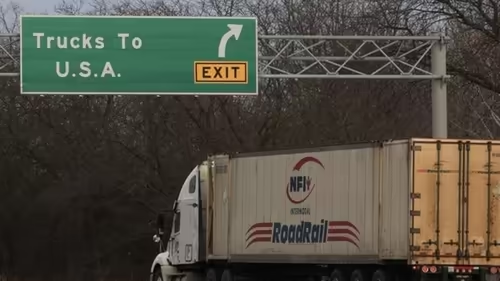
What was supposed to be a routine check on commercial driver certifications has blown open into one of Ontario’s most serious licensing fraud cases in recent years.
Ontario Provincial Police (OPP) have charged eight men—several of whom are of Indian origin—with a total of 24 criminal counts related to a sophisticated scheme to cheat on mandatory commercial driver’s license (CDL) exams. The accused allegedly used impersonators, forged documents, and insider assistance to obtain Class A and Class D licenses without ever legitimately passing the required knowledge or road tests.
The implications go far beyond paperwork fraud. These licenses allow holders to operate massive trucks, buses, and transport vehicles carrying passengers or hazardous materials. If unqualified drivers are on the road, public safety is at immediate risk. This Ontario driver exam fraud case has now triggered a province-wide review of testing protocols and raised urgent questions about oversight in the transportation sector.
Table of Contents
- What Happened in the Ontario Fraud Case?
- Who Are the Accused?
- How the Scam Worked: Impersonators and Fake IDs
- Why Commercial License Fraud Is So Dangerous
- Broader Patterns of Licensing Fraud in Canada
- What Changes Are Being Implemented?
- Conclusion
- Sources
What Happened in the Ontario Fraud Case?
The investigation, dubbed “Project Safe Passage,” began in late 2025 after Transport Canada flagged anomalies in CDL issuance patterns in the Greater Toronto Area (GTA). Suspiciously high pass rates at certain DriveTest centers—and identical handwriting across multiple exam booklets—triggered a joint probe by the OPP, Ministry of Transportation (MTO), and ServiceOntario.
According to court documents, the group operated between 2023 and 2025, charging clients up to CAD $5,000 to secure a commercial license through fraudulent means. In some cases, paid impersonators would take written and road tests on behalf of applicants who lacked the language skills, driving ability, or theoretical knowledge to qualify [[1]].
Who Are the Accused?
While full names haven’t been released due to ongoing legal proceedings, police confirm that “several” of the eight accused are of Indian origin, reflecting broader demographic trends in Ontario’s trucking and logistics workforce. Many immigrants pursue commercial driving as a fast-track career path—but legitimate training takes months and costs thousands.
The accused include:
- Two former driving school instructors
- One ex-DriveTest center employee (allegedly provided internal access)
- Five individuals acting as organizers or impersonators
All face charges including fraud over $5,000, personation with intent, uttering forged documents, and conspiracy to commit an indictable offence—each carrying potential prison sentences of up to 14 years [[2]].
How the Scam Worked: Impersonators and Fake IDs
Investigators uncovered a disturbingly organized operation:
- Recruitment: Clients were sourced through word-of-mouth in immigrant communities, often targeting those struggling with English or French proficiency tests.
- Document Forgery: Fake identification and residency proofs were created to match the impersonator’s appearance.
- Exam Substitution: Skilled drivers would pose as applicants during road tests, while others memorized answers for written exams.
- Licence Delivery: Once issued, the real applicant would receive the license and begin working—often for small trucking firms with minimal background checks.
One intercepted WhatsApp message read: “Don’t worry about the test. Just send your photo and $3,500. You’ll have your Class A in 10 days.”
Why Commercial License Fraud Is So Dangerous
This isn’t just about cheating a test—it’s about putting lives at risk. Consider:
- A Class A license permits operation of vehicles over 11,000 kg—like tractor-trailers carrying fuel, chemicals, or dozens of passengers.
- Commercial drivers must master air brake systems, cargo securement, and emergency protocols—knowledge not easily faked.
- In 2024, Ontario recorded 127 fatal crashes involving large trucks. Unqualified drivers could drastically increase this number [[3]].
As OPP Inspector Lena Moreau stated: “This wasn’t victimless fraud. It endangered every person on the highway.”
Broader Patterns of Licensing Fraud in Canada
While this case is large, it’s not isolated. Similar scams have surfaced in:
- British Columbia (2022): 12 charged in a Surrey-based GDL (Graduated Licensing) fraud ring.
- Alberta (2023): Fake driving schools shut down in Edmonton for selling “guaranteed passes.”
- Quebec (2024): Investigation into Montreal-based brokers helping immigrants bypass French-language road tests.
Immigrant communities are often targeted because of systemic barriers—language gaps, credential recognition issues, and economic pressure to earn quickly. But exploiting these vulnerabilities undermines both public trust and legitimate newcomers striving to follow the rules [INTERNAL_LINK:immigrant-pathways-to-canadian-licensing].
What Changes Are Being Implemented?
In response, Ontario’s MTO has announced immediate reforms:
- Biometric verification (photo + fingerprint) at all DriveTest centers by Q3 2026.
- Mandatory video recording of all road tests.
- Random re-testing audits for newly licensed commercial drivers.
- Whistleblower hotline for reporting suspicious activity.
ServiceOntario is also reviewing all CDLs issued since 2023 in the GTA—a move that could revoke hundreds of licenses.
Conclusion
The Ontario driver exam fraud scandal is a wake-up call. While the accused must face justice, the real solution lies in making the system more accessible—not easier to cheat. Streamlining language support, reducing wait times, and offering subsidized training could prevent desperate choices. Because when it comes to commercial driving, there’s no shortcut worth risking a life.