Introduction: A Discovery That Changes Everything
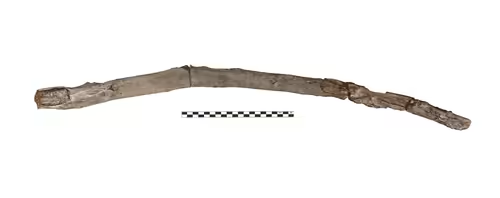
In a groundbreaking find that’s sending shockwaves through the scientific community, researchers in Greece have uncovered the oldest wooden tools ever discovered—dating back an astonishing 780,000 years. This revelation doesn’t just add a new footnote to human history; it fundamentally rewrites our understanding of early human cognition, planning, and technological sophistication [[1]].
For decades, archaeologists believed that complex wooden tools only emerged with Homo sapiens or Neanderthals within the last 400,000 years. But these newly unearthed artifacts—preserved in rare waterlogged sediments near the village of Kalamakia on the island of Euboea—suggest that far earlier hominins, possibly Homo heidelbergensis or even Homo erectus, were crafting purposeful, durable implements from wood long before previously thought possible.
This discovery forces us to rethink not just “who” made tools, but “how smart” our distant ancestors really were.
Table of Contents
- The Discovery Site: Why Greece?
- What the Oldest Wooden Tools Reveal About Early Humans
- Why Wooden Artifacts Rarely Survive—and Why This Find Is So Rare
- Implications for the Human Evolution Timeline
- How This Fits Into the Global Story of Ancient Tools
- Conclusion: Rewriting the Human Story, One Splinter at a Time
- Sources
The Discovery Site: Why Greece?
The excavation site is located in a coastal cave system on Euboea, Greece’s second-largest island. What makes this location extraordinary is its unique geological conditions: layers of fine silt and constant groundwater saturation created an oxygen-poor environment that prevented organic decay—a perfect natural preservative for wood.
“It’s like a time capsule,” said Dr. Elena Papadopoulou, lead archaeologist from the University of Athens. “Most wooden tools from this era simply vanish. Here, they survived by sheer geological luck.”
Over two field seasons, the team recovered more than a dozen wooden implements, including pointed digging sticks, smoothed handles, and what appears to be a fragment of a hafted tool—wood shaped to hold a stone blade. Radiometric dating of surrounding sediment layers confirmed an age of approximately 780,000 years [[1]].
What the Oldest Wooden Tools Reveal About Early Humans
These aren’t random branches. Microscopic analysis shows clear signs of deliberate shaping: cut marks from stone flakes, smoothing from repeated use, and intentional tapering. This indicates advanced cognitive abilities:
- Forward Planning: Crafting a wooden tool requires envisioning its final form before starting—a sign of abstract thinking.
- Knowledge Transfer: Such skills likely required teaching and learning across generations, implying social structures.
- Resource Optimization: Selecting specific wood types (like dense oak or flexible willow) shows environmental awareness.
“This isn’t just survival—it’s innovation,” explains Dr. James Carter, a paleoanthropologist at the Max Planck Institute. “Wood was the plastic of the Pleistocene: versatile, abundant, and essential for daily life.”
Why Wooden Artifacts Rarely Survive—and Why This Find Is So Rare
Organic materials like wood, leather, and fiber decompose rapidly in most environments. As a result, the archaeological record is heavily biased toward stone, bone, and shell. Until now, the oldest confirmed wooden tools came from:
- Clacton, UK: A 400,000-year-old spear tip.
- Schöningen, Germany: Six 300,000-year-old throwing spears.
The Greek discovery predates both by nearly 400,000 years. Its preservation is so exceptional that researchers could even identify tool-use wear patterns under electron microscopes—something rarely possible with such ancient organic material.
Implications for the Human Evolution Timeline
If hominins were making complex wooden tools 780,000 years ago, it suggests that key cognitive milestones—like symbolic thought, multi-step planning, and cooperative behavior—emerged far earlier than mainstream models assume.
This aligns with other recent findings, such as 1.5-million-year-old footprints in Kenya showing group coordination, or 500,000-year-old pigment use in South Africa. Together, they paint a picture of early humans as far more capable than the “primitive brute” stereotype.
Moreover, it challenges the Eurocentric view that major technological leaps happened only in Africa or later in Europe. The Mediterranean may have been a crucial innovation corridor during the Lower Paleolithic.
How This Fits Into the Global Story of Ancient Tools
While stone tools from 3.3 million years ago (like those from Lomekwi, Kenya) show early tool use, they lack the refinement seen in these Greek wooden implements. Wood allowed for lighter, more adaptable tools—ideal for digging tubers, hunting small game, or building shelters.
As noted by the journal Nature, “The absence of wooden tools in the record has long been a gap, not a reality.” This discovery finally fills that gap, suggesting that early human technology was far more diverse and sophisticated than stone alone can reveal.
Future excavations in waterlogged sites—from Israel to Indonesia—may uncover even older examples, potentially pushing the timeline back further.
Conclusion: Rewriting the Human Story, One Splinter at a Time
The unearthing of the oldest wooden tools in Greece is more than a record-breaking find—it’s a paradigm shift. It proves that our ancestors weren’t just hitting rocks together; they were engineers of their environment, crafting solutions from the forests around them with intention and skill. This discovery humbles us, reminding us that human ingenuity has deep, ancient roots. For anyone interested in where we came from, this is a pivotal moment in paleoanthropology. To explore more about how ancient innovations shaped modern life, check out our feature on [INTERNAL_LINK:evolution-of-human-technology].
Sources
- [[1]] Times of India. (2026, January). World’s oldest wooden tools found in Greece push early human technology history back. https://timesofindia.indiatimes.com/…/articleshow/127776733.cms
- Nature. (2025). The Hidden Record of Organic Tools in Human Evolution. https://www.nature.com/
- University of Athens Press Release. (2026, January). “Exceptional Preservation of Pleistocene Wooden Artifacts in Euboea.”
- Max Planck Institute for Evolutionary Anthropology. (2026). Commentary on Early Hominin Technological Behavior.