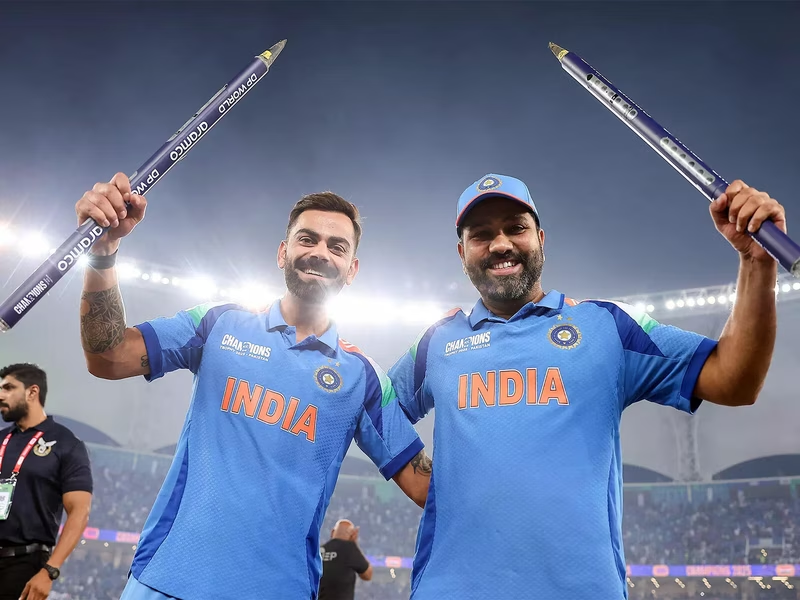
The white-ball game is at a crossroads. In a recent and deeply reflective commentary, veteran Indian spinner Ravichandran Ashwin dropped a bombshell that has sent shockwaves through the cricketing world: he fears One Day International (ODI) cricket is headed for a “slow death” and may not survive much beyond the 2027 World Cup .
Ashwin’s concern isn’t about the quality of play, but about the format’s very relevance in an age dominated by the glitz and speed of T20 leagues and the timeless prestige of Test cricket. At the heart of his argument is a sobering truth—the ODI cricket future appears to be inextricably linked to the careers of its biggest global icons: Virat Kohli and Rohit Sharma.
Table of Contents
- Ashwin’s Chilling Prediction Explained
- The Kohli-Rohit Carry: Why Stars Make the Format
- T20 Leagues: The Real Competition for Attention
- Why Test Cricket Endures (While ODI Struggles)
- Can ODI Cricket Be Saved? A Path Forward
Ashwin’s Chilling Prediction Explained
Ashwin didn’t mince words. He described the potential fate of the 50-over format as a “slow death,” a gradual fading into obscurity rather than a sudden collapse . His logic is pragmatic. Once the colossal figures of Kohli and Sharma—two of the format’s greatest ever performers and biggest crowd-pullers—retire from ODIs, a massive void in star power and public interest will be left behind.
Without these megastars, Ashwin argues, the commercial appeal of bilateral ODI series plummets. Broadcasters may lose interest, fans may tune out, and boards may prioritize their lucrative T20 franchise leagues instead. The ODI World Cup would remain a marquee event, but the format’s health depends on what happens in the years between these quadrennial tournaments.
The Kohli-Rohit Carry: Why Stars Make the Format
Virat Kohli and Rohit Sharma aren’t just players; they are institutions within ODI cricket.
- Virat Kohli is the all-time leading run-scorer in ODIs and holds the record for most centuries. His intensity and chasing mastery have defined an era .
- Rohit Sharma is the ‘Hitman,’ the only player with three ODI double-centuries and a captain who led India to the 2023 World Cup final .
Together, they have been the backbone of India’s ODI dominance for over a decade. Their presence guarantees headlines, viewership, and a level of competitive excellence that is hard to replicate. The fear is that the next generation, while talented, may not possess the same global drawing power or longevity in a format that is increasingly squeezed for space on the calendar.
T20 Leagues: The Real Competition for Attention
The rise of T20 franchise leagues is the single biggest disruptor to the traditional international calendar. The IPL, The Hundred, the BBL, and a dozen other leagues offer concentrated, high-octane entertainment that fits perfectly into the modern fan’s schedule.
These leagues also offer players financial security that international cricket, outside of the very top nations, often can’t match. This economic pressure is leading to a scenario where boards are scheduling fewer ODI series to protect their domestic league windows, and players are, in some cases, prioritizing league contracts over national duty .
The result? A vicious cycle: fewer high-quality ODI matches lead to declining fan interest, which leads to lower revenues, which leads to even less investment in the format.
Why Test Cricket Endures (While ODI Struggles)
In his analysis, Ashwin draws a sharp contrast between the fates of ODI and Test cricket. He believes Test cricket has a “longer shelf life” . Why?
Test matches are the ultimate sporting challenge, a five-day battle of skill, patience, and endurance that is unique in the global sports landscape. They are the benchmark for a player’s true greatness. This enduring appeal is supported by dedicated fanbases and historic rivalries (like England vs. Australia’s Ashes) that transcend generations. The International Cricket Council (ICC), the sport’s global governing body, continues to back the World Test Championship, providing a clear pinnacle for the format.
ODI cricket, stuck in the middle, lacks this unique identity. It’s not as fast as T20, nor as deep and challenging as Test cricket. Its survival hinges on its ability to carve out a distinct and compelling role.
Can ODI Cricket Be Saved? A Path Forward
All hope isn’t lost. There are concrete steps that could help secure the ODI cricket future:
- Globalize the Game: Create more competitive balance. The current dynamic, where a handful of teams dominate, kills suspense. Investment in Associate nations is crucial.
- Innovate the Calendar: Use the ICC’s Future Tours Programme to create a more structured, high-stakes ODI league system, similar to the World Test Championship, to give every match meaning.
- Leverage Technology & Storytelling: Broadcasters and boards must do a better job of marketing ODI stars and narratives to make every series feel like an event, not just a filler.
For more on the evolution of the game, check out our deep dive on [INTERNAL_LINK:future-of-cricket-formats].
Summary
Ravichandran Ashwin’s warning about the ODI cricket future is a stark wake-up call for the sport’s administrators. The format’s reliance on superstar players like Kohli and Sharma has masked its underlying vulnerabilities. With the explosive growth of T20 leagues and the timeless appeal of Test cricket, the 50-over game is in danger of becoming obsolete unless immediate, bold steps are taken to redefine its purpose and enhance its global appeal.
Sources
- Times of India: ‘Slow death’ – Ashwin’s chilling warning on ODI cricket after Kohli, Rohit era
- ESPNcricinfo Statsguru: ODI Batting Records for Kohli & Sharma
- International Cricket Council (ICC): Official Statements & Future Tours Programme