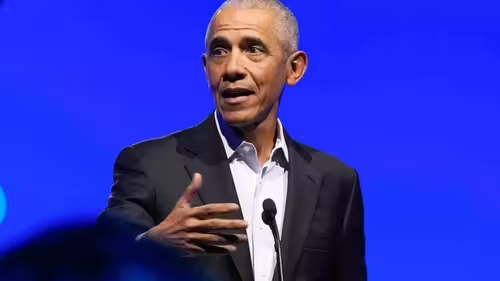
In one of their most forceful public interventions since leaving the White House, Barack and Michelle Obama have delivered a searing indictment of America’s current political climate—calling the recent murder of Alex Pretti a tragic symptom of a deeper national crisis. Their joint statement, released over the weekend, didn’t just mourn a life lost; it issued a direct warning: this is a wake-up call for America.
The Obamas’ message comes amid growing national anxiety over rising political violence, hate-fueled attacks, and increasingly toxic public discourse. By explicitly connecting Pretti’s death to broader trends in U.S. politics—including what they describe as Donald Trump’s “assault on truth and decency”—the former first couple have reignited a fierce debate about accountability, leadership, and the soul of the nation.
Table of Contents
- Who Was Alex Pretti?
- The Obamas’ Full Statement: A Moral Reckoning
- Did Trump’s Rhetoric Play a Role?
- A Disturbing Rise in Political Violence
- Public and Political Reactions
- What Comes Next for America?
- Conclusion: Heeding the Wake-Up Call
- Sources
Who Was Alex Pretti?
Alex Pretti, a 28-year-old community organizer from Portland, Oregon, was found dead on January 20, 2026, after being attacked during a local town hall meeting focused on immigrant rights. Authorities are investigating the killing as a possible hate-motivated crime, with early reports suggesting the assailant shouted politically charged slogans before the assault .
Pretti, known for his work with youth advocacy groups and interfaith dialogue initiatives, had no known enemies—making the brutality of his death all the more shocking to friends, family, and colleagues. His murder has since become a flashpoint in national conversations about safety, free speech, and the cost of polarization.
The Obamas’ Full Statement: A Moral Reckoning
In their statement, the Obamas wrote: “Alex Pretti’s death is not an isolated incident. It is the consequence of a steady drumbeat of dehumanization, lies, and division that has been normalized in our public square.” They went on to say that when leaders “mock empathy, glorify cruelty, and treat truth as optional,” they create a culture where violence becomes inevitable.
Critically, they framed the tragedy as a wake-up call for America—a moment demanding collective introspection and urgent action. “We cannot allow fear to silence our neighbors or let cynicism replace our commitment to justice,” they urged, calling on citizens to “reclaim the values that make us who we are.”
Did Trump’s Rhetoric Play a Role?
While the Obamas did not name Trump directly in every sentence, their reference to a “deliberate assault on our shared values” left little room for ambiguity. Over the past decade, researchers at institutions like the Brennan Center for Justice have documented a clear correlation between inflammatory political speech and spikes in hate crimes and extremist activity .
Trump’s repeated use of terms like “vermin,” “enemies of the people,” and calls to “dominate” protesters have drawn criticism from civil rights groups for years. The Obamas’ statement appears to place Pretti’s killing within this continuum—a view echoed by several Democratic lawmakers and advocacy organizations in the wake of the tragedy.
A Disturbing Rise in Political Violence
Alex Pretti’s death is part of a troubling trend:
- According to the FBI, hate crimes in the U.S. rose by 12% in 2025—the highest level in over two decades .
- The Southern Poverty Law Center reported a 30% increase in far-right extremist groups since 2020 .
- Incidents of violence at public meetings, protests, and polling places have doubled since 2016 .
Experts warn that when political leaders fail to condemn extremism—or worse, amplify it—the consequences spill into everyday life. Pretti’s murder, they argue, is not just a crime but a symptom of systemic decay.
Public and Political Reactions
The Obamas’ statement has sparked intense reactions across the political spectrum:
- Progressive groups praised the couple for “speaking truth to power” and called for renewed civic engagement.
- Republican leaders dismissed the remarks as “politicizing a tragedy” and accused the Obamas of partisan bias.
- Grassroots movements have organized vigils in over 50 cities under the banner “Honor Alex, Defend Democracy.”
Meanwhile, President-elect Robert F. Kennedy Jr., set to take office in January 2027, has remained silent on the issue—a silence critics say speaks volumes.
What Comes Next for America?
The Obamas’ intervention raises critical questions: Will this moment catalyze real change? Can Americans rebuild a culture of mutual respect? And what role should former leaders play in times of national crisis?
Some analysts suggest that high-profile statements like this can shift public opinion, especially among undecided voters and younger demographics. Others caution that without concrete policy action—such as stronger hate crime legislation or social media regulation—words alone may not be enough.
Conclusion: Heeding the Wake-Up Call
The phrase “wake-up call for America” is more than rhetorical flair—it’s a challenge. The Obamas are urging the nation to confront uncomfortable truths about its direction. Whether Americans choose to listen, act, and heal together will determine if Alex Pretti’s death becomes a turning point… or just another footnote in a story of decline. For ongoing coverage of U.S. political tensions and civic responses, see [INTERNAL_LINK:us-news].
Sources
- Times of India: ‘Wake-up call for America’: Obamas condemn killing of Alex Pretti
- Brennan Center for Justice: Political Violence in the United States
- FBI Uniform Crime Reporting: 2025 Hate Crime Statistics
- Southern Poverty Law Center: Year in Hate and Extremism Report (2025)