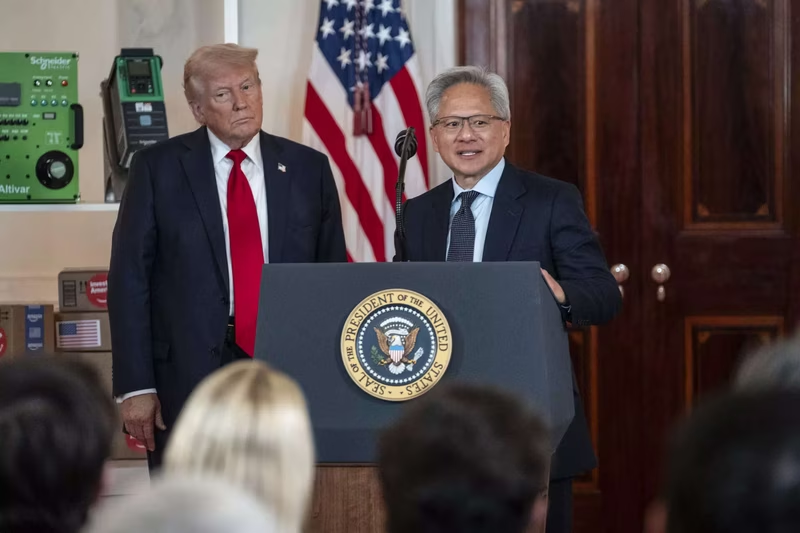
In a move that’s sent shockwaves through the global tech industry, the Trump administration has officially given the green light for Nvidia H200 AI chips to be sold to China. But there’s a massive catch: the U.S. government will take a 25% cut from every sale, and shipments are capped at just half of what Nvidia sells domestically [[1], [3]]. This isn’t just a business deal; it’s a calculated geopolitical maneuver in the high-stakes battle for AI supremacy.
Table of Contents
- The Deal Breakdown: What the 25% Cut Really Means
- Why the Nvidia H200 is a Game-Changer
- China’s Dilemma: To Buy or Not to Buy?
- The Strategic Play Behind US Policy Whiplash
- What This Means for the Future of AI
- Conclusion
- Sources
The Deal Breakdown: What the 25% Cut Really Means
On the surface, this decision appears to be a reversal of the Biden-era export controls that severely restricted the flow of advanced semiconductors to China . However, the Trump administration’s version is far from a free pass. The policy is a two-pronged approach:
- A 25% Surcharge: For every H200 chip sold to a Chinese customer, the U.S. Treasury will collect a 25% tariff. This effectively turns the U.S. government into a silent partner on every transaction, monetizing a strategic asset while simultaneously making it more expensive for China [[3], [7]].
- Strict Export Caps: Nvidia cannot ship more than 50% of its domestic H200 sales volume to China. This safeguard is designed to prevent a scenario where the U.S. starves its own market and allies of critical AI hardware while feeding its primary competitor .
This framework attempts to walk a razor-thin line: allowing American companies to profit from a market with “very high” demand for the H200 , while ensuring that national security interests aren’t compromised.
Why the Nvidia H200 is a Game-Changer
To understand the significance of this deal, you need to grasp the raw power of the Nvidia H200. As the successor to the already formidable H100, the H200 is built for the most demanding AI and high-performance computing (HPC) workloads.
Key specifications that make it so coveted include [[15], [23]]:
- Massive Memory: A staggering 141GB of HBM3e memory.
- Blazing Speed: A memory bandwidth of 4.8TB/s, which is crucial for feeding data to the AI engines.
- Raw AI Power: Capable of delivering 4 PetaFLOPS of FP8 Tensor Core performance.
For Chinese tech giants racing to build their own large language models and AI infrastructure, access to the H200 is a lifeline. Their domestic alternatives, while improving, still lag significantly in performance and ecosystem maturity. This creates a powerful incentive for them to pay the premium, even with the 25% U.S. surcharge attached .
China’s Dilemma: To Buy or Not to Buy?
The original report from the Times of India posed a critical question: is China even sure it wants to buy these chips under such terms? This is a brilliant piece of strategic ambiguity from Beijing’s perspective.
On one hand, the demand is undeniably there. Nvidia’s CEO, Jensen Huang, has publicly stated that the company is seeing “very high” customer demand in China for the H200 . On the other hand, accepting the deal on America’s terms could be seen as a sign of weakness and a tacit admission of dependence on U.S. technology.
China is heavily investing in its own semiconductor industry, with firms like Huawei making rapid strides. By hesitating or negotiating hard on the price, China may be trying to buy time for its domestic champions to close the gap, all while using the threat of walking away as leverage.
The Strategic Play Behind US Policy Whiplash
This sudden policy shift—from restriction to conditional approval—has been described as “policy whiplash” . But it’s likely a deliberate strategy with multiple objectives.
First, it’s about revenue. The U.S. government can now directly profit from the very technology it’s trying to control. Second, it’s about control. By creating a legal, monitored channel for these sales, the U.S. can better track where the chips end up and potentially gather intelligence, closing loopholes that might exist in a total ban .
Third, and perhaps most importantly, it’s a wedge strategy. By offering a slightly less powerful but still highly capable chip (the Blackwell series remains restricted ), the U.S. aims to satisfy enough of China’s immediate AI hunger to slow down its frantic push for complete self-reliance. Why build your own if you can buy a good-enough solution, even at a premium? This is a classic tactic in economic statecraft, designed to manage a rival’s technological ascent without triggering a full-blown rupture.
What This Means for the Future of AI
This Nvidia H200 deal is a microcosm of the new reality in global tech. The era of frictionless globalization for cutting-edge technology is over. We are now in an age of “techno-nationalism,” where national security concerns are paramount, and trade is a direct extension of foreign policy.
For businesses, this means navigating an increasingly complex web of regulations and political risks. For consumers and developers, it could mean a bifurcated AI ecosystem, with different standards and capabilities emerging in the U.S.-led and China-led spheres. While this deal provides a temporary bridge, the long-term trajectory points towards greater technological decoupling.
Conclusion
The approval of the Nvidia H200 for sale to China, complete with a 25% U.S. government cut and strict quotas, is far more than a simple commercial transaction. It’s a sophisticated, high-risk gambit by the Trump administration. It seeks to balance the economic benefits of serving a massive market against the strategic imperative of maintaining a technological edge. Whether this delicate compromise holds, or if it simply delays an inevitable and more complete split in the global AI landscape, remains to be seen. One thing is certain: the rules of the game have changed, and the stakes have never been higher.
Sources
- Introl. “Trump Opens H200 Exports to China with 25% Surcharge.” https://introl.io/insights/trump-opens-h200-exports-to-china-with-25-surcharge/
- Times of India. “Donald Trump government wants to take 25% ‘cut’ on the sale of Nvidia chips…” https://timesofindia.indiatimes.com/technology/tech-news/donald-trump-government-wants-to-take-25-cut-on-the-sale-of-nvidia-chips-that-china-is-not-sure-it-wants-to-buy/articleshow/126539938.cms
- White House. “Fact Sheet: President Donald J. Trump Takes Action on Advanced Computing.” https://www.whitehouse.gov/factsheets/2026/01/08/fact-sheet-president-donald-j-trump-takes-action-on-advanced-computing/
- CNBC. “Nvidia says H200 demand in China is ‘very high’ as export licenses near completion.” https://www.cnbc.com/2026/01/06/nvidia-says-h200-demand-in-china-is-very-high-as-export-licenses-near-completion.html
- Center for Security and Emerging Technology. “U.S. Export Controls on AI and Semiconductors.” https://cset.georgetown.edu/publication/us-export-controls-on-ai-and-semiconductors/