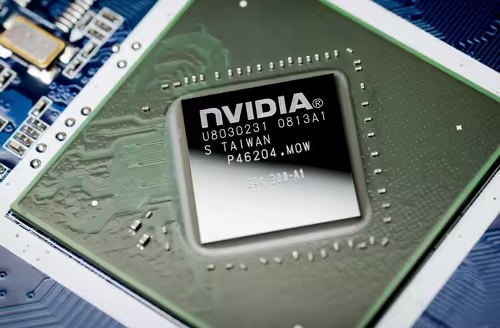
The high-stakes battle for global AI supremacy has just entered a dangerous new phase. In a stunning blow to one of America’s most valuable tech giants, Chinese customs authorities have effectively blocked the import of Nvidia’s cutting-edge H200 AI chips. This unexpected move has sent shockwaves through the tech industry, forcing local component suppliers to halt production lines and prompting major Chinese tech firms to cancel their orders. Despite having received US government approval for these “compliant” chips, Nvidia has been caught off guard by a de facto ban from Beijing, which is aggressively pushing its domestic champions like Huawei .
Table of Contents
- The Nvidia H200 Setback in China
- Why China is Blocking the H200
- The Rise of Huawei’s Ascend Chips
- Impact on Nvidia’s Business and Strategy
- The Broader US-China AI Chip War
- What Happens Next for Global AI Supply Chains?
The Nvidia H200 Setback in China
Nvidia’s H200 is the world’s most powerful AI accelerator, designed to train and run the largest and most complex artificial intelligence models. To comply with US export controls, Nvidia created a slightly downgraded version specifically for the Chinese market. The company believed it had navigated the regulatory maze, securing the necessary approvals from Washington.
However, the real gatekeeper appears to be Beijing. According to multiple industry sources, Chinese customs officials have refused to clear shipments of the H200, effectively implementing an unofficial but very real ban . This has created a state of paralysis for Nvidia’s entire China operation. Local partners who manufacture components for the H200 servers have been forced to stop their assembly lines, while major cloud service providers and internet giants, under pressure from the state, are backing out of their purchase agreements .
Why China is Blocking the H200
This isn’t just about technology; it’s a strategic national policy. China has made achieving self-reliance in semiconductors a top priority, enshrining it in its latest Five-Year Plan. The goal is to break free from its dependence on foreign, especially American, chipmakers. By blocking even the “compliant” H200, Beijing is sending a clear message to its domestic tech sector: buy local or face consequences.
Chinese authorities are actively pressuring companies to adopt homegrown alternatives, creating a protected market for domestic players. This move is less about the technical specifications of the H200 and more about accelerating the development and adoption of China’s own AI ecosystem, regardless of the short-term performance gap.
The Rise of Huawei’s Ascend Chips
The primary beneficiary of this policy is Huawei. After being crippled by earlier US sanctions, the Chinese tech giant has staged a remarkable comeback with its Ascend series of AI chips. The latest iteration, the Ascend 910B, is now being positioned as the direct competitor to Nvidia’s offerings.
While independent benchmarks suggest the Ascend 910B still lags behind the H200 in raw performance and software ecosystem maturity, it is “good enough” for many Chinese applications. More importantly, it comes with the full backing of the Chinese state. Major firms like Baidu, Alibaba, and Tencent are now being strongly encouraged, if not mandated, to integrate Huawei’s chips into their data centers, creating a massive captive market that Nvidia can no longer access .
Impact on Nvidia’s Business and Strategy
For Nvidia, the financial impact is significant. China was once its second-largest market, contributing billions in revenue. While the company has already seen its sales there decline due to previous US restrictions, the H200 was supposed to be a lifeline—a product that could keep them relevant in the world’s largest internet market.
This latest blockade shatters that hope. It forces Nvidia to double down on other markets and accelerate its efforts to build a non-China revenue stream. It also raises serious questions about the long-term viability of its “compliant chip” strategy. If Beijing is willing to block even approved products, the path to serving the Chinese market may be permanently closed, regardless of US policy.
The Broader US-China AI Chip War
This incident is a stark illustration of the new Cold War in technology. The competition is no longer just about who can build the best chip, but about who can control the entire AI supply chain—from design and manufacturing to software and end-user adoption. The US aims to maintain its technological edge by restricting the flow of advanced chips to China, while China is responding by building a parallel, sovereign tech stack.
This bifurcation of the global tech market creates immense challenges for multinational companies caught in the middle. They are forced to choose sides, develop separate product lines, and navigate an increasingly complex web of regulations and political pressures .
What Happens Next for Global AI Supply Chains?
The blocking of the Nvidia H200 is a watershed moment. It signals that the era of a single, global AI market is over. We are now moving towards a world of two distinct ecosystems: one led by the US and its allies, centered on Nvidia and AMD, and another led by China, built around Huawei and other domestic players.
For businesses and developers, this means they will need to consider which ecosystem they want to build for. For investors, it means the valuation of tech companies will increasingly be tied to their ability to thrive in one of these two worlds. The AI race is on, but it’s now being run on two separate tracks, with no finish line in sight.
Summary
Chinese customs’ decision to block the Nvidia H200 is a pivotal event in the escalating US-China tech war. By halting imports and pushing its tech giants toward domestic alternatives like Huawei’s Ascend chips, China is making a decisive move toward AI self-sufficiency. This leaves Nvidia with a shattered China strategy and underscores a new reality: the global AI landscape is splitting into two competing, and increasingly isolated, spheres of influence.