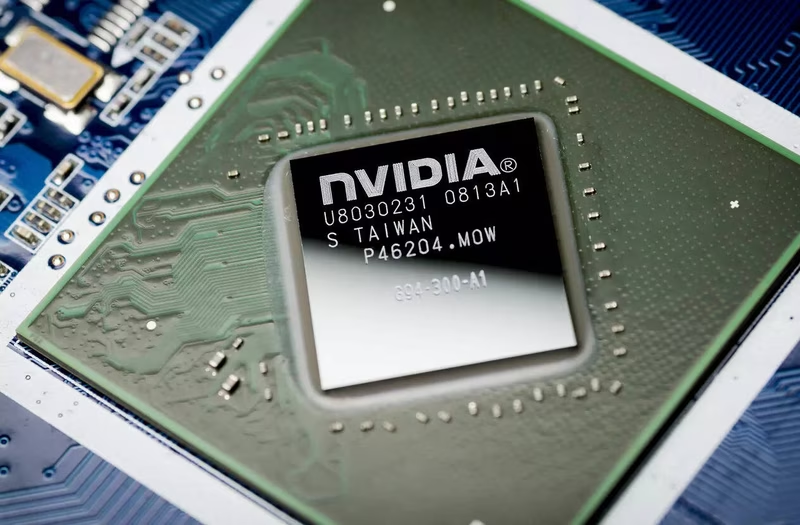
Nvidia’s Bombshell Claim: US Export Rules Are Backfiring
In a dramatic reversal of the usual corporate script, Nvidia—the undisputed king of AI chips—has publicly accused the US government of shooting itself in the foot. According to CEO Jensen Huang and company leadership, three years of sweeping Nvidia export controls haven’t weakened China’s AI ambitions. Instead, they’ve cost US taxpayers billions and handed a strategic advantage to foreign competitors, including Chinese firms.
Table of Contents
- Nvidia’s Bold Accusation: “We’re Losing, China’s Winning”
- The Real Impact of US Export Controls
- How China Is Adapting—and Thriving
- The H200 Dilemma: Licensing, Vetted Customers, and Loopholes
- Broader Implications for US Tech Leadership
- What’s Next for Nvidia and US Policy?
- Conclusion: A Policy Reckoning Is Due
- Sources
Nvidia’s Bold Accusation: “We’re Losing, China’s Winning”
During a recent policy briefing, Nvidia didn’t mince words. The company stated that overly broad US export restrictions—designed to curb China’s access to cutting-edge AI hardware—have had the opposite effect. Rather than stalling Chinese innovation, the controls have accelerated domestic chip development in China while depriving American companies of critical revenue.
“Three years of export control by the US government have cost billions of your tax dollars and helped China,” Nvidia declared in a pointed message to American stakeholders . This isn’t just corporate lobbying; it’s a warning from the frontlines of the global AI race.
The Real Impact of US Export Controls
Since 2022, the US Department of Commerce has imposed stringent export controls on advanced AI chips, including Nvidia’s A100 and H100 GPUs, banning their sale to Chinese entities without special licenses. The goal was clear: maintain America’s technological edge by limiting China’s access to the world’s most powerful AI accelerators.
But the execution, Nvidia argues, has been flawed. The restrictions are so broad that they’ve blocked sales even to non-military Chinese customers who pose no national security risk. This vacuum, Nvidia claims, has created a golden opportunity for Chinese rivals like Huawei and Biren to step in with homegrown alternatives—effectively subsidizing China’s semiconductor independence with American market share.
How China Is Adapting—and Thriving
Far from being crippled, China has responded with remarkable agility. Huawei’s Ascend 910B chip, for instance, is now being widely adopted by Chinese cloud providers and AI startups as a domestic substitute for Nvidia’s banned GPUs. According to analysts at SemiAnalysis, China’s AI chip ecosystem is growing faster than ever—precisely because of the US restrictions.
“The US export controls acted like a forced incubator for China’s semiconductor industry,” notes one industry expert. “Instead of buying from Nvidia, Chinese firms now invest in local supply chains, R&D, and talent—building a self-reliant AI infrastructure that may soon rival the West.”
The H200 Dilemma: Licensing, Vetted Customers, and Loopholes
Amid the controversy, Nvidia continues to work closely with the US administration on licensing its next-generation H200 chip—the successor to the H100—for “vetted customers” in restricted markets. This cautious collaboration reflects a growing tension: how to enforce national security without strangling innovation and revenue.
The company has also developed China-specific chips like the A800 and H800, designed to comply with US bandwidth limits. Yet even these “compliant” models have faced delays and regulatory scrutiny, further eroding Nvidia’s foothold in a market that once contributed significantly to its bottom line.
Broader Implications for US Tech Leadership
Nvidia’s critique raises a fundamental question: Are US tech export policies calibrated for real-world impact—or driven by political optics?
Consider these consequences of current rules:
- Loss of R&D funding: Billions in lost revenue mean less capital for Nvidia to invest in next-gen AI research—research that keeps the US ahead.
- Strengthening rivals: Chinese firms gain time, market share, and customer trust while US companies sit on the sidelines.
- Global fragmentation: The world is splitting into separate tech ecosystems, reducing interoperability and increasing costs for everyone.
As [INTERNAL_LINK:us-semiconductor-strategy] evolves, policymakers must balance security with sustainability.
What’s Next for Nvidia and US Policy?
Nvidia isn’t calling for a rollback of all controls. Instead, it’s urging a smarter, more surgical approach—one that targets actual threats while allowing commercial AI collaboration with trustworthy partners. The company is also investing heavily in software (like CUDA) and cloud partnerships to maintain influence even where hardware sales are restricted.
Meanwhile, Congress and the Commerce Department are under increasing pressure to review the effectiveness of current policies. Bipartisan hearings are expected in early 2026, with Nvidia likely to testify alongside other tech giants.
Conclusion: A Policy Reckoning Is Due
The Nvidia export controls debate is more than a corporate grievance—it’s a pivotal moment for US tech policy. If the goal is to contain China’s AI rise, current methods may be achieving the opposite. By ceding market share, stifling innovation, and fueling China’s indigenous chip ambitions, overbroad restrictions risk turning America’s lead into a liability. As Nvidia’s warning makes clear: in the AI chip war, good intentions aren’t enough—strategy is everything.
Sources
- Times of India: Nvidia blames US export controls for losses
- US Bureau of Industry and Security – Export Controls
- SemiAnalysis: “China’s AI Chip Ecosystem in 2025,” December 2025
- Reuters: “Nvidia seeks H200 licenses amid US-China tech tensions,” November 2025