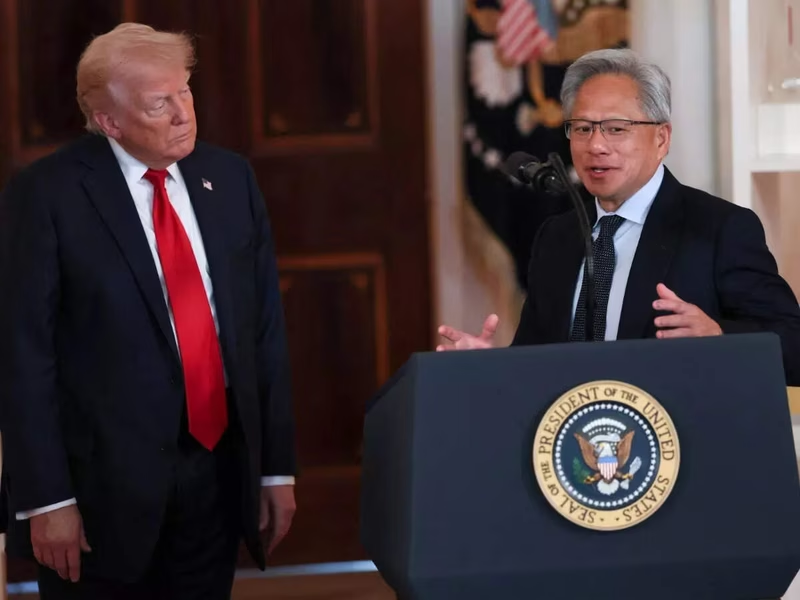
At a time when Washington and Beijing are locked in a high-stakes game of technological one-upmanship, Nvidia CEO Jensen Huang has thrown a rhetorical grenade into the debate. Calling the idea of a complete US-China tech decoupling “naive,” Huang didn’t just voice a corporate concern—he issued a stark warning to two of the world’s most powerful nations . His message was clear: the future of global innovation, economic stability, and even everyday technology depends not on separation, but on a hard-won, pragmatic coexistence.
Table of Contents
- Jensen Huang’s Bold Stance on US-China Relations
- Why US-China Tech Decoupling Is a Flawed Strategy
- The Billion-Dollar Stakes: Nvidia’s China Market
- Technological Independence vs. Economic Interdependence
- The Global Ripple Effect of a Tech Cold War
- What Huang’s Message Means for the Future of AI
- Conclusion: A Call for Pragmatic Cooperation
- Sources
Jensen Huang’s Bold Stance on US-China Relations
Speaking with remarkable candor, Huang framed the US-China relationship not as a zero-sum game, but as a critical partnership the entire world is counting on. “The world wants you two to figure out your relationship,” he told an audience, his words a direct appeal to policymakers in both capitals . He argued that the notion of completely severing technological and economic ties between the two giants is not only unrealistic but also deeply harmful to global progress.
This isn’t just philosophical musing from a Silicon Valley executive. It’s a statement grounded in the harsh realities of the modern semiconductor supply chain, where design, manufacturing, and consumption are intricately woven across national borders.
Why US-China Tech Decoupling Is a Flawed Strategy
The push for US-China tech decoupling has been a cornerstone of recent American policy, driven by legitimate national security concerns over advanced technologies like AI and semiconductors falling into the hands of potential adversaries. However, Huang’s critique highlights several fundamental flaws in this approach:
- Economic Inefficiency: The global tech ecosystem is built on specialization and scale. Forcing companies to create two separate, redundant supply chains—one for the US and its allies, another for China—is astronomically expensive and slows down innovation for everyone .
- Innovation Slowdown: China is not just a market; it’s a massive hub of engineering talent and a key driver of demand for cutting-edge hardware. Cutting off this feedback loop would inevitably stifle the pace of technological advancement globally .
- Global Instability: A fragmented tech world creates uncertainty for businesses and consumers worldwide, leading to higher costs, product shortages, and a more volatile economic environment .
The Billion-Dollar Stakes: Nvidia’s China Market
For Nvidia, this isn’t an abstract debate. China represents a colossal market worth billions of dollars in annual revenue. Before US export controls tightened, China accounted for a significant portion of Nvidia’s data center sales—the very segment powering the AI boom .
Huang remains optimistic that a path forward can be found. He believes Nvidia can develop specialized chips that comply with US regulations while still serving the Chinese market’s need for advanced computing power. This delicate balancing act is crucial for the company’s long-term growth strategy and underscores just how high the financial stakes are in this geopolitical tug-of-war.
Technological Independence vs. Economic Interdependence
Huang’s vision isn’t one of blind dependency. He advocates for a nuanced model: countries should strive for “technological independence” in critical areas for national security. However, this should exist alongside deep “economic interdependence” in commercial sectors. In essence, you can secure your core strategic assets while still trading freely in the open market for consumer and enterprise technologies .
This framework offers a more realistic and sustainable path than the all-or-nothing approach of full decoupling. It acknowledges security concerns without sacrificing the immense benefits of a connected global economy.
The Global Ripple Effect of a Tech Cold War
The consequences of a prolonged US-China tech cold war extend far beyond the two nations. Countries across Europe, Asia, and the Middle East are being forced to choose sides, disrupting their own industrial strategies and investment plans. Companies in India, South Korea, and Germany, for instance, rely on components and software from both ecosystems .
A fractured tech landscape would force these nations into costly and complex compliance regimes, ultimately making their own industries less competitive on the global stage. Huang’s plea is, therefore, a global one—a call to preserve the integrated system that has fueled decades of unprecedented technological progress.
What Huang’s Message Means for the Future of AI
The field of artificial intelligence is the epicenter of this conflict. Advanced AI requires the most powerful chips, which are at the heart of the export restrictions. If the US-China tech decoupling intensifies, it could lead to the development of two separate, incompatible AI ecosystems. This would be a disaster for scientific collaboration, standard-setting, and the ethical governance of this transformative technology.
Huang’s position suggests that for AI to reach its full potential—for the benefit of all humanity—its foundational hardware must remain part of a shared, albeit carefully managed, global commons.
Conclusion: A Call for Pragmatic Cooperation
Jensen Huang’s dismissal of US-China tech decoupling as “naive” is more than a soundbite; it’s a clarion call from the front lines of the global tech industry. His argument for a balanced approach—securing what’s vital while trading what’s commercial—offers a pragmatic alternative to the escalating rhetoric of division. In a world increasingly dependent on complex technology, the ability of its two largest powers to “work it out” isn’t just desirable; as Huang insists, it’s absolutely essential for our collective future.
Sources
- Times of India: Nvidia CEO Jensen Huang: US-China break up is ‘naive’; world needs you to work it out
- Bloomberg: Nvidia’s Huang Says China Is Too Big to Ignore Despite U.S. Restrictions
- Council on Foreign Relations: U.S.-China Technology Decoupling: What It Would Mean
- MIT Technology Review: [INTERNAL_LINK:future-of-ai]