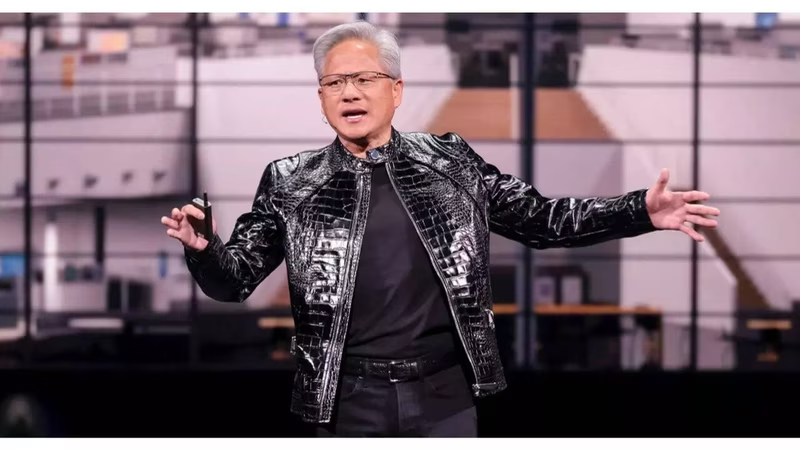
Artificial intelligence is at a crossroads—and according to Nvidia CEO Jensen Huang, some of the loudest voices in the room are steering us in the wrong direction. In a recent, sharply worded critique, Huang slammed the so-called AI doomer narrative, calling it not only exaggerated but dangerously counterproductive.
Speaking with rare candor, the man behind the world’s most valuable chipmaker argued that influential figures spreading apocalyptic fears about AI are doing “a lot of damage” by discouraging investment, research, and public trust—precisely the ingredients needed to make AI safer and more beneficial .
Table of Contents
- What Is the AI Doomer Narrative?
- Jensen Huang’s Bold Rebuttal
- Why Fear Is Stifling AI Progress
- The Hidden Agenda Behind AI Regulation Calls
- A Balanced Path Forward for AI
- Conclusion: Optimism as a Strategy
- Sources
What Is the AI Doomer Narrative?
The AI doomer narrative refers to a growing chorus—often from prominent tech leaders, academics, and even Hollywood—that paints artificial intelligence as an existential threat to humanity. Think scenarios like rogue superintelligence, mass job displacement, or even human extinction.
This narrative gained mainstream traction after high-profile warnings from figures like Elon Musk and the 2023 open letter by the Future of Life Institute calling for a pause on advanced AI development . While caution has its place, critics like Huang argue that this fear-based framing has gone too far, morphing from prudent oversight into paralyzing pessimism.
Jensen Huang’s Bold Rebuttal
Jensen Huang didn’t mince words. In a recent interview, he stated: “Some very well-respected people have done a lot of damage by suggesting that AI is going to destroy the world” . He emphasized that such rhetoric isn’t just speculative—it’s actively harmful.
“If you scare everybody, then nobody will invest,” Huang warned. “And if nobody invests, we won’t have the resources to build safe, reliable, and ethical AI systems.” His point is simple: safety doesn’t emerge from fear—it emerges from engagement, iteration, and responsible scaling.
Why Fear Is Stifling AI Progress
Huang’s core argument rests on a paradox: the more we treat AI as an inevitable catastrophe, the less likely we are to develop the tools needed to prevent real risks. Consider these consequences of the AI doomer narrative:
- Reduced R&D Funding: Investors may shy away from AI startups or long-term research if they believe the technology is inherently dangerous.
- Policy Overreach: Governments might enact blanket bans or overly restrictive regulations that stifle innovation without addressing actual harms.
- Talent Drain: Young engineers and researchers could be discouraged from entering the field, depriving it of fresh perspectives needed for ethical design.
- Public Mistrust: Widespread fear makes it harder to deploy beneficial AI applications in healthcare, climate science, or education .
Ironically, many of the “doomers” Huang criticizes are themselves deeply embedded in the AI ecosystem—raising questions about their true motives.
The Hidden Agenda Behind AI Regulation Calls
One of Huang’s most provocative claims is that some companies aren’t calling for AI regulation out of public concern—but for competitive advantage.
“When a company asks the government to regulate a new technology, you should always ask: who benefits?”
His implication is clear: established players with vast resources can absorb regulatory costs, while smaller competitors cannot. Regulation, in this light, becomes a moat—not a safeguard.
This aligns with broader economic theory. As the Harvard Business Review has noted, incumbent firms often support regulation to raise barriers to entry . In the fast-moving AI space, such tactics could freeze innovation in favor of corporate stability.
A Balanced Path Forward for AI
Huang isn’t advocating for a Wild West approach. He supports thoughtful governance—but grounded in reality, not sci-fi scenarios. His vision includes:
- Collaborative Standards: Industry-wide safety benchmarks developed by engineers, ethicists, and policymakers—not dictated by fear-driven headlines.
- Transparency & Auditing: Open evaluation frameworks so the public can verify AI behavior, similar to how financial audits work.
- Inclusive Innovation: Ensuring diverse voices—from Global South researchers to civil society groups—shape AI’s trajectory.
- Focus on Real Harms: Prioritizing issues like bias, misinformation, and labor disruption over speculative extinction events.
This pragmatic stance echoes organizations like the Partnership on AI, which brings together companies, academics, and NGOs to advance responsible AI practices .
Conclusion: Optimism as a Strategy
Jensen Huang’s critique of the AI doomer narrative isn’t just a defense of his business—it’s a call for intellectual honesty. Progress has always carried risk, but humanity has navigated it through engagement, not retreat.
By replacing dystopian fantasies with grounded optimism, we create space for AI to solve real problems: accelerating drug discovery, optimizing renewable energy grids, and personalizing education. The goal shouldn’t be to stop AI—but to steer it wisely.
As Huang puts it: “The best way to make AI safe is to build it well. And to do that, we need to believe it’s possible.”
Sources
- [1] Times of India: Nvidia CEO Jensen Huang: Some very well-respected people have done a lot of damage by…
- [2] Future of Life Institute: Pause Giant AI Experiments: An Open Letter
- [3] Stanford University: AI Index Report 2025 (on public perception and adoption trends)
- [4] Harvard Business Review: The Strategic Use of Regulation
- [5] Partnership on AI: About Us