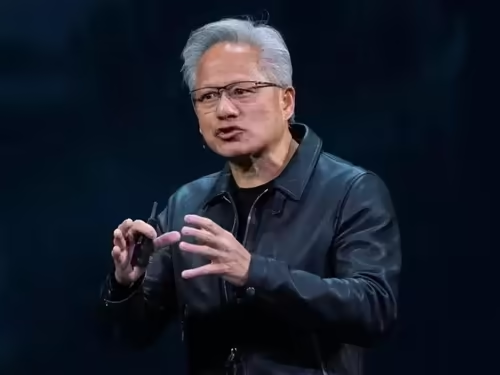
In a world where AI hype often blurs the lines between genuine innovation and financial engineering, one man is drawing a hard line in the sand. Nvidia CEO Jensen Huang has fired back at critics who’ve labeled his company’s recent $2 billion investment in cloud provider CoreWeave as a textbook case of circular financing. His verdict? It’s “ridiculous.”
But what exactly is this controversial practice, and why is Huang so adamant that his strategy is fundamentally different? Let’s cut through the noise and unpack the real story behind this high-stakes AI power play.
Table of Contents
- What is Circular Financing?
- Huang’s Furious Rebuttal to Critics
- The Strategic Logic Behind the CoreWeave Bet
- Why This Matters for the Future of AI
- Conclusion: A Vision Beyond the Balance Sheet
- Sources
What is Circular Financing?
Before we dive into Huang’s defense, it’s crucial to understand the term causing all the fuss. Circular financing refers to a self-reinforcing funding loop where a company (like a chipmaker or cloud provider) invests heavily in its own customers. Those customers then use that capital to buy more products or services from the original investor, creating a closed financial circuit [[7]].
Critics argue this practice can artificially inflate valuations and create a bubble, as the money isn’t coming from an independent assessment of the customer’s long-term viability but rather from a supplier with a vested interest in their immediate success [[10]]. In the red-hot AI sector, where demand for computing power is insatiable, this model has become increasingly common, drawing scrutiny from investors and analysts alike [[14]].
Huang’s Furious Rebuttal to Critics
Huang isn’t just disagreeing with the circular financing label—he’s calling it out as a fundamental misunderstanding of his company’s strategy. He insists that Nvidia’s investment in CoreWeave is not a clever accounting trick, but a strategic placement of capital in what he calls a “generational company” [[1]].
His core argument is one of scale and necessity. Huang points out that the massive AI infrastructure projects being undertaken by firms like CoreWeave require unprecedented levels of capital—far beyond what any single investment from Nvidia could provide. “Our contribution is a small fraction of the massive capital these AI firms require for growth,” he stated, effectively arguing that Nvidia is a catalyst, not the entire engine [[3]].
By framing the investment as a vote of confidence in a partner critical to the broader AI ecosystem, Huang is attempting to shift the narrative from financial engineering to strategic co-creation. He’s saying, in essence, that Nvidia isn’t just selling chips; it’s helping to build the very factories—the “AI factories” as he calls them—that will drive the next wave of technological progress [[19]].
The Strategic Logic Behind the CoreWeave Bet
So, what makes CoreWeave such a “generational” bet for Nvidia? The partnership goes far beyond a simple equity stake. The two companies have announced an expanded collaboration to accelerate the build-out of AI infrastructure on a global scale [[24]].
Here’s the strategic breakdown:
- Guaranteed Demand for Nvidia Tech: CoreWeave’s entire cloud platform is built on Nvidia’s powerful GPUs. By ensuring CoreWeave’s success, Nvidia secures a major, long-term customer for its most advanced hardware.
- Accelerating the AI Ecosystem: A well-funded, rapidly expanding CoreWeave means more accessible, powerful AI computing for thousands of startups and enterprises. This, in turn, fuels greater demand for the AI applications that run on Nvidia’s stack.
- Building “AI Factories”: The partnership aims to help CoreWeave add a staggering five gigawatts of AI-optimized compute capacity by 2030 [[20]]. These aren’t just data centers; they’re industrial-scale facilities designed to produce AI models, and they all run on Nvidia’s architecture.
This is a classic example of vertical integration in the digital age. Nvidia isn’t just a component supplier; it’s becoming a foundational pillar of the entire AI value chain, from silicon to software to cloud infrastructure. For more on how tech giants are reshaping markets, see our deep dive on [INTERNAL_LINK:big-tech-vertical-integration].
Why This Matters for the Future of AI
The debate over Huang’s CoreWeave investment is about more than just one deal. It’s a proxy for a much larger question: How will the trillions of dollars needed to build the AI future be funded? [[11]]
If Huang’s model is correct, strategic partnerships between suppliers and their most capable customers will be the primary engine of growth. This creates a powerful, efficient flywheel but also concentrates immense power in the hands of a few key players like Nvidia, Microsoft, and Amazon.
On the other hand, if the critics are right, the industry risks building a house of cards—a valuation bubble propped up by internal capital flows that could collapse if the underlying economics of these AI ventures fail to materialize. The stakes couldn’t be higher, and the outcome will shape the competitive landscape of technology for decades to come.
Conclusion: A Vision Beyond the Balance Sheet
Jensen Huang’s dismissal of “circular financing” claims as “ridiculous” is more than just a CEO’s defensive posture. It’s a declaration of his ambitious vision for Nvidia’s role in the world. He sees his company not as a mere vendor, but as a co-architect of the AI era. The $2 billion investment in CoreWeave is a down payment on that future—a strategic bet that the success of his partners is inextricably linked to the success of his own company. Whether this is a masterstroke of long-term strategy or a risky financial maneuver remains to be seen, but one thing is clear: Huang is playing a game on a board that others are only just beginning to understand.
Sources
- Yahoo Finance: Nvidia Just Invested Another $2 Billion Into CoreWeave
- AOL: Jensen Huang says it’s ‘ridiculous’ to say Nvidia’s $2 billion investment in CoreWeave is another circular deal
- Nvidia Newsroom: NVIDIA and CoreWeave Strengthen Collaboration to Accelerate Buildout of AI Factories
- Built In: How Circular Financing Is Fueling the AI Boom
- DeeCon Consulting: AI’s Circular Financing: Bubble or Sustainable Boom?
- Calcalistech: The circular economy of AI: How big tech is financing itself