Introduction: From Silicon to Storytelling
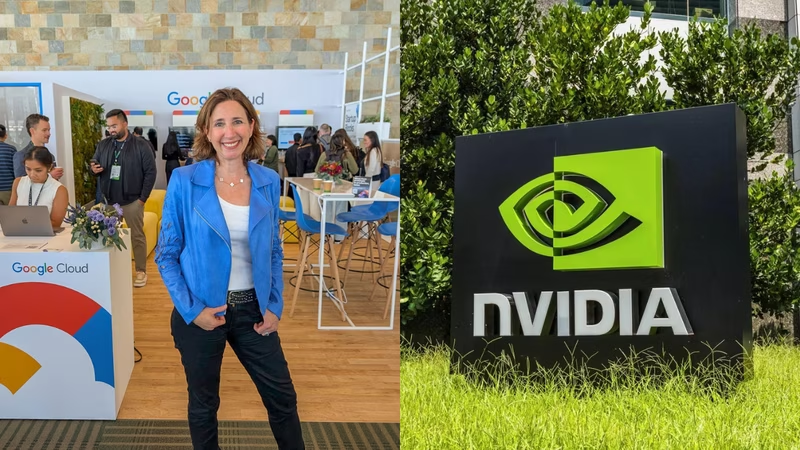
For decades, Nvidia thrived on a simple mantra: build the best chips, and the world will come. Engineers, not marketers, ruled the roost. But in January 2026, that quietly revolutionary culture took a dramatic turn. The company announced its first-ever Chief Marketing Officer (CMO)—Alison Wagonfeld, a veteran leader from Google Cloud .
This isn’t just a personnel change. It’s a seismic signal that Nvidia, now valued among the world’s most valuable companies thanks to its AI dominance, is ready to step out of the data center and into the global spotlight. With AI reshaping every industry, CEO Jensen Huang understands that raw technical prowess isn’t enough—you need a story, a brand, and a voice the world can trust. Enter Wagonfeld.
Table of Contents
- Who Is Alison Wagonfeld?
- Why Nvidia Needed a CMO Now
- The Strategic Vision Behind the Nvidia CMO Hire
- How This Changes Nvidia’s Brand Approach
- What This Means for the AI Industry
- Conclusion: Engineering Meets Emotion
- Sources
Who Is Alison Wagonfeld?
Alison Wagonfeld brings over two decades of high-stakes tech marketing experience to Nvidia. Most recently, she served as Head of Marketing for Google Cloud, where she played a pivotal role in positioning Google as a serious enterprise competitor to AWS and Microsoft Azure . Before that, she held leadership roles at HP and was an early investor and advisor at several Silicon Valley startups.
In her LinkedIn announcement, Wagonfeld wrote: “I am thrilled to be moving from one AI leader to another at such a pivotal moment.” Her expertise lies in translating complex cloud and AI technologies into compelling narratives for developers, enterprises, and even mainstream audiences—a skill set Nvidia now urgently needs.
Why Nvidia Needed a CMO Now
Nvidia’s meteoric rise—from gaming GPUs to the engine of the global AI boom—has been almost entirely driven by product innovation. But with a market cap rivaling Apple and Microsoft, and competitors like AMD, Intel, and custom silicon from Amazon and Google closing in, the game has changed.
Three key pressures forced Nvidia’s hand:
- Market Saturation Risk: As more companies build their own AI chips, Nvidia must differentiate beyond specs—it must own the *idea* of AI itself.
- Enterprise Trust Gap: While developers love CUDA, C-suite executives need to understand Nvidia’s long-term vision, security, and ecosystem value.
- Consumer Awareness: With AI PCs, robotics, and automotive ambitions, Nvidia can no longer be a “behind-the-scenes” brand.
The Strategic Vision Behind the Nvidia CMO Hire
Wagonfeld doesn’t just report to the marketing team—she reports directly to CEO Jensen Huang. This direct line underscores that the Nvidia CMO role is strategic, not tactical. Her mandate likely includes:
- Unifying fragmented marketing efforts across gaming, data centers, automotive, and Omniverse.
- Building a cohesive global brand narrative around “accelerated computing for a better future.”
- Elevating Nvidia from a component supplier to a platform and partner of choice.
This mirrors moves by other tech giants. When Satya Nadella brought in Kathleen Hogan as CMO at Microsoft, it marked a shift from Windows-centric messaging to cloud and AI storytelling. Nvidia is now making its own version of that leap.
How This Changes Nvidia’s Brand Approach
Expect to see a dramatic evolution in how Nvidia communicates:
From Developer-Centric to Multi-Audience
While GTC (GPU Technology Conference) will remain sacred for engineers, Wagonfeld will likely launch campaigns targeting business leaders, policymakers, and even consumers—showcasing real-world AI impact in healthcare, climate science, and entertainment.
From Product Specs to Purpose-Driven Stories
Instead of just touting TFLOPS, expect narratives about how Nvidia’s tech is curing diseases or enabling sustainable cities. This emotional resonance is critical for long-term brand loyalty.
From Reactive to Proactive Thought Leadership
With Wagonfeld’s guidance, Nvidia may become more vocal on AI ethics, regulation, and workforce transformation—positioning Huang not just as a CEO, but as a statesman of the AI age.
What This Means for the AI Industry
Nvidia’s move sets a new benchmark. It signals that in the AI era, marketing isn’t fluff—it’s a core competitive weapon. Companies that fail to articulate their vision clearly will lose mindshare, even if their tech is superior.
For marketers, this is validation. As AI commoditizes hardware and software, the battle will be won in the court of public perception. Wagonfeld’s appointment is a masterclass in timing: when your technology becomes infrastructure, your brand must become inspiration.
You can learn more about the evolving role of marketing in deep-tech firms at [INTERNAL_LINK:ai-marketing-trends-2026].
Conclusion: Engineering Meets Emotion
The hiring of a Nvidia CMO marks the end of an era—and the beginning of a new one. Nvidia is no longer just a chipmaker; it’s the architect of the AI future. And to lead that future, it needs more than transistors—it needs trust, clarity, and a human connection. With Alison Wagonfeld at the helm, Nvidia is finally ready to tell its story to the world, not just to the server room.
Sources
- Times of India: Google Cloud Executive Alison Wagonfeld joins Nvidia as Marketing Head
- LinkedIn: Alison Wagonfeld’s Official Profile
- Harvard Business Review: The Rise of the Chief Marketing Officer in Tech
- Nvidia Investor Relations: Official Press Releases