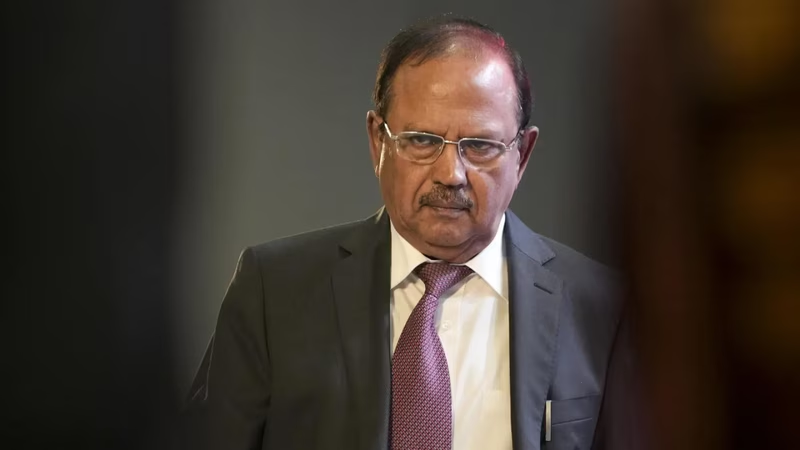
Imagine running one of the world’s most complex national security operations—without a smartphone. No WhatsApp, no email, no Google searches. For most of us, it sounds impossible. But for India’s National Security Advisor (NSA), Ajit Doval, it’s not just possible—it’s essential.
In a rare personal disclosure, Doval recently stated, “I don’t use mobile, internet for day-to-day work.” This simple sentence has sparked widespread discussion about the NSA Ajit Doval security protocol—a philosophy that prioritizes operational secrecy over digital convenience, even in 2026 .
This isn’t about being old-fashioned. It’s about understanding that in the digital battlefield, the greatest vulnerability is often the device in your pocket.
Table of Contents
- The Man Behind the Myth
- NSA Ajit Doval security protocol: The Core Rationale
- Historical Precedents in Global Intelligence
- The Modern Cyber Threat Landscape
- How India’s Top Leaders Communicate Securely
- What This Means for Public Cyber Hygiene
- Conclusion: The Power of Disconnection
- Sources
The Man Behind the Myth
Ajit Doval isn’t just any bureaucrat. A former Indian Police Service (IPS) officer and the only police officer to receive the Kirti Chakra for gallantry, he served as the Director of the Intelligence Bureau (IB) before becoming NSA in 2014. His career spans covert operations in Punjab, Kashmir, and beyond—experiences that have shaped his deep skepticism of digital footprints .
Known for his strategic mind and Spartan lifestyle, Doval’s aversion to personal digital devices is consistent with his lifelong ethos: minimize risk, maximize control. In intelligence work, information is power—and uncontrolled data flow is a fatal weakness.
NSA Ajit Doval security protocol: The Core Rationale
Doval’s decision stems from three critical principles of counterintelligence:
- Metadata is a Goldmine: Even if your calls are encrypted, your phone constantly leaks metadata—location, call logs, app usage. To a skilled adversary, this paints a detailed picture of your habits, contacts, and routines.
- Zero-Day Exploits Are Real: Sophisticated state actors possess undisclosed vulnerabilities (“zero-days”) that can compromise any commercial device, regardless of security settings. The only 100% secure phone is the one you don’t carry.
- Human Error is Unavoidable: A single misclick on a phishing link or a momentary lapse in judgment can compromise an entire network. By removing the device, you eliminate the attack surface entirely.
Instead of smartphones, Doval relies on secure landlines, encrypted wired communication systems within government complexes, and trusted human couriers for physical documents—a method proven resilient against cyber intrusion [INTERNAL_LINK:india-national-security-infrastructure].
Historical Precedents in Global Intelligence
Doval isn’t alone. Many of the world’s most seasoned intelligence figures have adopted similar practices:
- Former U.S. Defense Secretary James Mattis was known to avoid email, preferring handwritten notes.
- Russian President Vladimir Putin famously uses a typewriter for sensitive communications.
- During the Cold War, KGB and CIA handlers often used dead drops and one-time pads—low-tech but unbreakable methods.
As cybersecurity expert Bruce Schneier notes, “Security is a process, not a product.” Sometimes, the most advanced security posture is to step back from technology altogether .
The Modern Cyber Threat Landscape
The threat isn’t hypothetical. In recent years, we’ve seen:
- Nation-state hackers targeting government officials via SMS-based spyware like Pegasus.
- AI-powered voice cloning used in social engineering attacks.
- Supply chain compromises that infect devices before they’re even sold.
For someone with access to India’s nuclear codes, military deployment plans, and counterterrorism strategies, the risk is existential. As the head of the National Security Council Secretariat, Doval’s clearance level demands absolute compartmentalization—a standard that consumer tech simply cannot meet.
How India’s Top Leaders Communicate Securely
While the Prime Minister and other ministers use specially configured, air-gapped devices with custom OS layers, even those are limited to non-classified matters. For Top Secret/SCI (Sensitive Compartmented Information) discussions, communication reverts to analog or highly restricted digital channels within secure facilities like the South Block or the PMO’s underground bunker.
Doval’s personal discipline sets a cultural tone: if the NSA won’t carry a phone, it signals to the entire security apparatus that digital minimalism is a virtue, not a limitation.
What This Means for Public Cyber Hygiene
You don’t need to ditch your smartphone—but Doval’s example offers powerful lessons:
- Assume everything is monitored: Act as if your digital activity is public.
- Use burner phones for sensitive conversations: If discussing private matters, consider temporary devices.
- Disable location services and Bluetooth when not needed: Reduce your digital shadow.
- Never discuss classified or confidential info over unsecured channels.
In an era of mass surveillance and AI-driven analytics, privacy is a practice—not a setting.
Conclusion: The Power of Disconnection
NSA Ajit Doval’s refusal to use mobile or internet isn’t a quirk—it’s a masterclass in threat-aware leadership. His NSA Ajit Doval security protocol reminds us that true security sometimes means rejecting convenience for control. In a world racing toward total connectivity, his disciplined disconnection may be the ultimate act of strategic foresight.