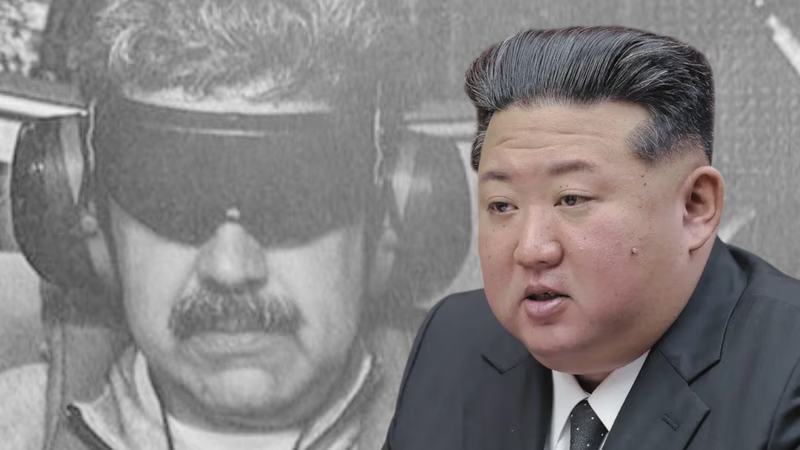
In a rare and sharply worded diplomatic outburst, North Korea has launched a scathing condemnation of the United States—alleging military strikes on Venezuelan soil and the arrest of President Nicolás Maduro. While the veracity of these claims remains under intense scrutiny, Pyongyang’s response is anything but ambiguous: it has declared the actions a ‘serious encroachment of sovereignty’ and called for a global protest against what it calls ‘Yankee imperialism.’
This unexpected alliance—between one of the world’s most isolated regimes and a Latin American nation long at odds with Washington—raises urgent questions about the shifting dynamics of anti-U.S. solidarity, the spread of disinformation, and the real state of affairs in Caracas. At the heart of this controversy is the phrase that’s now echoing across international forums: North Korea slams US strikes in Venezuela.
Table of Contents
- What North Korea Actually Said
- Fact-Checking the Claims: US Strikes and Maduro’s Arrest?
- Why North Korea Is Speaking Up: The Geopolitical Motive
- Venezuela’s Real Crisis and US Involvement
- Global Reactions and the Call for Protest
- What This Means for International Relations
- Conclusion: Rhetoric or Reality?
- Sources
What North Korea Actually Said
Through its state-run Korean Central News Agency (KCNA), North Korea issued a formal statement accusing the United States of conducting ‘unilateral military strikes’ inside Venezuela and orchestrating the ‘illegal detention’ of President Nicolás Maduro. The regime labeled these acts as a ‘blatant violation of international law’ and a ‘grave threat to global peace.’
Pyongyang urged ‘all peace-loving nations and peoples’ to rise up in protest, framing the alleged incident as part of a broader American campaign to ‘overthrow sovereign governments that refuse to bow to Washington’s dictates.’ This language mirrors North Korea’s long-standing anti-imperialist rhetoric, frequently used to rally domestic support and build alliances with other U.S. adversaries.
Fact-Checking the Claims: US Strikes and Maduro’s Arrest?
As of January 4, 2026, there is no credible evidence from international media, U.S. government sources, or independent observers confirming U.S. military strikes in Venezuela or the arrest of President Maduro.
The U.S. State Department has not issued any statement about military operations in Venezuela, and major news organizations—including Reuters and The Associated Press—report no such events. In fact, Nicolás Maduro was seen in public just days ago, addressing a political rally in Caracas and denouncing U.S. sanctions—hardly the behavior of a recently arrested head of state.
This raises a critical possibility: the North Korean statement may be based on disinformation, propaganda, or a deliberate attempt to amplify anti-U.S. sentiment. Alternatively, it could be a strategic move to test international reactions or signal solidarity with a fellow sanctioned regime.
Why North Korea Is Speaking Up: The Geopolitical Motive
North Korea’s vocal support for Venezuela isn’t random. Both nations are under heavy U.S. sanctions and share a common enemy in Washington. By positioning itself as a defender of Venezuela’s sovereignty, Pyongyang achieves several strategic goals:
- Strengthening anti-U.S. alliances: Building rhetorical solidarity with other sanctioned states reinforces a united front against American pressure.
- Domestic propaganda: Portraying North Korea as a global voice for the oppressed bolsters the regime’s legitimacy at home.
- Diverting attention: Highlighting alleged U.S. aggression abroad can deflect scrutiny from North Korea’s own human rights record and nuclear ambitions.
Moreover, this move aligns with North Korea’s recent diplomatic outreach to Russia and China—both of which have supported Venezuela’s government. It’s a calculated play in the emerging multipolar world order where anti-American blocs are gaining traction.
Venezuela’s Real Crisis and US Involvement
While the specific claims of strikes and arrest appear unfounded, the U.S. has indeed played a major role in Venezuela’s ongoing political and economic turmoil. Since 2019, Washington has recognized opposition leader Juan Guaidó as Venezuela’s legitimate president and imposed sweeping sanctions on the Maduro regime, targeting oil exports and freezing billions in assets .
Though the U.S. has repeatedly ruled out military intervention, it has provided logistical and financial support to opposition groups and maintained a strong diplomatic presence in neighboring Colombia. The Biden administration has, however, shown signs of cautious engagement with Maduro in recent years, especially as Venezuela’s oil becomes strategically valuable amid global energy shifts.
For readers interested in the deeper context, see our analysis on Venezuela’s political crisis and the impact of U.S. sanctions.
Global Reactions and the Call for Protest
North Korea’s call for a ‘global protest’ has so far garnered little traction. Neither Russia nor China—despite their sympathy for Maduro—has echoed Pyongyang’s inflammatory language. The United Nations has not issued any statement on the alleged strikes, and Latin American governments, including those traditionally critical of the U.S., have remained silent.
This silence underscores a key reality: while many nations oppose U.S. interventionism in principle, they are wary of aligning with North Korea’s brand of militant rhetoric. The international community tends to treat Pyongyang’s statements as propaganda rather than factual reporting—a perception that limits its diplomatic influence.
What This Means for International Relations
This episode highlights a growing trend: sanctioned states are increasingly using joint declarations and symbolic solidarity to resist U.S. pressure. Even if based on unverified claims, such statements serve to normalize anti-American narratives and create alternative information ecosystems.
For the United States, the challenge is twofold: countering disinformation while avoiding actions that could validate such accusations. For the rest of the world, it’s a reminder that in an era of hybrid warfare, words from Pyongyang can be as strategic as missiles.
Conclusion: Rhetoric or Reality?
The declaration that North Korea slams US strikes in Venezuela is a potent piece of geopolitical theater—but not a reflection of verified events. While the U.S. undeniably exerts significant pressure on Venezuela, the claims of military strikes and Maduro’s arrest appear to be either misinformation or deliberate exaggeration.
Nonetheless, the statement reveals a deeper truth: a coordinated narrative is emerging among America’s adversaries, one that paints the U.S. as a global aggressor. Whether or not the facts support it, this narrative is being weaponized to build alliances, rally domestic support, and challenge the Western-led international order. In today’s information battlefield, that might be just as impactful as a real strike.
Sources
- Times of India. “North Korea slams US strikes in Venezuela, arrest of Maduro; calls for global protest.” https://timesofindia.indiatimes.com/world/rest-of-world/serious-encroachment-of-sovereignty-north-korea-slams-us-strikes-in-venezuela-arrest-of-maduro-calls-for-global-protest/articleshow/126334236.cms
- Reuters. “No evidence of U.S. military action in Venezuela, officials say.” https://www.reuters.com
- U.S. Department of State. Public statements archive on Venezuela policy.
- Council on Foreign Relations. “U.S. Policy Toward Venezuela.” https://www.cfr.org
- KCNA Watch. Official North Korean statement translation (archived).