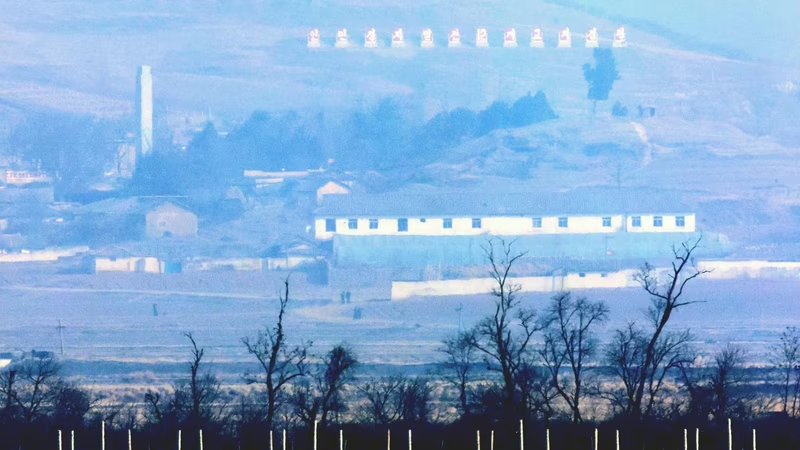
North Korea Drone Intrusion: A New Flashpoint on the Korean Peninsula
In a move that has sent shockwaves through the region, North Korea has launched a furious accusation against its southern neighbor, claiming a deliberate and “unpardonable” drone intrusion into its sovereign airspace. The regime in Pyongyang has not only alleged the violation but has also issued a stark warning of “severe consequences,” raising fears of a significant escalation along the world’s most heavily fortified border.
However, in a swift and unequivocal response, South Korea has flatly denied any involvement, stating its military did not operate any drones on the date in question. This tit-for-tat exchange has plunged the already tense relationship between the two Koreas into a new state of uncertainty, leaving analysts and diplomats scrambling to assess the situation.
Table of Contents
- The Accusation from Pyongyang
- Seoul’s Firm Denial
- A History of Aerial Provocations
- Why This Incident is Different
- Potential Consequences and Regional Impact
- Conclusion: Navigating a Perilous Standoff
The Accusation from Pyongyang
According to North Korean state media, a surveillance drone took off from the South Korean city of Incheon on January 4, 2026, and proceeded to fly deep into North Korean territory, allegedly filming important strategic facilities . The regime labeled this act as a “grave infringement upon the sovereignty of the DPRK” and described Seoul’s actions as exhibiting “unpardonable hysteria” .
The North Korean military claims to have detected, tracked, and ultimately shot down the aerial intruder. They have released what they claim is evidence of the drone’s flight path, further stoking the controversy . This is not the first time Pyongyang has made such claims in recent months, suggesting a pattern of heightened sensitivity to perceived aerial threats from the South.
Seoul’s Firm Denial
South Korea’s Ministry of National Defense has categorically rejected the North’s allegations. In a statement, Defense Minister Ahn Gyu-back declared the claims were “absolutely not true” . The ministry confirmed that the South Korean military had not operated any drones on the dates specified by North Korea .
While denying official military involvement, South Korean authorities have not entirely ruled out the possibility of civilian or non-state actors being responsible. They have announced they will investigate whether a private individual or group might have launched a drone that inadvertently crossed the border, a scenario that, while less provocative, would still be a serious breach of protocol and could be exploited by the North for political gain .
A History of Aerial Provocations
The use of drones as a tool of espionage and provocation is a relatively new but increasingly common feature of the inter-Korean conflict. The dynamics have shifted significantly over the past decade:
- 2014: Crude North Korean quadcopters were found crash-landed south of the DMZ, marking the beginning of this new era of aerial surveillance .
- December 2022: In a major incident, five North Korean drones crossed the DMZ into South Korea, prompting the South to scramble aircraft and even leading to a fatal crash of a South Korean trainer aircraft during the interception attempt [[15], [16]].
- 2023-2025: Both sides have repeatedly accused each other of drone incursions, creating a cycle of accusation and counter-accusation that has steadily eroded trust [[12], [14]].
This history shows that while drone flights are a modern tactic, they are firmly rooted in the long-standing hostility and mutual suspicion that defines the Korean Peninsula.
Why This Incident is Different
Several factors make the current North Korea drone intrusion accusation particularly concerning:
- Explicit Threat of Consequences: Pyongyang’s language has been unusually harsh, moving beyond mere condemnation to a direct threat of retaliation. This raises the stakes significantly.
- Timing: The incident occurs at a time of heightened global geopolitical tension, which could embolden North Korea to take more aggressive actions.
- The Denial’s Specificity: South Korea’s denial is not just a general rebuttal but a specific confirmation that its military was not operating drones on that day, which could imply that if a drone did cross, it was either from the North itself (a false flag) or from a third party, both of which are highly destabilizing scenarios.
Potential Consequences and Regional Impact
The potential fallout from this standoff is immense. At its most extreme, North Korea could respond with a military provocation of its own, such as artillery fire near the Northern Limit Line (NLL) or another missile test. Even a limited response could trigger a cycle of escalation that would be difficult to control.
For its part, South Korea is in a difficult position. It must defend its sovereignty and deny false accusations without appearing weak or giving Pyongyang a pretext for aggression. The alliance with the United States will be crucial in providing a deterrent, but it also risks drawing Washington into a regional crisis.
This situation is a stark reminder of the fragility of peace on the Korean Peninsula. For more on the complex security dynamics in the region, see our analysis on [INTERNAL_LINK:geopolitics-of-east-asia].
Conclusion: Navigating a Perilous Standoff
The latest clash over a suspected North Korea drone intrusion is more than just a he-said, she-said dispute. It is a dangerous flashpoint that exposes the deep-seated animosity and the ever-present risk of miscalculation between the two Koreas. While South Korea’s firm denial provides some clarity, the North’s aggressive posture and threat of consequences create a volatile and unpredictable environment. The international community will be watching closely, hoping that cooler heads will prevail and that this incident does not become the spark for a much larger conflagration.
Sources
- Times of India: ‘Unpardonable hysteria’: N Korea accuses South of drone intrusion; warns of consequences
- Yonhap News Agency: South Korea’s defense minister denies launching drone to North Korea [[5], [6], [8]]
- Council on Foreign Relations: Timeline of U.S.-North Korea Nuclear and Missile Diplomacy
- Wikipedia: List of border incidents involving North and South Korea [[15], [17]]