Table of Contents
- The Tragic Night: A Routine Drive Turns Fatal
- The 90-Minute Fight for Life
- What the Autopsy Reveals About the Noida Techie Drowning
- The FIR and the Blame Game
- India’s Construction Safety Crisis: A Ticking Time Bomb
- Conclusion: A Call for Accountability
- Sources
The Tragic Night: A Routine Drive Turns Fatal
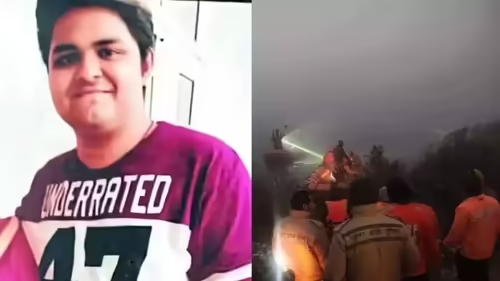
On a fog-shrouded night in Greater Noida’s Sector 150, a routine drive home turned into a nightmare for 27-year-old software engineer Yuvraj Mehta. His SUV, navigating through dense fog, struck a damaged boundary wall and plunged into a deep, water-filled pit—an open grave dug for a construction project that was left completely unsecured .
This wasn’t just an accident; it was a catastrophic failure of basic safety protocols. The pit, reportedly around 50 feet deep, had no fencing, no warning signs, and no lighting—making it an invisible hazard on a public road . For a young professional like Yuvraj, it was a death trap waiting to be sprung.
The 90-Minute Fight for Life
In the chilling aftermath of the crash, Yuvraj didn’t succumb immediately. He managed to climb onto the roof of his submerged SUV and began a frantic, 90-minute battle for survival .
He made desperate phone calls to his family, his voice filled with terror as he described his situation, pleading for help while the cold water rose around him . His family, hearing his cries, rushed to the area and alerted authorities. Yet, the rescue operation was hampered by the very conditions that caused the crash: near-zero visibility from the fog and the sheer depth and inaccessibility of the pit .
By the time rescuers arrived, it was too late. Yuvraj Mehta, a bright young man with his whole life ahead of him, was gone.
What the Autopsy Reveals About the Noida Techie Drowning
The official post-mortem report provided a grim and detailed account of Yuvraj’s final moments. The primary cause of death was confirmed as asphyxia due to ante-mortem drowning . This means he was alive and breathing in water, leading to a lack of oxygen.
The report further stated that this was followed by cardiac arrest, a common consequence of the extreme physical stress and hypothermia from being trapped in cold water for an extended period . The presence of water in his lungs was a definitive indicator of drowning .
This medical evidence paints a harrowing picture: Yuvraj was conscious and fighting for every breath until his body could take no more. The autopsy wasn’t just a clinical document; it was a testament to his desperate struggle.
The FIR and the Blame Game
Public outrage over the incident was swift and severe. In response, the local police filed a First Information Report (FIR) against the two builders who owned the land where the deadly pit was located .
The charges are clear: criminal negligence. By failing to secure the excavation site with proper barricades, signage, or lighting, the developers created a lethal public hazard. An internal investigation by the developer also led to the sacking of a junior engineer, acknowledging their own internal safety failures .
This case has become a flashpoint, highlighting the all-too-common practice of prioritizing speed and cost-cutting over fundamental human safety in India’s booming construction sector.
India’s Construction Safety Crisis: A Ticking Time Bomb
The tragedy of Yuvraj Mehta is not an isolated incident. It’s a symptom of a much larger, systemic problem. Indian regulations, such as the guidelines under the Building and Other Construction Workers (BOCW) Act, are explicit about safety measures for excavations .
Key safety rules that were blatantly ignored in this case include:
- Secure Perimeters: Open pits must be fenced off or covered to prevent accidental falls .
- Clear Signage: Warning signs must be prominently displayed around any hazardous excavation site.
- No Material Near Edges: Regulations state that no material should be stacked near the edge of a pit, which can weaken its structure and create a fall hazard .
Despite these clear rules, enforcement is often lax, and penalties are insufficient to deter negligent practices. This leaves ordinary citizens like Yuvraj vulnerable to dangers they cannot even see coming. [INTERNAL_LINK:construction-site-safety-india] explores this crisis in greater depth.
Conclusion: A Call for Accountability
The Noida techie drowning is a heart-wrenching story of a life lost far too soon. But beyond the personal tragedy, it serves as a stark and urgent warning. Unsecured construction sites are not just eyesores; they are potential death traps.
True justice for Yuvraj Mehta won’t just come from an FIR against a few individuals. It requires a fundamental shift in the industry—a commitment to enforcing existing safety laws, holding developers accountable, and ensuring that profit never again comes before public safety. His 90-minute fight for life must not have been in vain.
Sources
- Times of India: Asphyxiation, heart failure: Autopsy details Noida techie Yuvraj Mehta’s desperate fight before drowning in pit
- NDTV: Noida techie death: Rescue team lacked ‘willpower’, cited family
- Hindustan Times: FIR against 2 builders after techie drowns in Noida pit
- Government of India, Ministry of Labour & Employment: Building and Other Construction Workers (Regulation of Employment and Conditions of Service) Act, 1996