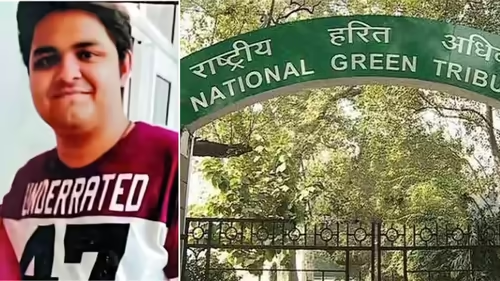
The bustling city of Noida, often seen as a symbol of India’s rapid urban growth, has been rocked by a tragedy that exposes a dark underbelly of unchecked development. The Noida techie death of 27-year-old software engineer Yuvraj Mehta isn’t just a personal loss; it’s a stark indictment of systemic failures in environmental governance and civic responsibility.
Mehta’s life was tragically cut short when he fell into a deep, waterlogged trench in Sector 150. What should have been a routine evening turned into a nightmare, revealing a dangerous cocktail of illegal construction practices and blatant disregard for environmental laws. In an unprecedented move, the National Green Tribunal (NGT) has taken suo motu cognisance of the incident, flagging it as a clear case of environmental violation .
Table of Contents
- The Tragic Incident: What Happened to Yuvraj Mehta?
- NGT’s Suo Motu Action: A Powerful Legal Tool
- Environmental Laws Violated in the Noida Techie Death Case
- Legal Fallout and Ongoing Investigations
- Broader Implications for Urban Development in Noida
- Conclusion: A Call for Accountability
- Sources
The Tragic Incident: What Happened to Yuvraj Mehta?
On a fateful day, Yuvraj Mehta, a young professional working in the city’s thriving tech sector, was walking near a commercial plot in Sector 150. Unbeknownst to him, the area concealed a massive, unmarked, and water-filled trench. Reports suggest this trench was a result of illegal excavation where builders had dumped excavated soil directly into a nearby natural drain or ‘nala’, a practice that is not only illegal but also incredibly hazardous .
This reckless act of dumping blocked the natural flow of water, causing the trench to fill up and become a hidden death trap. Mehta, unable to see the danger in the poorly lit area, fell in and drowned. His death has since become a rallying cry against the culture of impunity enjoyed by some developers in the region.
NGT’s Suo Motu Action: A Powerful Legal Tool
The National Green Tribunal’s decision to take suo motu cognisance is a significant development. This means the tribunal initiated proceedings on its own, without waiting for a formal complaint from a citizen or an NGO. This power, which was upheld by the Supreme Court of India in 2021, allows the NGT to act swiftly on matters of grave public importance related to the environment .
In its notice, the NGT explicitly stated that the incident “indicates violation of the Environment (Protection) Act, 1986” and raises “substantial issues relating to the environment” . This proactive stance by the NGT sends a strong message that environmental degradation leading to loss of life will not be tolerated.
Environmental Laws Violated in the Noida Techie Death Case
The core of the NGT’s intervention lies in the alleged flouting of several key environmental statutes. The primary legislation in question is the Environment (Protection) Act, 1986. This act empowers the central government to take all necessary measures to protect and improve the quality of the environment.
Specifically, the actions of the builders are believed to have violated norms related to the proper disposal of construction and demolition waste. Dumping excavated earth into a natural drainage system is a direct contravention of these rules. Furthermore, the case may also involve violations of the Water (Prevention and Control of Pollution) Act, 1974, as the blockage of the nala can lead to water stagnation and pollution .
The key environmental violations flagged include:
- Illegal dumping of construction waste into a natural drain (nala).
- Obstruction of natural water flow, leading to the creation of a hazardous water body.
- Failure to secure an open excavation site with proper barricades and warning signs.
- Potential contamination of groundwater due to stagnant, polluted water.
Legal Fallout and Ongoing Investigations
The legal consequences for those responsible are mounting. Following the initial outcry, the Uttar Pradesh government ordered the formation of a Special Investigation Team (SIT) to probe the matter . In a significant escalation, the Noida police have now registered a fresh FIR against the builders specifically under various sections of the Environment (Protection) Act and the Water Pollution Act .
This second FIR moves beyond the initial charges under the Indian Penal Code (IPC) and directly targets the environmental crimes that created the fatal conditions. The NGT has now summoned the Greater Noida Industrial Development Authority (GNIDA), the Noida Authority, and the Public Works Department (PWD) to explain their roles and the lapses that allowed such a dangerous situation to persist .
Broader Implications for Urban Development in Noida
The Noida techie death is not an isolated incident but a symptom of a larger problem plaguing many of India’s rapidly expanding urban centers. It highlights the critical gap between ambitious development projects and the enforcement of basic safety and environmental regulations.
This case serves as a crucial reminder for other cities and for our own internal coverage on urban planning. We must ask: [INTERNAL_LINK:urban-planning-in-india] Are our authorities equipped and empowered to monitor the thousands of construction sites that dot our skylines? The pressure to build faster and cheaper often comes at the cost of safety and sustainability, a trade-off that can have deadly consequences.
The NGT’s firm intervention could set a vital precedent. It signals that regulatory bodies are willing to hold powerful real estate interests accountable for their actions, especially when those actions endanger public life. For more on how environmental tribunals function in India, you can refer to this detailed overview from the Government of India’s official portal.
Conclusion: A Call for Accountability
The drowning of Yuvraj Mehta is a heartbreaking story of a life lost to negligence. However, the subsequent actions by the NGT and law enforcement offer a glimmer of hope for justice and reform. The suo motu cognisance taken by the tribunal is a powerful assertion of its role as a guardian of the environment and public safety.
As the investigations continue, the focus must remain on ensuring that those responsible face the full force of the law. More importantly, this tragedy must serve as a catalyst for stricter enforcement of environmental regulations across all urban development projects in Noida and beyond. Only then can we prevent such a devastating loss from happening again.
Sources
- Times of India: Noida techie death: NGT takes suo motu cognisance; flags environmental violation
- Web Search Results: Various reports on the Noida techie death case, NGT’s notice, and FIR details [[1], [3], [8], [9], [13], [14]].
- Supreme Court of India Judgment on NGT’s Suo Motu Powers .
- Government of India, Ministry of Environment, Forest and Climate Change: Environment (Protection) Act, 1986.