It was supposed to be a routine drive home. Instead, it became a nightmare that ended a young life and exposed shocking lapses in construction safety norms. On the night of January 16–17, 2026, 28-year-old software engineer Yuvraj Mehta was driving through Sector 150 in Greater Noida when his SUV veered off the road—and plunged into a deep, water-filled pit with no barricades, no warning signs, and no lighting.
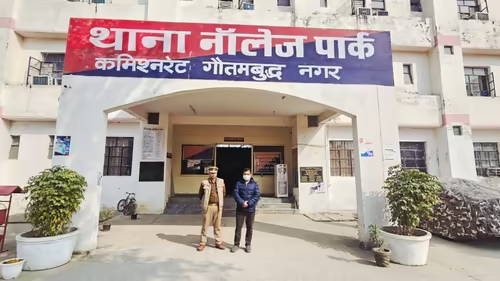
Mehta didn’t survive. But what followed was even more damning: an investigation that revealed systemic negligence by the very people entrusted with building safe urban infrastructure. Now, Abhay Kumar, the builder behind the MZ Wiztown project, stands accused of criminal negligence—and has been arrested by Greater Noida police.
This isn’t just an accident. It’s a symptom of a larger crisis in India’s real estate industry, where speed and profit often override basic human safety.
Table of Contents
- The Night of the Tragedy: What Happened?
- Builder Arrested for Criminal Negligence
- Why Was the Pit Unbarricaded? A Pattern of Lapses
- Legal Framework Failure in Construction Safety
- Public Outcry and Calls for Reform
- What This Means for India’s Real Estate Sector
- Conclusion: A Preventable Loss
- Sources
The Night of the Tragedy: What Happened?
According to police reports, Yuvraj Mehta was returning from work around 11:30 PM when his vehicle lost control near the MZ Wiztown construction site. With zero visibility and no physical barriers, the SUV crashed into a 15-foot-deep excavation pit filled with rainwater.
Emergency services arrived within 45 minutes, but it was too late. Mehta was pronounced dead at the scene. Eyewitnesses told investigators that the area had been hazardous for weeks—yet no action was taken by local authorities or the developer.
“There were no cones, no red lights, not even a rope,” said a local resident who wished to remain anonymous. “How is this allowed in a city that claims to be ‘smart’?”
Builder Arrested for Criminal Negligence
Following public pressure and a swift internal probe, Greater Noida Police arrested Abhay Kumar, the promoter of MZ Wiztown, under Section 304A of the Indian Penal Code (causing death by negligence) and Section 337 (causing hurt by endangering life).
Investigators confirmed that the pit was dug for foundation work but left completely unsecured—a clear violation of the Building and Other Construction Workers (Regulation of Employment and Conditions of Service) Act, 1996, which mandates fencing, signage, and illumination around all open excavations .
Kumar is currently in judicial custody, and the project has been temporarily halted pending a safety audit.
Why Was the Pit Unbarricaded? A Pattern of Lapses
This incident isn’t isolated. Across Noida, Greater Noida, and Gurugram, similar accidents have occurred due to poor site management:
- In 2024, a delivery rider died after falling into an uncovered manhole near a DLF construction site.
- In 2023, two children were injured in Ghaziabad when they stumbled into an unmarked trench.
- A 2022 report by the National Crime Records Bureau (NCRB) listed over 1,200 deaths linked to unsafe construction practices nationwide.
Developers often cut corners to save costs or accelerate timelines. Local municipal bodies, understaffed and under-resourced, fail to enforce regulations consistently. The result? Ordinary citizens pay with their lives.
Legal Framework Failure in Construction Safety
India has robust laws on paper. The BOCW Act, along with guidelines from the Central Public Works Department (CPWD), clearly states that all open excavations must be:
- Fenced with a minimum height of 1.8 meters,
- Equipped with reflective warning signs,
- Illuminated at night if near public pathways.
Yet enforcement is patchy. A 2025 study by the Comptroller and Auditor General of India (CAG) found that only 32% of inspected sites in Uttar Pradesh complied with basic safety norms .
Without accountability, these rules become mere suggestions.
Public Outcry and Calls for Reform
The Noida techie death has ignited widespread anger on social media, with hashtags like #JusticeForYuvraj and #SecureOurStreets trending nationally. Tech professionals, many of whom commute through these corridors daily, are demanding stricter oversight.
Civil society groups are urging the Uttar Pradesh government to:
- Mandate GPS-tagged safety audits for all active construction sites,
- Impose automatic project halts for violations,
- Create a public dashboard showing real-time compliance status.
[INTERNAL_LINK:urban-infrastructure-safety-india] could explore policy solutions in depth.
What This Means for India’s Real Estate Sector
As India pushes for rapid urbanization under initiatives like ‘Housing for All,’ this tragedy is a stark reminder: growth without governance is dangerous. Reputable developers fear that such incidents tarnish the entire industry.
“Responsible builders invest in safety—it’s non-negotiable,” said a senior executive from a top-tier realty firm. “But fly-by-night operators give us all a bad name.”
Investors and homebuyers may now demand third-party safety certifications before committing to new projects—a shift that could reshape market dynamics.
Conclusion: A Preventable Loss
Yuvraj Mehta’s death didn’t have to happen. A simple barricade, a single warning light, or a basic site inspection could have saved his life. The arrest of Abhay Kumar is a step toward justice—but true change requires systemic reform. Until construction sites are treated as zones of public safety, not just profit, tragedies like the Noida techie death will keep repeating. For Yuvraj’s family, and for thousands of commuters, that change can’t come soon enough.
Sources
- Times of India: Noida techie’s death: Builder arrested for criminal negligence
- Indian Penal Code, Sections 304A & 337
- Building and Other Construction Workers (Regulation of Employment and Conditions of Service) Act, 1996
- National Crime Records Bureau (NCRB): Accidental Deaths & Suicides in India Report, 2022
- Comptroller and Auditor General of India (CAG): Performance Audit of Urban Infrastructure Safety, 2025