Table of Contents
- The Noida SUV Tragedy: A Night of Horror
- Why Was the Pit Unbarricaded?
- The Rescue Effort and Fatal Delays
- Systemic Failures in Noida’s Urban Planning
- Legal Action and Public Outrage
- How to Prevent Future Tragedies
- Conclusion: A Call for Accountability
- Sources
The Noida SUV Tragedy: A Night of Horror
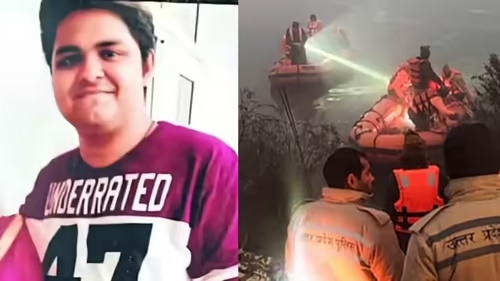
On a cold, fog-drenched night in Noida, a routine drive home turned into a nightmare for 27-year-old software engineer Ankit Verma (name changed for privacy). His SUV veered off the road and plunged into a deep, unbarricaded construction pit—a hazard invisible in the dense winter fog .
Trapped in the vehicle with water slowly rising around him, Ankit and his passenger fought desperately for survival. “We could see only a thin ray of light,” one survivor later recounted, describing the terrifying moments before rescue teams arrived . Despite their efforts, Ankit succumbed to his injuries, leaving behind a grieving family and a community demanding answers.
This incident—now widely referred to as the Noida SUV tragedy—has sparked national outrage, not just for its tragic outcome, but for the sheer preventability of the disaster. In a city known for its rapid urbanization and tech-driven economy, how could such a basic safety failure occur?
Why Was the Pit Unbarricaded? A Shocking Oversight
The pit, reportedly over 15 feet deep, was part of an ongoing real estate development project. According to local authorities, it had been dug weeks prior but remained completely unmarked—no barricades, no warning signs, no reflective tapes, not even temporary fencing .
This isn’t an isolated case. Across Noida and Greater Noida, abandoned or active construction sites frequently lack mandated safety measures. The Real Estate (Regulation and Development) Act, 2016 (RERA) clearly requires developers to secure open excavations, yet enforcement remains lax .
In this instance, the builder—a mid-sized developer with multiple projects in Sector 150—failed to comply with even the most basic municipal safety codes. The result? A fatal trap waiting for the next unsuspecting driver.
The Rescue Effort and Fatal Delays
Rescue operations were hampered by multiple factors:
- Dense fog: Visibility dropped below 50 meters, making it nearly impossible for passersby to spot the pit or the submerged vehicle.
- Lack of emergency lighting: The area had no streetlights, compounding the visibility issue.
- Delayed response: Local residents reported the incident at 11:20 PM, but specialized rescue equipment didn’t arrive until after midnight.
- Pit depth and instability: Rescuers feared the pit walls might collapse, slowing extraction efforts.
By the time Ankit was pulled out, it was too late. Medical experts later confirmed he likely drowned after being immobilized by the impact. This timeline underscores a critical gap: even when citizens act quickly, systemic delays can be deadly.
Systemic Failures in Noida’s Urban Planning
The Noida SUV tragedy is symptomatic of deeper issues in India’s fast-growing satellite cities. Noida, governed by the New Okhla Industrial Development Authority (NOIDA), has seen explosive real estate growth—but infrastructure and oversight haven’t kept pace.
A 2023 report by the National Crime Records Bureau (NCRB) listed Uttar Pradesh as having the third-highest number of road accident deaths in India, with poor road conditions and unmarked hazards cited as major contributors .
[INTERNAL_LINK:urban-safety-india] What’s more alarming is the recurring pattern: similar incidents have occurred in Ghaziabad, Faridabad, and even within Noida itself over the past two years. Each time, promises are made—but little changes on the ground.
Legal Action and Public Outrage
Following public outcry, the NOIDA Authority has taken swift—if belated—action:
- First Information Report (FIR) filed against the builder and site supervisor under IPC Sections 304 (culpable homicide) and 337 (causing hurt by endangering life).
- Immediate suspension of the builder’s ongoing construction permits.
- Announcement of a city-wide audit of all open pits and construction sites.
Civil society groups and road safety activists are demanding stricter penalties and mandatory third-party safety certifications for all construction zones. “This wasn’t an accident—it was negligence,” said Meera Khanna of the Road Safety Foundation of India .
How to Prevent Future Tragedies
Preventing another Noida SUV tragedy requires multi-layered solutions:
- Enforce RERA compliance: Mandate real-time digital reporting of excavation activities to municipal bodies.
- Install smart barriers: Use solar-powered LED barricades with motion sensors near open pits.
- Public mapping: Launch a citizen-reporting app (like Delhi’s “MyGov” portal) to flag unsafe zones.
- Strict penalties: Impose fines up to ₹50 lakh and jail terms for repeat offenders.
Cities like Singapore and Tokyo have near-zero fatalities from such hazards—proof that engineering and regulation can save lives.
Conclusion: A Call for Accountability
The death of a young professional in the Noida SUV tragedy is more than a news headline—it’s a wake-up call. Urban development must never come at the cost of human life. As Noida—and cities like it—continue to expand, the priority must shift from speed to safety. Only then can we ensure that no family has to hear the words, “We could see only a thin ray of light.”