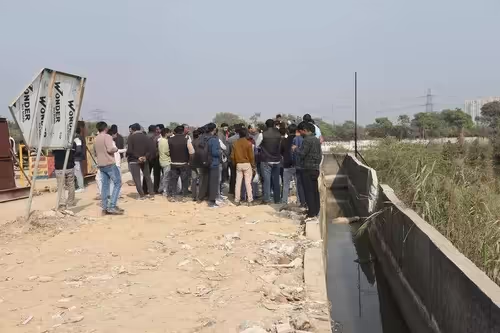
In the dead of a foggy night in Greater Noida, a simple drive home turned into a nightmare. Yuvraj Mehta, a 27-year-old software engineer, was navigating Sector 150 when his SUV plunged into a 30-foot-deep, water-filled trench—a gaping maw on what was supposed to be a safe, modern road in a meticulously ‘planned’ city . This wasn’t just an accident; it was a direct consequence of years of systemic civic neglect that has plagued Noida’s rapid, yet reckless, expansion.
Table of Contents
- The Fatal Night: A Sequence of Preventable Failures
- Noida Road Crash: A Symptom of Deeper Urban Planning Ills
- A History of Ignored Warnings and Broken Promises
- The Human Cost of Bureaucratic Apathy
- What Must Change for a Safer Noida?
- Conclusion: From Planned City to Planned Neglect
- Sources
The Fatal Night: A Sequence of Preventable Failures
The road where Yuvraj met his tragic end was a textbook example of dangerous infrastructure. It featured a sharp, 90-degree turn leading directly to an open, unmarked, and unlit drain—essentially a death trap waiting to happen . There were no barricades, no reflective poles, no warning signs, and critically, no street lighting to alert drivers of the impending hazard .
Reports indicate that Yuvraj survived the initial impact of the crash. He managed to climb onto the roof of his submerged vehicle and cried for help for over 90 agonizing minutes. But in the fog and darkness, with no one around and no emergency response system in place, his calls went unanswered until it was too late . This heartbreaking detail underscores not just a failure of physical infrastructure, but a complete collapse of the city’s duty of care to its citizens.
Noida Road Crash: A Symptom of Deeper Urban Planning Ills
The Noida road crash is not an isolated incident. It’s a glaring symptom of a much larger problem: the failure of India’s urban planning model. Cities like Noida are often developed at breakneck speed to accommodate a booming population, but the focus is almost exclusively on real estate and construction, with little regard for essential social and safety infrastructure .
This approach has created a paradox: a “planned” city that is, in reality, dangerously unplanned when it comes to the basics of livability. The very trench that claimed Yuvraj’s life was reportedly allotted for a stormwater drain project back in 2015, but the plan remained “on paper” while the open pit became a permanent fixture—and a lethal one .
India’s road safety record is already grim, with the Ministry of Road Transport and Highways reporting over 1.73 lakh deaths in 2023 alone . While a significant portion occurs on highways, the rising number of fatalities in urban areas—like this one in Noida—is a direct result of poor local planning, crumbling infrastructure, and a lack of accountability .
A History of Ignored Warnings and Broken Promises
Residents of Greater Noida have been sounding the alarm for years. They have consistently complained about “poor lighting, absence of reflector poles and hazardous open drains” that pose serious safety risks . These are not new grievances; they are a chronic condition of life in many of Noida’s newer sectors.
The pattern is clear: infrastructure projects are announced with great fanfare, but their execution is either delayed indefinitely or executed with shoddy workmanship. Sewer overflows, road cave-ins, and massive potholes are common complaints across multiple sectors, painting a picture of a city in a state of constant civic distress .
The tragedy has finally forced the hand of authorities. In the wake of the public outcry, the Greater Noida Industrial Development Authority (GNIDA) has ordered a sweeping road safety overhaul, and even Chief Minister Yogi Adityanath has called for a statewide road safety drive [[9], [11]]. But for Yuvraj Mehta and his family, these reactive measures are tragically too late. The question remains: why does it take a death to spur action?
The Human Cost of Bureaucratic Apathy
Beyond the statistics and the bureaucratic jargon lies a profound human cost. Yuvraj Mehta was not just a victim of a car crash; he was a victim of a system that prioritizes development metrics over human life. His story is a stark reminder that every unlit road, every missing barricade, and every ignored resident complaint is a potential death sentence.
This case highlights a critical gap in India’s urban governance: the lack of a robust, citizen-centric feedback and enforcement mechanism. When residents report hazards, there is often no transparent system to track the resolution, leading to a culture of apathy and impunity among civic agencies. For families in Noida, this isn’t just an inconvenience; it’s a daily gamble with their lives.
What Must Change for a Safer Noida?
To prevent future tragedies, a multi-pronged approach is essential:
- Immediate Infrastructure Audit: A comprehensive, third-party audit of all roads, especially in newer sectors, to identify and rectify hazards like sharp turns near open drains, poor lighting, and missing signage.
- Transparent Project Tracking: A public dashboard should be created to track the status of all civic infrastructure projects, from announcement to completion, holding authorities accountable for delays.
- Citizen Empowerment: Establish a responsive, 24/7 grievance redressal system with guaranteed response times for critical safety issues reported by residents.
- Enforcement of Safety Standards: Strict penalties for developers and civic bodies that fail to adhere to mandatory safety and planning norms before a sector is opened for habitation.
For more on urban development challenges, see our analysis on [INTERNAL_LINK:india-urban-planning-crisis].
Conclusion: From Planned City to Planned Neglect
The death of Yuvraj Mehta on a dark, dangerous road in Noida is a national shame. It exposes the hollowness of the term “planned city” when the plan excludes the most fundamental element: the safety of its people. The Noida road crash is a wake-up call not just for local authorities, but for every Indian city grappling with the chaos of rapid urbanization. Without a fundamental shift towards accountability, transparency, and genuine citizen welfare, these so-called modern utopias will continue to be built on a foundation of neglect and human cost.
Sources
- Times of India: How civic neglect killed techie in ‘planned’ Noida
- Web Search Results: Various reports on the Noida crash and civic infrastructure failures [[1]-[13]]
- Ministry of Road Transport and Highways (MoRTH): Road Safety in India Status Report 2023 [[16], [22]]
- Urban Studies & Policy Analysis on Indian city planning failures [[14], [15], [18]]