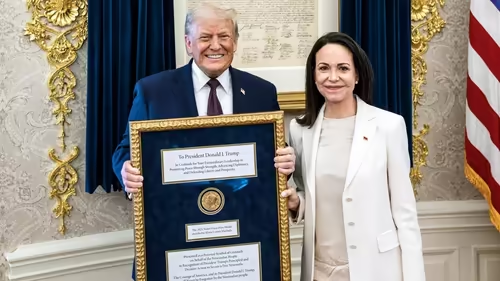
In a move that sent shockwaves through the diplomatic and political world, Venezuelan opposition leader María Corina Machado recently presented her Nobel Peace Prize medal to former U.S. President Donald Trump. The act, described by Trump as a “wonderful gesture of mutual respect,” immediately sparked a global debate: can a Nobel Prize actually be given away? Now, the guardians of Alfred Nobel’s legacy have spoken, drawing a crucial line between the physical symbol of the award and the honor it represents .
Table of Contents
- The Controversial Handover
- Nobel Committee’s Official Clarification
- Historical Precedents for Gifting or Selling Nobel Prizes
- What the Nobel Rules Actually Say
- Why This Distinction Matters
- Conclusion: A Matter of Honor, Not Ownership
- Sources
The Controversial Handover
The story began when María Corina Machado, a prominent figure in Venezuela’s struggle for democracy, confirmed she had gifted her Nobel Peace Prize medal to Donald Trump. Trump, in turn, posted about the event, stating, “María presented me with her Nobel Peace Prize for the work I have done. Such a wonderful gesture of mutual respect” . This announcement ignited a firestorm of commentary, with critics questioning the appropriateness of the act and supporters hailing it as a powerful symbol of international solidarity. The central question on everyone’s mind was whether this transfer was even permissible under the rules of the Nobel Foundation.
Nobel Committee’s Official Clarification
Responding to the intense media scrutiny, the Norwegian Nobel Committee, which awards the Peace Prize, issued a clear and definitive statement. Their message was twofold: while a laureate is free to dispose of their physical medal as they see fit, the title of “Nobel Laureate” is an inseparable, personal honor that cannot be transferred, sold, or gifted . In essence, Trump may now possess the gold medal, but he will never be recognized as a Nobel Peace Prize winner. The committee emphasized that the award is given for a specific achievement by a specific individual at a specific time, and that recognition is forever tied to that person .
Historical Precedents for Gifting or Selling Nobel Prizes
This isn’t the first time a Nobel medal has changed hands. History is replete with examples that test the boundaries of the prize’s sanctity. Perhaps the most famous case is that of James Watson, the co-discoverer of DNA’s structure, who auctioned his 1962 Nobel Prize in Physiology or Medicine in 2014. The buyer later returned it to him. Even more dramatically, during World War II, German scientists Max von Laue and James Franck sent their gold medals to Niels Bohr in Copenhagen for safekeeping. When the Nazis invaded, Hungarian chemist George de Hevesy dissolved the medals in aqua regia to prevent their confiscation, later recasting them after the war . These stories highlight that while the metal can be moved, the honor remains with the original recipient.
Notable Instances of Nobel Medals Changing Hands
- James Watson (2014): Sold his medal at auction for $4.1 million, a decision he later expressed regret over .
- Max von Laue & James Franck (1940): Their medals were famously dissolved in acid to hide them from the Nazis, then recast post-war .
- Dmitri Mendeleev: Though never awarded one, his name is often cited in discussions about the prize’s history, showing its cultural weight .
What the Nobel Rules Actually Say
The statutes of the Nobel Foundation are quite explicit on this matter. According to their guidelines, the prize amount and the diploma are the property of the laureate, who can use them as they wish. The same applies to the physical medal. However, the Foundation’s rules are equally clear that the status of being a Nobel Laureate is a personal, non-transferable distinction conferred by the awarding institution . This legal and ethical framework ensures that the integrity of the prize is maintained, preventing its prestige from being commodified or politically instrumentalized beyond the laureate’s own actions.
Why This Distinction Matters
The Nobel Committee’s clarification is not just bureaucratic nitpicking; it’s a defense of the prize’s very soul. The Nobel Peace Prize is meant to recognize extraordinary contributions to peace, fraternity among nations, and the reduction of standing armies. Allowing the laureate title to be transferred would fundamentally undermine its purpose, turning a mark of singular achievement into a tradable commodity or a political token. By firmly stating that Trump is not now, and never will be, a Nobel Laureate, the committee protects the award’s credibility and its power to inspire future peacemakers. For more on the history and impact of the award, see our feature on [INTERNAL_LINK:nobel-peace-prize-history-and-impact].
Conclusion: A Matter of Honor, Not Ownership
The saga of Machado’s medal serves as a powerful reminder that some things cannot be owned, only earned. While the gleaming gold disc may now sit in a display case elsewhere, the honor, the legacy, and the responsibility that come with the Nobel Peace Prize remain forever with its rightful recipient. The Nobel Committee’s swift and clear response has successfully drawn a bright line between a personal gift and an institutional honor, ensuring that the true value of the prize—the recognition of a life dedicated to peace—remains intact for generations to come.
Sources
- Nobel Peace Center. “Official Statement on Transfer of Nobel Medals”.
- Times of India. “‘Laureates can give away medals but … ‘: Nobel Committee reacts”. https://timesofindia.indiatimes.com/…
- Reuters. “Factbox: When Nobel Prizes have been sold, lost or hidden”.
- The Guardian. “Nobel Peace Prize: What happens when you win – and can you give it away?”.
- Donald J. Trump. Official Social Media Post.