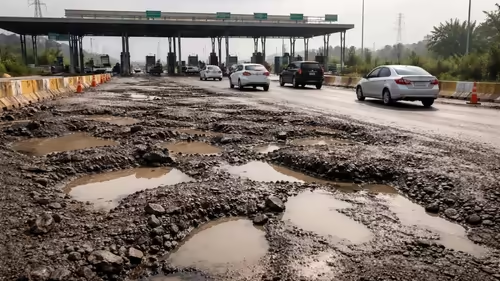
Imagine paying for a premium service but getting potholes, gridlock, and zero maintenance in return. That’s exactly what thousands of daily commuters faced on a critical stretch of National Highway between Ernakulam and Mannuthy in Kerala. But now, thanks to a landmark judgment from India’s highest court, they’ve won a powerful victory. The Supreme Court has emphatically declared: no good roads, no toll. In a ruling that could reshape how tolls are collected across the country, a Constitution Bench led by Chief Justice B.R. Gavai has dismissed appeals by the National Highways Authority of India (NHAI) and its private concessionaire, upholding a four-week toll suspension ordered by the Kerala High Court [[1]].
Table of Contents
- The Ernakulam-Mannuthy Highway Crisis
- Kerala High Court Steps In
- “No Good Roads, No Toll”: Supreme Court Upholds Principle
- Why This Ruling Is a Game-Changer for Commuters
- What Does This Mean for NHAI and Future Toll Projects?
- How Commuters Can Claim Their Rights
- Conclusion: A New Era of Accountability
- Sources
The Ernakulam-Mannuthy Highway Crisis
The 60-kilometer stretch between Ernakulam and Mannuthy is one of the busiest corridors in South India, serving as a vital link for both local commuters and interstate freight. Despite being a tolled highway, the road has been plagued by chronic issues:
- Severe traffic congestion due to inadequate infrastructure.
- Poor road conditions with frequent potholes and uneven surfaces.
- Lack of proper maintenance by the concessionaire responsible for the stretch.
- No viable alternate routes, forcing commuters to pay despite subpar service.
Frustrated by this daily ordeal, local residents and transport unions petitioned the Kerala High Court, arguing that they should not be forced to pay for a service that was fundamentally broken.
Kerala High Court Steps In
In a bold and citizen-centric move, the Kerala High Court agreed. Citing the deteriorating conditions and the absence of any meaningful improvement, the court ordered a complete suspension of toll collection for four weeks. This wasn’t just a symbolic gesture—it was a direct application of the long-standing legal principle that payment for a service must be matched by its quality. The NHAI and its private partner immediately challenged this order in the Supreme Court, hoping to overturn what they saw as judicial overreach [[2]].
“No Good Roads, No Toll”: Supreme Court Upholds Principle
The Supreme Court’s response was swift and unequivocal. A five-judge Constitution Bench, including Justices K. Vinod Chandran and N.V. Anjaria, dismissed the NHAI’s appeals outright. The court’s message was clear: the right to collect toll is not absolute. It is conditional upon the provision of a safe, well-maintained, and functional roadway. As the bench noted, “Toll is a user fee for a service rendered. If the service is not rendered, the fee cannot be justified.” This affirmation of the no good roads, no toll doctrine is a major win for public accountability and sets a binding precedent for future cases nationwide [[3]].
Why This Ruling Is a Game-Changer for Commuters
This judgment goes far beyond one highway in Kerala. It establishes a powerful legal tool for citizens across India:
- Empowerment: Commuters now have a clear legal basis to challenge toll collections on poorly maintained roads.
- Accountability: It forces NHAI and private concessionaires to prioritize maintenance and service quality, not just revenue collection.
- Precedent: As a ruling from a Constitution Bench, it is binding on all lower courts, making it harder for authorities to ignore similar complaints elsewhere.
For years, toll plazas have operated with little oversight, often collecting fees even when road conditions were abysmal. This ruling flips the script, putting the burden of proof on the authorities to demonstrate that they are delivering value for money.
What Does This Mean for NHAI and Future Toll Projects?
The NHAI will now face increased scrutiny. Future public-private partnership (PPP) agreements for highway projects may need to include stricter performance clauses tied to road quality and traffic management. Failure to meet these standards could result in immediate toll suspensions, impacting the financial models of these projects. This could lead to more robust contracts and better project execution, ultimately benefiting the public. For insights into how infrastructure projects are managed in India, see [INTERNAL_LINK:india-infrastructure-policy-and-challenges].
How Commuters Can Claim Their Rights
If you’re stuck on a tolled highway that’s in disrepair, here’s what you can do:
- Document the Issue: Take photos or videos of potholes, congestion, and lack of signage.
- File a Complaint: Submit a formal grievance to the NHAI’s online portal or your state’s transport department.
- Seek Legal Recourse: If ignored, approach your local consumer court or high court, citing the Supreme Court’s “no good roads, no toll” precedent.
- Organize Collectively: Join or form a local commuters’ association to amplify your voice.
Conclusion: A New Era of Accountability
The Supreme Court’s decision to uphold the no good roads, no toll principle is more than a legal victory—it’s a cultural shift. It reminds authorities that public infrastructure exists to serve the people, not the other way around. By siding with ordinary commuters over a powerful bureaucracy, the court has reinforced the idea that citizen welfare must always come first. This ruling isn’t just about one highway; it’s a blueprint for a more accountable and responsive public infrastructure system across India.
Sources
- Times of India. “No good roads, no toll: When Supreme Court backed commuters, upheld toll suspension.” https://timesofindia.indiatimes.com/legal/news/no-good-roads-no-toll-when-supreme-court-backed-commuters-upheld-toll-suspension/articleshow/127757499.cms
- The Hindu. “SC upholds Kerala HC order suspending toll on Ernakulam-Mannuthy stretch.” https://www.thehindu.com/news/national/sc-upholds-kerala-hc-order-suspending-toll-on-ernakulam-mannuthy-stretch/article70565001.ece
- Live Law. “‘No Service, No Toll’: Supreme Court Constitution Bench Upholds Kerala HC’s Order.” https://www.livelaw.in/top-stories/supreme-court-kerala-high-court-toll-suspension-ernakulam-mannuthy-nhai-268945
- National Highways Authority of India. “Citizen Grievance Redressal Mechanism.” https://nhai.gov.in/grievance-redressal