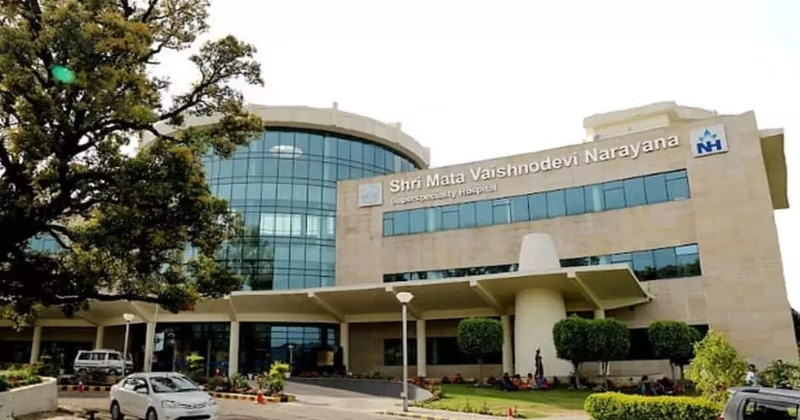
In a move that has sent shockwaves through Jammu and Kashmir’s education sector, the National Medical Commission (NMC) has officially **shut down the MBBS course** at the Shri Mata Vaishno Devi Institute of Medical Excellence (SMVDIME). The decision—based on a surprise inspection—cites alarming deficiencies in faculty strength, hospital infrastructure, and clinical exposure for students. Despite political outcry and claims of regional bias, the regulator insists the action was purely regulatory, not political .
For aspiring doctors who enrolled with dreams of serving in the Himalayan region, this is more than an institutional failure—it’s a personal crisis. But what exactly triggered the NMC’s drastic step? And how will affected students continue their medical education? We break it all down.
Table of Contents
- Why NMC Shuts Down MBBS Course: The Inspection Findings
- NMC Shuts Down MBBS Course: The Official Violations
- Political Fallout and Misplaced Blame
- What Happens to Current Students?
- Broader Implications for Medical Education in India
- Conclusion: Quality Can’t Be Compromised
Why NMC Shuts Down MBBS Course: The Inspection Findings
The NMC’s decision wasn’t impulsive. A team of inspectors conducted an unannounced visit to SMVDIME in late 2025 and documented severe non-compliance with the **Minimum Standard Requirements (MSR)** for medical colleges in India .
Key red flags included:
- Faculty Shortage: The college had only 58 permanent faculty members against the mandated 123 for a 150-seat MBBS intake.
- Inadequate Clinical Exposure: The associated hospital recorded fewer than 20,000 annual patient visits—far below the required 60,000 needed to provide diverse case exposure.
- Infrastructure Gaps: Critical departments like radiology, pathology, and emergency care lacked advanced equipment and round-the-clock staffing.
- Bed-Student Ratio Failure: The hospital had just 300 functional beds for 450 MBBS students, violating the NMC’s 1:1.5 bed-to-student rule .
“These aren’t minor lapses—they’re fundamental failures that compromise patient safety and student learning,” an NMC official stated anonymously .
NMC Shuts Down MBBS Course: The Official Violations
Under the **National Medical Commission Act, 2019**, the regulator has the authority to withdraw recognition if a college fails to maintain standards even after warnings. SMVDIME had received two prior advisories in 2023 and 2024 but reportedly made only cosmetic improvements.
The final inspection report concluded that the institution was “not in a position to provide the required standard of medical education,” prompting immediate de-recognition of its MBBS program from the 2026–27 academic session onward .
Political Fallout and Misplaced Blame
Local politicians quickly alleged discrimination, claiming the college was targeted because it admitted a majority of students from outside J&K. However, the NMC strongly refuted this, emphasizing that **all 11 medical colleges inspected in December 2025**—including those in Tamil Nadu, Bihar, and Maharashtra—faced similar scrutiny, with three others issued show-cause notices .
“This is about standards, not geography,” said Dr. R.K. Singh, a former NMC member. “If we allow subpar colleges to operate, we’re producing underqualified doctors—putting millions of lives at risk” .
What Happens to Current Students?
The NMC has assured that no student will lose their MBBS seat. In a rare and compassionate move, it has directed all existing students (estimated at 450 across five batches) to be transferred as **supernumerary (extra) seats** to other recognized government medical colleges across India.
Key provisions include:
- Students will be relocated based on merit and preference.
- Their tuition fees and academic credits will be fully honored.
- Final-year students will be prioritized for placement in colleges with matching curricula.
- The J&K government will bear transportation and accommodation costs for the transition period .
While disruptive, this solution prevents a lost generation of medical aspirants.
Broader Implications for Medical Education in India
The Vaishno Devi case is a wake-up call for India’s rapidly expanding medical education sector. Since 2014, over 200 new MBBS colleges have been approved—but not all have kept pace with quality benchmarks.
The NMC’s crackdown signals a shift from quantity to **quality assurance**. As Dr. Mansukh Mandaviya, Union Health Minister, recently stated: “We need more doctors, but not at the cost of competence” .
Going forward, stricter monitoring, mandatory annual audits, and public disclosure of inspection reports may become the norm—raising the bar for all institutions.
Conclusion: Quality Can’t Be Compromised
The **NMC shuts down MBBS course** at Vaishno Devi not as punishment, but as protection—for students, patients, and the integrity of India’s healthcare system. While the immediate impact is painful, the long-term message is clear: in medical education, cutting corners is not an option. As India aims to meet WHO-recommended doctor-population ratios, it must ensure every new doctor is trained to the highest standard. Anything less is a risk society cannot afford.
Sources
[INTERNAL_LINK:NMC Guidelines for Medical Colleges]
[INTERNAL_LINK:List of Recognized MBBS Colleges in India]
Times of India – NMC Shuts Down Vaishno Devi MBBS Course
National Medical Commission – Minimum Standard Requirements
World Health Organization – Health Workforce Standards