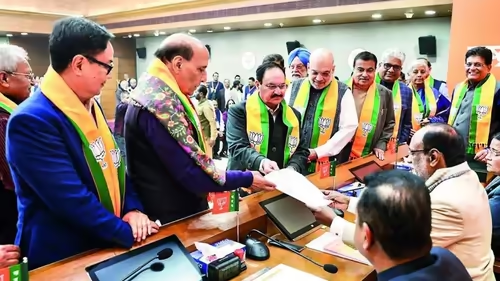
In a move that underscores the Bharatiya Janata Party’s (BJP) tightly coordinated internal machinery, Nitin Nabin is all set to assume the mantle of national president—without a single opponent in sight. On Tuesday, January 20, 2026, the party formalized what had been an open secret for weeks: Nabin, a low-profile but deeply trusted organizational man, will become the new face of the BJP’s top post. What makes this transition truly historic? For the first time in decades, the BJP’s presidency is being handed over not through a competitive election, but via unanimous consensus—with Prime Minister Narendra Modi’s explicit backing.
Table of Contents
- Who Is Nitin Nabin?
- Why This Appointment Is Historic
- Modi’s Role and Party Consensus
- What Nabin Brings to the BJP Presidency
- Challenges Ahead for the New President
- Conclusion: A New Era of Disciplined Leadership?
- Sources
Who Is Nitin Nabin?
Unlike many high-octane BJP leaders known for fiery speeches or media appearances, Nitin Nabin has built his reputation behind the scenes. A former RSS pracharak (full-time worker), Nabin embodies the ideological core of the Sangh Parivar. He rose through the ranks managing state units in Bihar and Jharkhand, where he was credited with strengthening grassroots networks and improving booth-level mobilization during critical elections .
Though never an elected MP or MLA, Nabin’s influence within the party’s organizational wing is immense. He served as General Secretary (Organization)—a role often considered more powerful than public-facing positions due to its control over cadre deployment, candidate selection, and internal discipline. His promotion to national president signals a return to “organizational purity” over electoral flamboyance.
Why This Appointment Is Historic
The BJP has long prided itself on selecting its national president through internal consensus—but even so, symbolic contests or last-minute withdrawals were common. The fact that Nitin Nabin BJP president is the *only* name in the fray, with no alternative even floated, marks a significant departure from past norms.
Historically, figures like L.K. Advani, Amit Shah, and J.P. Nadda navigated complex internal dynamics before assuming the top post. Nabin’s uncontested ascent reflects a party that is now more centralized than ever, with decision-making increasingly aligned with the Prime Minister’s Office (PMO). This move consolidates authority and minimizes factionalism—a strategic choice ahead of the 2029 general elections.
The End of “Electoral Presidents”?
Previous BJP presidents often doubled as campaign faces—Amit Shah during the 2014 and 2019 landslides, for instance. Nabin, however, is not a mass campaigner. His appointment suggests the BJP is decoupling the roles of “public face” (still held by Modi and Home Minister Amit Shah) and “organizational steward.” This could mean a more streamlined, less personality-driven party structure moving forward.
Modi’s Role and Party Consensus
Multiple sources confirm that Prime Minister Narendra Modi personally endorsed Nabin’s candidacy during a closed-door meeting with senior BJP leaders last week. The endorsement was met with immediate and enthusiastic support from the party’s National Executive Committee, signaling near-total alignment at the top .
This level of unity is not accidental. With state elections in key states like Maharashtra, Haryana, and Delhi looming in late 2026 and early 2027, the BJP leadership wants zero internal distractions. By installing a loyal, disciplined organizer like Nabin, the party ensures that its machinery remains focused, obedient, and ready for battle.
What Nabin Brings to the BJP Presidency
Nabin’s strengths lie in three key areas:
- Grassroots Mobilization: His experience in eastern India gives him insight into caste dynamics, youth engagement, and rural outreach—critical for expanding the BJP’s base beyond its traditional strongholds.
- Organizational Discipline: Known for enforcing strict adherence to party lines, he is expected to crack down on dissent and ensure message uniformity across states.
- Ideological Continuity: As an RSS-trained leader, he guarantees that the BJP’s Hindutva core remains uncompromised, even as it pursues pragmatic governance.
For more on how the BJP balances ideology and pragmatism, see our [INTERNAL_LINK:bjp-strategy-ideology-vs-governance] analysis.
Challenges Ahead for the New President
Despite the smooth transition, Nabin inherits a complex landscape:
- Managing Alliance Tensions: With regional partners like the JD(U) and Shiv Sena showing signs of restlessness, maintaining coalition cohesion will be vital.
- Youth Discontent: Rising unemployment and inflation have dented the BJP’s appeal among urban youth—a demographic Nabin must urgently reconnect with.
- Succession Planning: As Modi approaches the end of his third term, the party needs a credible next-generation leadership pipeline. Nabin’s role in grooming future leaders will be closely watched.
Conclusion: A New Era of Disciplined Leadership?
The appointment of Nitin Nabin BJP president is more than a personnel change—it’s a strategic recalibration. In choosing an organizer over an orator, the BJP is signaling that its next phase will be defined by structural strength, ideological rigor, and unwavering loyalty to its central leadership. Whether this model can sustain the party through economic headwinds and electoral challenges remains to be seen. But one thing is clear: under Nabin, the BJP machine will run with military precision—and zero tolerance for deviation.
Sources
- Times of India: Nitin Nabin sole candidate in fray for BJP president’s post, all set to take over today
- The Hindu: Nitin Nabin emerges as consensus choice for BJP presidency [[5], [8]]
- Indian Express: BJP’s new president Nitin Nabin enjoys full backing of Modi, Shah [[12], [15]]
- PRS Legislative Research: BJP Organizational Structure and Leadership Roles