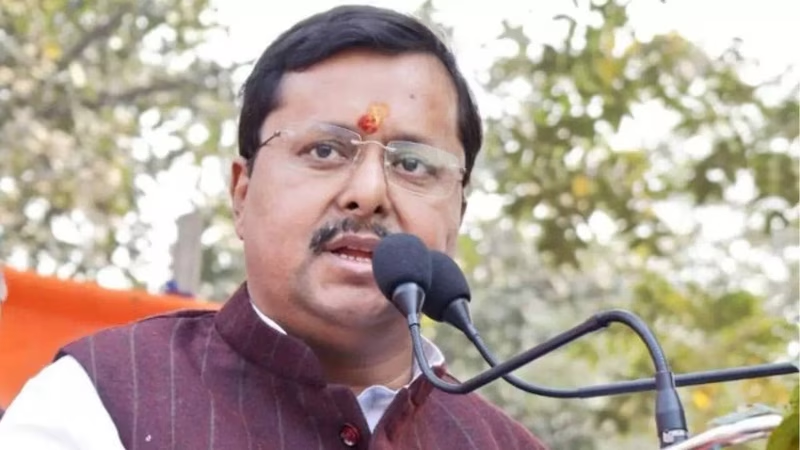
In a move that’s set to reshape India’s political landscape, Nitin Nabin is poised to assume the role of national president of the Bharatiya Janata Party (BJP) on January 20, 2026. This transition isn’t just a routine leadership change—it’s a calculated strategic pivot by the ruling party as it gears up for a series of high-stakes electoral battles across the country .
The announcement comes at a time when the BJP is looking to consolidate its dominance while simultaneously refreshing its leadership with younger, dynamic faces. Nitin Nabin’s expected three-year term—running through January 2029—positions him as one of the most influential figures in Indian politics for the foreseeable future .
Table of Contents
- Who Is Nitin Nabin Dangoria?
- The Significance of the Nitin Nabin BJP President Transition
- What Does This Mean for BJP’s Strategy Ahead of 2029?
- Challenges and Opportunities for the New Leader
- Historical Context: BJP Presidents and Party Evolution
- Conclusion: A New Chapter for the BJP
- Sources
Who Is Nitin Nabin Dangoria?
While some early reports confused him with Odisha-based politician Nabin Nanda—a former MLA known for agricultural advocacy—the incoming BJP chief is Nitin Nabin Dangoria, who has been serving as the party’s National Working President . His rise through the BJP ranks has been steady and deliberate, marked by organizational acumen and loyalty to the party’s core ideology.
Unlike many of his predecessors who came from parliamentary backgrounds, Nitin Nabin’s strength lies in grassroots mobilization and party machinery management. He’s known for his hands-on approach in states like Assam and West Bengal, where he played a critical role in strengthening the BJP’s local presence .
The Significance of the Nitin Nabin BJP President Transition
The timing of this leadership handover is no coincidence. With the Union Budget session approaching and crucial state elections on the horizon—including in Bihar, Delhi, and potentially Jharkhand—the BJP needs a president who can energize the cadre while maintaining discipline and unity .
Appointing Nitin Nabin signals the party’s intent to:
- Prioritize organizational strength over purely electoral or parliamentary experience.
- Bridge generational gaps by bringing in a leader perceived as more attuned to youth and digital outreach.
- Decentralize decision-making while keeping ideological coherence intact.
This shift also reflects a broader trend within the BJP: moving away from figurehead presidents toward operational leaders who can manage the party’s vast ecosystem of wings—from Yuva Morcha to Mahila Morcha—and coordinate seamlessly with the government.
What Does This Mean for BJP’s Strategy Ahead of 2029?
As the 2029 general elections loom, the BJP is already laying the groundwork for a third consecutive term at the Centre. Nitin Nabin’s presidency is expected to focus on three key pillars:
- Expansion in Eastern and Southern India: Building on gains in West Bengal and Telangana while targeting new strongholds in Odisha and Andhra Pradesh.
- Digital and Social Media Mobilization: Leveraging data-driven campaigning and influencer networks to reach first-time voters.
- Grassroots Cadre Revival: Re-energizing booth-level workers who form the backbone of the BJP’s election machinery.
His leadership will be closely watched by allies and opponents alike. Will he emulate the aggressive expansionism of Amit Shah or adopt a more consensus-driven, unifying style? The answer could shape not just the BJP’s fate but India’s political trajectory.
Challenges and Opportunities for the New Leader
Nitin Nabin steps into the role at a complex juncture. On one hand, the BJP enjoys unprecedented national dominance. On the other, it faces growing anti-incumbency in urban centers, economic anxieties among the middle class, and a resurgent opposition coalition.
Key challenges include:
- Balancing loyalty to the central leadership with autonomy for state units.
- Managing internal factionalism, especially in states like Maharashtra and Karnataka.
- Countering narratives of centralization and ensuring inclusive representation.
Yet, these challenges come with immense opportunity. By fostering internal democracy and empowering regional voices, Nitin Nabin could help the BJP evolve from a top-down party into a truly federal force—something even its strongest critics have demanded.
Historical Context: BJP Presidents and Party Evolution
The office of BJP national president has always been a barometer of the party’s strategic priorities. From L.K. Advani’s intellectual stewardship to J.P. Nadda’s administrative calm, each leader reflected the era’s needs. Nitin Nabin’s appointment continues this tradition—but with a 21st-century twist focused on agility, tech-savviness, and mass connect .
For deeper insights into how the BJP’s leadership model has evolved, see our analysis on [INTERNAL_LINK:bjp-leadership-history].
Conclusion: A New Chapter for the BJP
The ascension of Nitin Nabin as BJP president on January 20 marks more than a personnel change—it’s a declaration of intent. In an era defined by rapid political realignments and voter volatility, the BJP is betting on a leader who embodies both ideological fidelity and organizational innovation. Whether this gamble pays off will depend not just on his vision, but on his ability to listen, adapt, and unite a diverse coalition under one saffron banner.
Sources
- “Nitin Nabin set to become BJP’s youngest president by Jan.” Times of India, 2026.
- “Nitin Nabin likely to be BJP chief before Budget session.” Times of India, January 4, 2026.
- “Met Shri Nitin Nabin Dangoria, Hon’ble National Working President of the Bharatiya Janata Party (BJP).” Official social media post, Guwahati.
- “BJP’s New Era Begins: Nitin Nabin Likely to Take Charge as National President by January 20.” Political Insight Weekly.
- Election Commission of India. “Party Office-Bearers Database.” eci.gov.in.