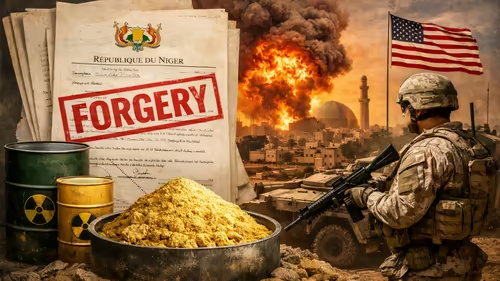
In the annals of modern history, few intelligence failures have had consequences as devastating—or as expensive—as the Niger uranium hoax. What began as a flimsy rumor, backed by crude forgeries, spiraled into a central pillar of the U.S. government’s case for invading Iraq in 2003. The result? A war that would cost an estimated $1.7 trillion, claim hundreds of thousands of lives, and destabilize an entire region for decades. And it all hinged on documents so poorly fabricated that experts spotted the fraud almost immediately.
Table of Contents
- The Claim That Changed History
- How the Niger Uranium Hoax Unfolded
- Why Did the U.S. Believe It?
- The Aftermath and Accountability
- Conclusion: Lessons from a Costly Lie
- Sources
The Claim That Changed History
On January 28, 2003, President George W. Bush stood before Congress and declared: “The British government has learned that Saddam Hussein recently sought significant quantities of uranium from Africa.” Though he didn’t name Niger explicitly, that was the country in question. This single sentence—later dubbed the “16 words”—became one of the most consequential lines in modern geopolitics .
The implication was clear: Saddam Hussein was reconstituting his nuclear weapons program. In the post-9/11 climate of fear, this allegation was enough to tip public opinion toward war. Yet, as we now know, the entire premise was built on a house of cards constructed from forged letters, dubious sources, and willful ignorance.
How the Niger Uranium Hoax Unfolded
The story begins in early 2001, when Italian military intelligence (SISMI) received anonymous documents alleging that Niger had agreed to sell 500 tons of yellowcake uranium to Iraq. These documents surfaced again in 2002, just as the Bush administration was building its case for war.
Enter former U.S. ambassador Joseph Wilson. At the CIA’s request, he traveled to Niger in February 2002 to investigate. His conclusion? The claim was “highly unlikely.” He reported that Niger’s uranium mines were under strict French and international control, and no such sale could occur without detection .
Yet, the claim persisted. In late 2002, the documents resurfaced—this time with glaring errors:
- They referenced a nonexistent official.
- Used letterhead from a company that hadn’t existed in years.
- Contained dates that didn’t align with political realities (e.g., referencing a president who had already been deposed).
By March 2003, the International Atomic Energy Agency (IAEA) publicly declared the documents to be “obvious forgeries” . But by then, the war drums were too loud to stop.
Why Did the U.S. Believe It? The Politics of Certainty
If the evidence was so flimsy, why did the Bush administration push it so aggressively? The answer lies in a mix of bureaucratic inertia, groupthink, and political expediency.
According to the bipartisan Senate Intelligence Committee report in 2004, the CIA had “low confidence” in the Niger claim as early as 2002. Yet, the information was still included in key briefings because it fit the prevailing narrative: that Saddam was a threat who needed to be removed .
Moreover, dissenting voices were sidelined. When Wilson went public in a New York Times op-ed in July 2003 titled “What I Didn’t Find in Africa,” the White House retaliated by leaking the identity of his wife, Valerie Plame, a covert CIA officer—a scandal that led to the conviction of senior aide Lewis “Scooter” Libby .
This episode revealed a dangerous dynamic: when intelligence contradicts a predetermined policy, it’s often ignored or discredited. The Niger uranium hoax wasn’t just a mistake—it was a symptom of a system that prioritized certainty over truth.
The Human and Financial Toll
The consequences of this deception were staggering:
- Human Cost: Over 4,500 U.S. soldiers and an estimated 200,000–300,000 Iraqi civilians died .
- Financial Cost: The war’s total cost is estimated at $1.7 trillion, with long-term obligations pushing it even higher .
- Geopolitical Fallout: The power vacuum led to the rise of ISIS and regional instability that persists today.
The Aftermath and Accountability
Despite multiple investigations—including the CIA’s own internal review and congressional inquiries—no high-level official was ever held criminally accountable for using false intelligence to justify war. The Bush administration maintained that it acted in good faith based on the best available information, a defense many historians and critics reject.
For the public, the Niger uranium hoax became a symbol of government overreach and the perils of unchecked executive power. It also eroded trust in intelligence agencies and mainstream media, fueling conspiracy theories and skepticism that linger to this day.
Conclusion: Lessons from a Costly Lie
More than two decades later, the Niger uranium hoax remains a cautionary tale about the dangers of confirmation bias, the weaponization of intelligence, and the human cost of political hubris. In an era where misinformation spreads faster than ever, the story of those forged documents serves as a stark reminder: extraordinary claims require extraordinary evidence—not just convenient ones. As we confront new global crises, the lessons from this $1.7 trillion mistake must not be forgotten.
Sources
- Times of India: The Niger uranium claim: How false documents fuelled America’s $1.7tn war in Iraq
- The New York Times: What I Didn’t Find in Africa – Joseph C. Wilson IV [[12], [15]]
- International Atomic Energy Agency (IAEA): Statement on Iraq Nuclear Allegations (March 14, 2003)
- U.S. Senate Select Committee on Intelligence: Report on Prewar Intelligence Assessments (2004)
- Brown University Costs of War Project: Estimated Human and Financial Costs of the Iraq War [[25], [30]]