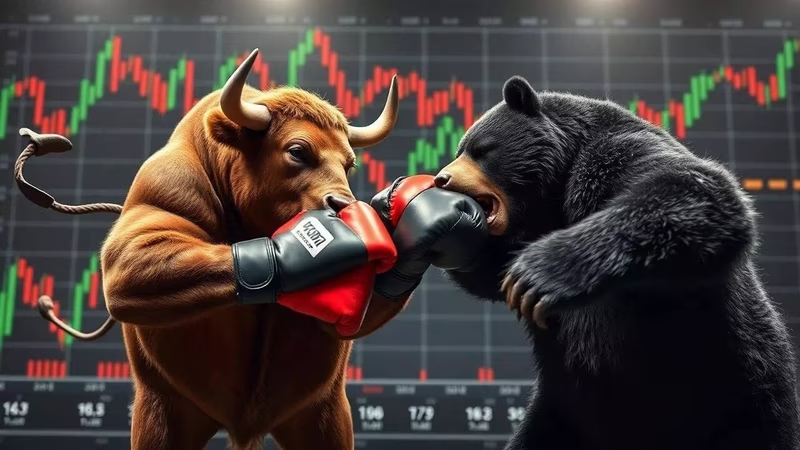
Despite rising geopolitical tensions, Indian equity markets kicked off Tuesday, January 13, 2026, on a remarkably bullish note. The Nifty50 today opened firmly above the 25,850 mark, while the BSE Sensex surged by more than 250 points in early trade—a show of resilience that has left analysts both impressed and cautious .
This upward momentum comes at a time when global markets are on edge following former U.S. President Donald Trump’s announcement of sweeping 25% tariffs on any nation engaging in trade with Iran—a move that directly threatens India’s strategic energy and infrastructure ties with Tehran . Yet, instead of retreating, Dalal Street appears to be betting on domestic strength, robust corporate earnings, and potential policy buffers from New Delhi.
Table of Contents
- Nifty50 Today: Market Snapshot and Key Drivers
- Trump’s Iran Tariff Threat: Why India Is Vulnerable
- Sector-Wise Performance: Who Led the Rally?
- Global Cues and FII Flows: What Changed Overnight?
- Expert Opinions: Is This Rally Sustainable?
- What Investors Should Do Next: Practical Steps
- Conclusion: Cautious Optimism on Dalal Street
- Sources
Nifty50 Today: Market Snapshot and Key Drivers
As of 9:30 AM IST, the Nifty50 today was trading at 25,872, up 0.98%, while the BSE Sensex stood at 84,315, reflecting a gain of 258 points. Broad-based buying was evident across large-cap stocks, with banking, IT, and auto sectors leading the charge .
Key factors fueling this optimism include:
- Strong Q3 earnings previews: Major banks and IT firms have signaled better-than-expected December-quarter results.
- Stable rupee: The INR held steady at 83.25 against the dollar, reducing import cost fears.
- Domestic liquidity: Retail investor participation remains high, with SIP inflows hitting record levels in December 2025.
- Policy reassurance: Finance Ministry officials hinted at “contingency measures” should U.S. tariffs materialize.
Trump’s Iran Tariff Threat: Why India Is Vulnerable
While markets rose, the shadow of Trump’s proposed 25% tariff looms large. If implemented, it could penalize India for its ongoing engagement with Iran—particularly the Chabahar Port project and any future oil imports .
India exports over $190 billion worth of goods to the U.S. annually, including pharmaceuticals, textiles, and software services. A blanket tariff would severely dent these sectors. However, traders appear to believe that either (a) the policy won’t be enacted before the 2026 U.S. election, or (b) India will secure an exemption—as it did during previous Iran sanctions.
Sector-Wise Performance: Who Led the Rally?
The gains weren’t uniform. Here’s how key sectors fared in early trade:
- Banking: Up 1.4% — HDFC Bank, ICICI Bank, and SBI all gained over 1.5% on strong credit growth data.
- IT: Up 1.2% — TCS and Infosys rose on renewed demand for digital transformation services from U.S. clients.
- Auto: Up 0.9% — Maruti Suzuki and M&M benefited from festive sales carryover and EV subsidy extensions.
- Oil & Gas: Flat to slightly down — Reliance and ONGC treaded water amid uncertainty over Iran-linked crude sourcing.
Notably, defense and railway stocks also saw sharp intraday spikes, possibly on speculation of increased government capex in the upcoming Union Budget.
Global Cues and FII Flows: What Changed Overnight?
Overnight, U.S. markets closed mixed. The Dow edged higher, but Nasdaq dipped on tech profit-taking. Asian markets were mostly positive, with Japan’s Nikkei up 0.7% and South Korea’s Kospi gaining 0.5%.
More importantly, Foreign Institutional Investors (FIIs) turned net buyers after three days of selling. Data from depositories shows FIIs purchased ₹420 crore worth of equities on Monday, signaling renewed confidence in Indian assets .
According to the International Monetary Fund (IMF), India remains the fastest-growing major economy, with a projected GDP expansion of 6.8% in FY2026—a key draw for long-term investors despite short-term geopolitical noise .
Expert Opinions: Is This Rally Sustainable?
“The market is pricing in hope, not fear,” says Priya Mehta, Chief Investment Officer at Horizon Wealth Advisors. “But if Trump’s tariffs become reality, we could see a sharp correction in export-oriented sectors.”
Conversely, Rajiv Sharma, Senior Analyst at CapitalEdge Research, argues: “India’s domestic consumption story is strong enough to absorb external shocks. This rally has legs.”
Most experts agree that volatility will increase in the coming weeks, especially as budget announcements and U.S. primary elections approach.
What Investors Should Do Next: Practical Steps
If you’re invested in the market, here’s how to navigate this phase:
- Diversify away from pure export plays: Reduce exposure to sectors heavily reliant on U.S. demand if tariffs escalate.
- Focus on domestic cyclicals: Banking, autos, and infrastructure are likely to benefit from local spending.
- Use dips to accumulate quality: Don’t panic-sell; instead, view corrections as entry points for blue-chip stocks.
- Monitor FII activity closely: Sustained foreign buying is a strong tailwind.
For a deeper strategy guide, explore our resource on [INTERNAL_LINK:building-a-resilient-portfolio-in-volatile-markets].
Conclusion: Cautious Optimism on Dalal Street
The Nifty50 today performance reflects a market walking a tightrope—celebrating domestic strengths while eyeing distant storm clouds. While the immediate outlook is positive, the threat of U.S. trade actions means investors must stay agile. For now, Dalal Street is betting that India’s economic fundamentals will shield it from the worst of global turbulence—but the next few weeks will be telling.
Sources
- Times of India: Stock market today: Nifty50 opens above 25,850
- Reuters: Trump proposes 25% tariffs on nations trading with Iran
- National Stock Exchange (NSE) Official Website
- Bombay Stock Exchange (BSE) Live Data
- SEBI: FII/DII Trading Activity Report (January 12, 2026)
- International Monetary Fund (IMF): India Economic Outlook