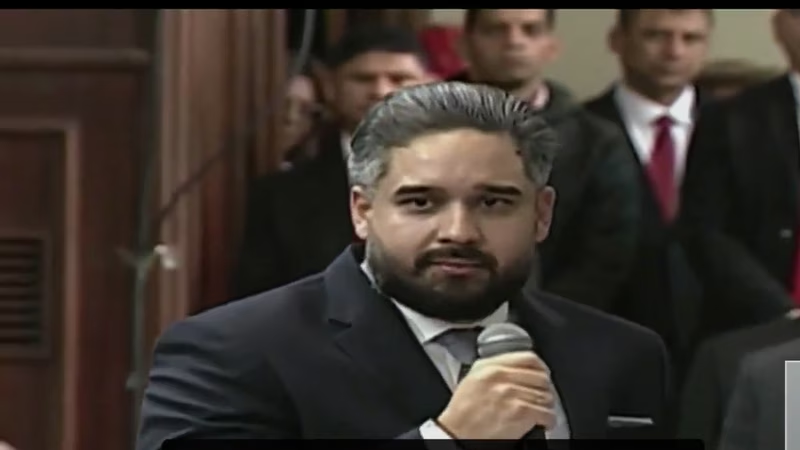
The political earthquake that struck Venezuela with the reported capture of President Nicolás Maduro by US forces has left the nation reeling. In the power vacuum that followed, the most poignant and personal response came not from a seasoned general or a veteran politician, but from the president’s own son. In a raw and tearful address to the National Assembly, **Nicolas Maduro’s son**, lawmaker Nicolás Maduro Guerra, delivered a message that was both a public show of loyalty and a private cry for his father’s return, intensifying the already sky-high tensions in the region .
Table of Contents
- The Emotional Plea: ‘Dad, I Tell You…’
- Context of the Crisis: Maduro’s Capture and US Charges
- A New Power Structure: Loyalty to Interim President Delcy Rodríguez
- Maduro’s Defiant Claim: ‘I Am Still the Leader’
- Regional and Global Repercussions of the Venezuelan Power Shift
- Conclusion: A Family’s Pain at the Heart of a Geopolitical Storm
- Sources
The Emotional Plea: ‘Dad, I Tell You…’
Standing before his fellow legislators, Maduro Guerra struggled to maintain his composure. Fighting back tears, he began his address with a heartbreakingly personal line that has since gone viral: **“Dad, I tell you…”**. The rest of his speech was a powerful blend of political defiance and familial anguish. He declared his unwavering support for the new interim leadership while simultaneously expressing his deep personal pain and hope for his father’s “swift and safe return” . This moment was significant because it humanized a political dynasty that has often been viewed through the lens of authoritarianism, showing the real human cost of the ongoing crisis for the first family itself.
Context of the Crisis: Maduro’s Capture and US Charges
The foundation of this unprecedented situation is the reported capture of long-time Venezuelan President Nicolás Maduro by US authorities. Maduro, who has been a thorn in Washington’s side for over a decade, is facing serious **drug trafficking charges in a New York court** . The US Department of Justice has had an indictment against him since 2020, accusing him of being a “narcoterrorist” for his alleged role in aiding the FARC in smuggling cocaine into the United States. If these reports of his capture are confirmed, it would be a stunning development, effectively decapitating the Venezuelan state’s leadership in one swift move and validating years of US efforts to hold him accountable.
A New Power Structure: Loyalty to Interim President Delcy Rodríguez
In the immediate aftermath, Venezuela’s constitutionally designated successor, Vice President **Delcy Rodríguez**, has assumed the role of interim president. Maduro Guerra’s speech was a crucial act of political theater, designed to shore up her legitimacy in the eyes of their loyalists. By publicly pledging his allegiance to Rodríguez, he was sending a clear message to the military and the ruling PSUV party: the official line of succession must be respected, and unity is paramount in this moment of crisis. His support is vital, as his position as a national lawmaker and his status as the president’s son give him a unique platform to influence the party’s base during this fragile transition .
Maduro’s Defiant Claim: ‘I Am Still the Leader’
Adding another layer of complexity to the situation, reports indicate that even from detention, Nicolás Maduro has not conceded power. He is said to have declared, **“I am still the leader of Venezuela,”** a statement that throws the entire legal and political process into disarray . This claim, if true, suggests that Maduro and his inner circle may attempt to delegitimize Rodríguez’s interim government, potentially leading to a dangerous internal power struggle within the ruling elite. This defiance from captivity could fracture the regime, with some factions backing the interim president and others remaining loyal to the captured leader’s symbolic authority.
Regional and Global Repercussions of the Venezuelan Power Shift
The fallout from this event will be felt far beyond Venezuela’s borders. The region is on high alert, with neighboring countries like Colombia and Brazil bracing for a potential refugee surge or increased cross-border instability. For global powers, the situation presents both an opportunity and a risk.
- The United States now faces the challenge of managing a post-Maduro Venezuela, balancing justice for his alleged crimes with the need for a stable transition to prevent a complete state collapse.
- Russia and China, key allies and creditors of the Maduro regime, will be watching closely to protect their significant economic and strategic interests in the country’s vast oil reserves .
- The Lima Group and other regional bodies may see this as a chance to push for a negotiated democratic opening, but the path forward remains fraught with uncertainty.
The Council on Foreign Relations, a leading US foreign policy think tank, has long highlighted Venezuela as a critical flashpoint in the Western Hemisphere, where internal instability can quickly trigger a wider geopolitical crisis .
Conclusion: A Family’s Pain at the Heart of a Geopolitical Storm
The image of **Nicolas Maduro’s son**, his voice cracking with emotion in the National Assembly, is a stark reminder that behind every grand geopolitical event are real people and real families. His plea, “Dad, I tell you…”, transcends politics, capturing a universal moment of a child’s fear for a parent. Yet, this deeply personal moment is inextricably linked to a national and international crisis of immense proportions. As Venezuela navigates this treacherous new chapter, the world will be watching to see whether the country descends into further chaos or finds a path toward a more stable and democratic future. For ongoing analysis of the crisis, see our [INTERNAL_LINK:venezuela-political-crisis-2026-update].
Sources
1. The Times of India. “‘Dad I tell you …’: Nicolas Maduro’s son sends defiant message, gets emotional – watch.” https://timesofindia.indiatimes.com/world/rest-of-world/dad-i-tell-you-nicolas-maduros-son-sends-defiant-message-gets-emotional-watch/articleshow/126375483.cms .
2. Reuters. “Venezuela’s power structure after Maduro: What happens next?” January 6, 2026 .
3. BBC News. “Venezuela crisis: Why its oil matters to the world.” https://www.bbc.com .
4. Council on Foreign Relations. “Venezuela: The Crisis Explained.” https://www.cfr.org/backgrounder/venezuela-crisis-explained .