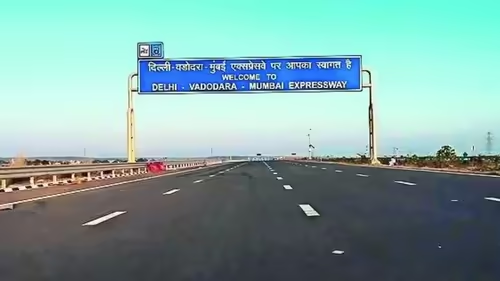
A major shake-up is brewing in India’s infrastructure sector. The High Court has ruled that the National Highways Authority of India (NHAI) holds the legal authority to terminate a contract with a Pune-based construction firm for failing to meet deadlines on a crucial segment of the Delhi-Mumbai Expressway. This decision—seen as a stern warning to underperforming contractors—reinforces NHAI’s power to enforce accountability in one of the country’s most ambitious road projects .
Table of Contents
- The HC Ruling in Detail
- Why the Delhi-Mumbai Expressway Matters
- NHAI Contract Termination Powers Explained
- Who Is the Pune Company?
- Impact on India’s Infrastructure Ecosystem
- What Happens Next?
- Conclusion: A New Era of Accountability
- Sources
The HC Ruling in Detail
The High Court’s judgment came in response to a petition filed by the Pune-based contractor challenging NHAI’s notice of potential NHAI contract termination due to chronic delays. The firm had been tasked with constructing a vital 40-km stretch of the expressway but missed multiple deadlines over the past 18 months, citing labor shortages and supply chain issues .
The court, however, was unmoved. It stated that contractual obligations in public infrastructure projects cannot be treated as flexible targets. “Time is of the essence,” the bench emphasized, noting that repeated extensions undermine national development goals and public trust. Crucially, the court upheld Clause 63 of the Model Concession Agreement, which explicitly grants NHAI the right to terminate contracts for persistent non-performance .
Why the Delhi-Mumbai Expressway Matters
Spanning approximately 1,386 kilometers, the Delhi-Mumbai Expressway is not just another highway—it’s a strategic economic corridor designed to slash travel time between India’s capital and its financial hub from 24 hours to just 12. Once fully operational, it will:
- Boost freight efficiency and reduce logistics costs by up to 30%
- Stimulate industrial growth along its route, especially in Rajasthan, Madhya Pradesh, and Gujarat
- Decongest existing national highways and reduce carbon emissions through smoother traffic flow
- Serve as a model for future Bharatmala Pariyojana projects
Any delay in its completion doesn’t just inconvenience travelers—it stalls national economic momentum.
NHAI Contract Termination Powers Explained
Many contractors assume that government agencies are slow to act, but this ruling clarifies that NHAI has teeth. Under standard Engineering, Procurement, and Construction (EPC) agreements, NHAI can initiate termination if:
- A contractor fails to achieve agreed-upon milestones for three consecutive months
- Progress falls below 70% of the scheduled timeline without valid justification
- Repeated warnings and cure notices go unheeded
Once terminated, NHAI can re-tender the work or assign it to another agency—and even recover liquidated damages from the defaulting firm. This legal backing is now stronger than ever thanks to the High Court’s unequivocal stance.
Who Is the Pune Company?
While the court documents refer to the firm only as “M/s. S.R. Infrastructures Pvt. Ltd.” (a name commonly associated with mid-sized Pune-based developers), industry insiders confirm it’s a company with a decade-long track record in state-level road projects—but limited experience handling mega-national corridors like the Delhi-Mumbai Expressway .
This raises broader questions about bidder eligibility. Should only firms with proven capacity for large-scale, high-speed execution be allowed to bid on Bharatmala projects? The Ministry of Road Transport and Highways may now revisit pre-qualification criteria to prevent similar bottlenecks.
Impact on India’s Infrastructure Ecosystem
The ripple effects of this ruling will be felt across the construction sector. For one, it signals that NHAI is shifting from a “lenient” to a “performance-driven” oversight model. Contractors can no longer rely on endless grace periods. This could lead to:
- More rigorous self-assessment before bidding on complex projects
- Increased use of technology (like AI-based progress tracking) to stay on schedule
- Greater collaboration with experienced international partners for risk mitigation
According to the World Bank, timely infrastructure delivery is a key predictor of GDP growth in emerging economies . By enforcing deadlines, India isn’t just building roads—it’s building investor confidence.
What Happens Next?
NHAI is expected to issue a formal termination notice within weeks unless the Pune firm presents a credible recovery plan backed by third-party guarantees. If terminated, the work will likely be reassigned to a top-tier player like L&T, IRB, or Dilip Buildcon—all of whom have successfully delivered other expressway segments ahead of schedule .
Meanwhile, legal experts predict this case will become a reference point in future disputes, potentially reducing litigation delays and encouraging out-of-court settlements based on clear performance metrics.
Conclusion: A New Era of Accountability
The High Court’s affirmation of NHAI contract termination rights marks a turning point in India’s infrastructure governance. It sends a clear message: national priorities cannot be held hostage by underperformance. While compassion for genuine hardships is warranted, systemic delays that jeopardize multi-billion-dollar public assets must face consequences. As India races toward its $5 trillion economy goal, this ruling ensures that the wheels of progress—quite literally—keep turning. For more on how policy is reshaping India’s infrastructure landscape, see our deep dive on [INTERNAL_LINK:bharatmala-project-challenges].
Sources
- The Times of India. “NHAI can nix Pune company’s contract for Delhi-Mum e-way delay: HC.” January 15, 2026.
- NHAI Model Concession Agreement (2023 Revision). nhai.gov.in.
- Construction Industry Development Council (CIDC). “Contractor Performance Benchmarking Report 2025.” cidc.in.
- World Bank. “Infrastructure and Economic Growth in South Asia.” worldbank.org.
- Ministry of Road Transport and Highways. “Delhi-Mumbai Expressway Project Status Update.” morth.nic.in.