Table of Contents
- The Costly Mistake Millions Make Every Year
- What Is the New vs Old Tax Regime?
- When the Old Regime Saves You More (Hint: Rent Matters)
- When the New Regime Wins (Spoiler: Simplicity Has a Price)
- Step-by-Step: How to Choose the Right Regime
- Common Misconceptions That Lead to Overpayment
- Plan First, Invest Later: The Golden Rule
- Conclusion: Don’t Guess—Calculate
- Sources
The Costly Mistake Millions Make Every Year
You file your taxes. You claim your deductions. You feel good about your savings. But what if you picked the wrong tax regime from the start—and unknowingly paid **₹50,000, ₹1 lakh, or even more** than you needed to?
This isn’t hypothetical. According to tax experts, a growing number of salaried Indians are facing higher tax outgo simply because they defaulted to the new tax regime without comparing it to the old one . The result? Missed exemptions, wasted investments, and unnecessary financial strain—all avoidable with just 30 minutes of planning.
What Is the New vs Old Tax Regime?
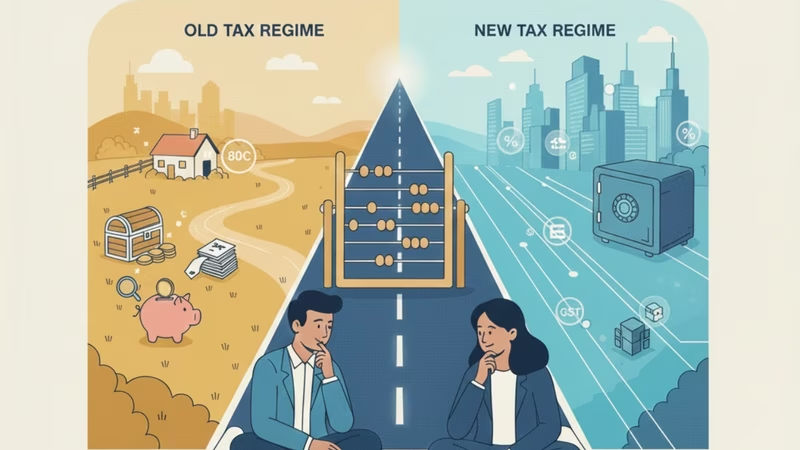
India currently offers two parallel income tax systems:
- Old Tax Regime: Higher tax rates but allows deductions under Sections 80C, 80D, HRA, home loan interest (24(b)), and more.
- New Tax Regime: Lower slab rates but **no major deductions or exemptions**—except standard deduction of ₹50,000 for salaried individuals.
Since FY 2023–24, the new regime has been the **default option** for salaried employees. That means unless you actively opt out, your employer will deduct TDS under the new rules—potentially locking you into a higher liability if you’re eligible for significant exemptions .
When the Old Regime Saves You More (Hint: Rent Matters)
If you live in a metro city and pay high rent, the old regime is almost always better. Why? Because **HRA (House Rent Allowance) exemption** can slash your taxable income dramatically.
For example:
- Annual salary: ₹15 lakh
- HRA received: ₹3.6 lakh
- Rent paid in Mumbai: ₹30,000/month (₹3.6 lakh/year)
Under the old regime, you could claim an HRA exemption of ~₹2.4 lakh. Add ₹1.5 lakh under 80C (PPF, ELSS, etc.) and ₹50,000 under 80D (health insurance)—your taxable income drops to **₹11.6 lakh**, potentially saving you over ₹40,000 in tax compared to the new regime .
When the New Regime Wins (Spoiler: Simplicity Has a Price)
The new regime shines for those with **minimal deductions**—typically younger professionals who:
- Live with parents (no rent/HRA)
- Don’t invest in 80C instruments
- Have no home loan or life insurance premiums
For them, the lower slabs (e.g., 5% up to ₹3 lakh, 10% up to ₹6 lakh) often result in lower tax without any paperwork. But here’s the catch: if you *start* investing mid-year, you might regret not switching regimes earlier.
Step-by-Step: How to Choose the Right Regime
Don’t guess. Calculate. Follow these steps before March 31:
- Estimate your total income (salary, interest, side gigs).
- List all potential deductions: HRA, 80C, 80D, home loan interest, NPS, etc.
- Use the Income Tax Department’s calculator (official portal) to compute liability under both regimes.
- Compare net take-home pay, not just tax numbers.
- Inform your employer by December if you want to switch (to adjust TDS).
Pro tip: Even if you choose the new regime now, you can still **switch to the old regime while filing ITR**—but only if you didn’t claim any new-regime-specific benefits. Planning early avoids last-minute chaos.
Common Misconceptions That Lead to Overpayment
Let’s bust some myths:
- “The new regime is always cheaper.” False—depends on your profile.
- “I can’t switch once my employer deducts TDS.” You can—while filing returns.
- “Standard deduction makes the new regime better for everyone.” Not if your HRA + 80C > ₹50,000.
Many taxpayers assume their CA or employer will “handle it.” But unless you provide your full financial picture, no one can optimize for you.
Plan First, Invest Later: The Golden Rule
The biggest insight from tax experts? **Don’t invest just to save tax**—invest because it aligns with your goals, *then* use it to reduce tax legally.
As the Times of India report emphasizes, “Plan first, invest later” . If you know the old regime saves you ₹70,000, then investing ₹1.5 lakh in ELSS makes sense. But if the new regime is better, that same investment yields no tax benefit—so you might put that money elsewhere.
This strategic shift—from reactive deduction-chasing to proactive regime comparison—is what separates smart taxpayers from the rest. For more on building a tax-efficient portfolio, check out our guide on [INTERNAL_LINK:smart-investing-for-tax-savings].
Conclusion: Don’t Guess—Calculate
The choice between the new vs old tax regime isn’t about trends—it’s about your personal finances. High rent? Stick with the old. Minimal deductions? The new might be your friend. But never assume. Take control, run the numbers, and reclaim every rupee you’re entitled to. In India’s complex tax landscape, planning isn’t optional—it’s your biggest deduction.
Sources
- Times of India: Plan first, invest later: Why choice between new & old tax regimes requires deep planning
- Income Tax Department of India: Official Tax Portal & Calculator
- ClearTax: Comparison of Old vs New Tax Regime