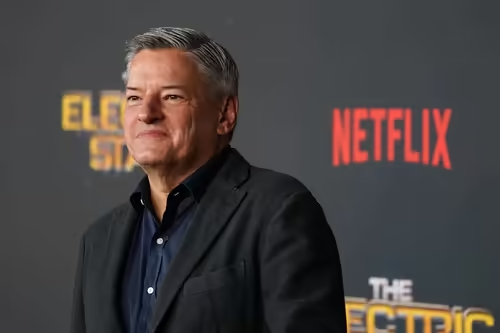
In a strategic masterclass that’s equal parts defense and declaration of war, Netflix co-CEO Ted Sarandos has thrown a curveball at regulators and investors alike. To justify the company’s colossal Netflix Warner Bros deal—a staggering $83 billion play—he’s pointed his finger not at traditional rivals like Disney+ or Max, but at an unexpected adversary: Instagram .
His message is clear: the battle for your eyeballs has moved far beyond the confines of the traditional streaming landscape. The new frontier is the living room TV, and everyone from TikTok to YouTube is charging in. But is this a genuine threat assessment, or a clever narrative to smooth the path for regulatory approval? Let’s dive deep into the strategy, the stakes, and the real competitive landscape of 2026.
Table of Contents
- The $83B Wager: What’s on the Line?
- “Instagram is Coming”: The New Competitive Landscape
- Why Social Media is a Real TV Threat in 2026
- The Regulatory Hurdle and Sarandos’s Defense
- What This Means for the Future of Streaming
- Conclusion
- Sources
The $83B Wager: What’s on the Line?
The proposed acquisition of Warner Bros. Discovery (WBD) is not just another corporate merger; it’s a seismic event designed to reshape the entire entertainment industry. Valued at approximately $72 billion in equity, plus the assumption of around $10.7 billion in debt, the deal would unite two of the most powerful content libraries in the world .
For Netflix, this means gaining instant access to iconic franchises like Harry Potter, DC Comics, Game of Thrones, and a vast catalog of classic films and shows. The goal is simple: achieve unprecedented scale to compete in an increasingly expensive and fragmented market. However, such a massive consolidation of power naturally raises red flags for antitrust regulators who fear it could stifle competition and lead to higher prices for consumers .
Netflix Warner Bros deal and the “Instagram is Coming” Warning
This is where Ted Sarandos’s recent comments become a critical piece of the puzzle. At a UBS investor conference, he didn’t just defend the deal; he redefined the entire battlefield. “TV is not what we grew up on. TV is now just about… the screen in the living room,” he stated, before delivering the now-famous line: “Instagram is coming” .
His argument is that the competition for viewer attention is no longer limited to other subscription video-on-demand (SVOD) services. The true rivals are any platform that can deliver engaging, short-form video content directly to the big screen. This includes:
- Instagram Reels & TikTok: Masters of addictive, algorithm-driven short-form video.
- YouTube: A behemoth offering everything from user-generated content to professional documentaries and live streams.
- Gaming Platforms: Services like Xbox Cloud Gaming and PlayStation Plus are also competing for leisure time.
By painting this broader picture, Sarandos aims to convince regulators that even a combined Netflix-WBD entity would be just one player in a vast and diverse ecosystem, not a monopolistic force .
Why Social Media is a Real TV Threat in 2026
Sarandos’s warning might sound hyperbolic, but the data backs him up. The lines between social media and traditional TV are blurring faster than ever. In 2026, the global video streaming market is expected to serve over 1.4 billion users, a number that continues to grow steadily .
More importantly, the nature of consumption is changing. Short-form and interactive video on platforms like Instagram Reels, YouTube Shorts, and TikTok are dominating user attention spans . These platforms are aggressively optimizing their apps for the big screen, with many smart TVs now featuring dedicated buttons for YouTube and even TikTok. The threat isn’t that Instagram will launch its own HBO competitor; it’s that a user might choose to scroll through Reels on their TV for an hour instead of watching a Netflix series. In the attention economy, that’s a direct loss.
The Regulatory Hurdle and Sarandos’s Defense
The success of the Netflix Warner Bros deal hinges entirely on regulatory approval, a process expected to take 12-18 months . President Trump has already signaled that his antitrust team will scrutinize the deal closely, calling it a potential “problem” .
Sarandos’s “Instagram is coming” narrative is a sophisticated legal and PR strategy. By broadening the definition of the relevant market from “streaming services” to “all digital entertainment on the living room screen,” Netflix argues that its market share is much smaller than it appears. This makes the merger seem less anti-competitive. It’s a classic move in antitrust law, and one that has been used successfully in tech before. Netflix is betting that regulators will see the logic in a world where a teenager’s primary entertainment is a curated feed of 15-second videos, not a weekly episodic drama.
What This Means for the Future of Streaming
If the deal goes through, the streaming landscape will be permanently altered. We can expect:
- Content Arms Race Intensifies: The combined entity will have unparalleled resources to produce and acquire top-tier content, forcing competitors to spend even more.
- Focus on Engagement Metrics: Success will be measured not just by subscribers, but by total watch time and engagement, pushing platforms to adopt more social and interactive features.
- Platform Fragmentation Continues: While Netflix grows larger, the overall market will remain fragmented, with niche services and social platforms carving out their own audiences .
This shift validates the need for platforms to think beyond their core product. For Netflix, it’s a justification for its massive acquisition. For everyone else, it’s a wake-up call that the competition is coming from all directions.
Conclusion
Ted Sarandos’s warning about Instagram is more than just a soundbite; it’s a fundamental truth about the modern media landscape. The Netflix Warner Bros deal is a high-stakes gamble to secure dominance in a world where the definition of “TV” is constantly evolving. Whether this narrative is enough to win over skeptical regulators remains to be seen, but one thing is certain: the future of entertainment is not just about who has the best shows, but who can best capture and hold our fleeting attention in an ocean of digital noise. The streaming wars have entered a new, more complex phase, and the battle lines are being drawn on our living room screens.
Sources
- Times of India: After ‘Google reason’ to buy Warner Bros, Netflix co-CEO Ted Sarandos now warns ‘Instagram is coming’ as he…
- Variety: Netflix Warns that Instagram is Coming to TVs in Defense of Warner Bros. Deal
- The Hollywood Reporter: Netflix’s $82.7 Billion Warner Bros. Acquisition: What It Includes, What It Doesn’t and What’s Next [[4], [20]]
- Bloomberg: Ted Sarandos: Netflix Has ‘Made Progress’ Getting Regulatory Approvals for WBD Acquisition
- Statista: Video Streaming Statistics 2026