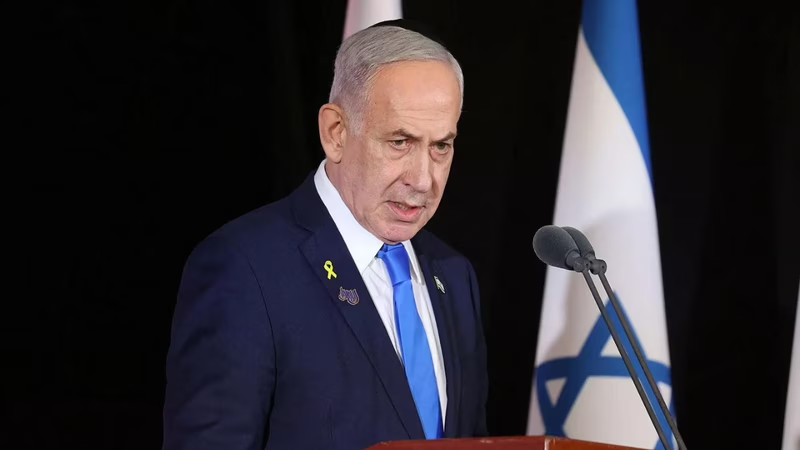
From the corridors of power in Jerusalem to the smoke-filled streets of Tehran, a new chapter in Middle Eastern geopolitics is unfolding. Israeli Prime Minister Benjamin Netanyahu has issued a striking declaration: Iran, he insists, will “soon be freed of tyranny.” Speaking amid the third week of widespread civil unrest in Iran, Netanyahu not only confirmed that Israel is “closely monitoring” the situation but also openly extended moral and political support to the protesters risking their lives on the frontlines . This rare public alignment with Iranian citizens—rather than just opposition groups—marks a significant shift in Israel’s rhetorical strategy and underscores the high stakes of the ongoing Iran protests.
Table of Contents
- Netanyahu’s Bold Statement: Decoding the Message
- The Current State of Iran Protests
- Why Israel Cares: The Strategic Stakes
- International Reactions and Diplomatic Fallout
- Historical Context: Iran-Israel Enmity
- Conclusion: A Region on the Brink
- Sources
Netanyahu’s Bold Statement: Decoding the Message
Netanyahu’s phrase—“soon be freed of tyranny”—is loaded with both hope and provocation. On one level, it’s a show of solidarity with ordinary Iranians demanding freedom from an authoritarian regime. On another, it’s a calculated geopolitical signal. By framing the protests as a legitimate popular uprising against oppression, Netanyahu positions Israel not as an enemy of Iran, but as an ally of its people—a narrative designed to isolate the Islamic Republic’s leadership on the global stage.
Critically, his statement avoids calling for direct regime change by external forces. Instead, he emphasizes internal transformation: “The Iranian people are rising,” he said, “and their courage will not be in vain” . This careful wording allows Israel to support the movement without appearing to interfere—a crucial distinction in a region hypersensitive to foreign intervention.
The Current State of Iran Protests
The Iran protests now entering their third week have evolved from localized economic grievances into a nationwide call for systemic change. Sparked by issues like inflation, unemployment, and water shortages, the demonstrations have increasingly targeted the very foundations of the clerical regime—chanting slogans against Supreme Leader Ayatollah Khamenei and demanding democratic reforms .
Despite a brutal crackdown involving internet blackouts, mass arrests, and reports of live ammunition being used against civilians, the protests show no signs of abating. Women, youth, and workers from diverse provinces—including traditionally conservative strongholds—are joining the movement, signaling a potential turning point in Iran’s post-revolutionary history.
Why Israel Cares: The Strategic Stakes
Israel’s interest in Iran’s internal stability isn’t merely humanitarian—it’s existential. For decades, the Islamic Republic has positioned itself as Israel’s chief regional adversary, funding and arming proxy militias like Hezbollah in Lebanon and Hamas in Gaza. A weakened or reformed Iran could dramatically alter this threat landscape.
Key strategic implications include:
- Nuclear Program: A regime distracted by internal chaos may slow its uranium enrichment efforts—or conversely, accelerate them as a show of strength.
- Proxy Warfare: Reduced state capacity could limit Iran’s ability to fund and coordinate attacks via its regional proxies.
- Regional Alliances: Arab states like Saudi Arabia and the UAE, already engaging in backchannel talks with Israel, may see a historic opportunity to reshape Middle Eastern security architecture [[INTERNAL_LINK:abraham-accords-impact]].
International Reactions and Diplomatic Fallout
Netanyahu’s comments have drawn mixed responses globally. Western democracies, including the U.S. and EU nations, have expressed cautious support for the protesters’ right to peaceful assembly but stopped short of endorsing regime change—fearing unintended consequences akin to the Iraq War. Meanwhile, Tehran reacted furiously, accusing Israel of “psychological warfare” and attempting to “exploit internal issues for propaganda” .
Notably, even traditional U.S. allies in the region are treading carefully. While sympathetic to the protesters, Gulf states are wary of outright backing a movement that could lead to chaos—or worse, a power vacuum filled by extremist factions.
Historical Context: Iran-Israel Enmity
The animosity between Iran and Israel didn’t always exist. Before the 1979 Islamic Revolution, the two nations maintained cordial relations under the Shah. But the revolution ushered in a theocratic regime that made anti-Zionism a cornerstone of its identity. Since then, Iran has repeatedly called for Israel’s destruction, while Israel has conducted covert operations—including cyberattacks and assassinations—to disrupt Iran’s nuclear and military programs .
Netanyahu’s current stance must be understood against this backdrop. His support for the protesters isn’t just about morality; it’s the latest front in a decades-long shadow war.
Conclusion: A Region on the Brink
As the Iran protests continue to challenge the regime’s grip on power, Netanyahu’s declaration that tyranny’s end is near reflects both optimism and strategic calculation. Whether this moment leads to genuine reform, violent suppression, or prolonged instability remains uncertain. But one thing is clear: the fate of Iran is no longer just an internal matter. It’s a flashpoint that could redefine alliances, redraw security lines, and determine the future of peace—or conflict—in the entire Middle East. The world watches, holding its breath.
Sources
- Times of India. “‘Soon be freed of tyranny’: Netanyahu says closely monitoring Iran; extends support to protesters.” https://timesofindia.indiatimes.com/world/rest-of-world/soon-be-freed-of-tyranny-netanyahu-says-closely-monitoring-iran-extends-support-to-protesters/articleshow/126467590.cms
- Reuters. “Iran protests enter third week with growing calls for regime change.” (January 2026)
- IRNA (Islamic Republic News Agency). “Iran condemns Israeli ‘interference’ in domestic affairs.”
- Council on Foreign Relations. “Iran-Israel Relations: A Timeline of Hostility.” https://www.cfr.org/backgrounder/iran-israel-relations