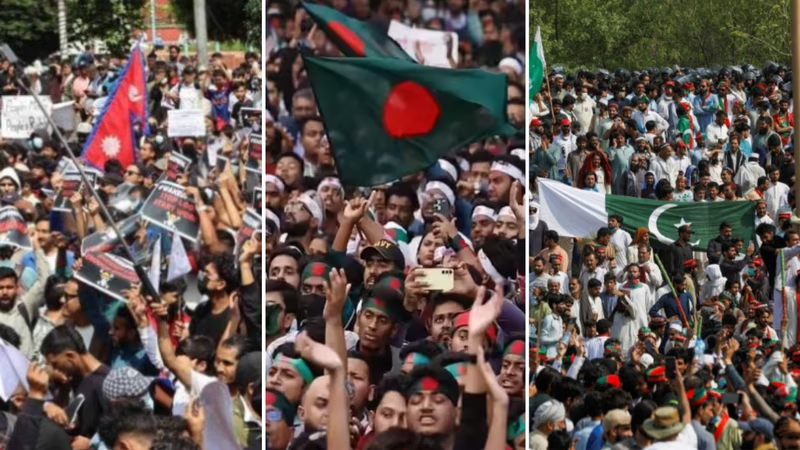
For nearly a decade, India’s ‘Neighbourhood First’ policy has served as the bedrock of its foreign strategy—prioritizing stronger economic, cultural, and security ties with South Asian nations over distant global powers. But in 2026, this doctrine is heading into its most volatile and consequential phase yet. With simultaneous political upheavals in Bangladesh, Pakistan, and Nepal, New Delhi faces a high-stakes trilemma that could redefine its role in the region—and determine whether ‘Neighbourhood First’ remains a principle or becomes a casualty of realpolitik.
The stakes couldn’t be higher. From democratic backsliding in Dhaka and terror threats from Islamabad to constitutional crises in Kathmandu, India’s immediate neighborhood is fracturing along multiple fault lines. How Prime Minister Narendra Modi’s government navigates this perfect storm will not only shape regional stability but also signal whether India can truly lead South Asia in an era of rising Chinese influence and global uncertainty. At the center of it all? The resilience of India’s Neighbourhood First policy.
Table of Contents
- What Is India’s Neighbourhood First Policy?
- Neighbourhood First Policy Under Pressure in 2026
- Bangladesh: Democratic Erosion and India’s Dilemma
- Pakistan: Security Threats and Diplomatic Stalemate
- Nepal: Constitutional Crisis and China’s Shadow
- Can India Balance Principles and Pragmatism?
- Conclusion: The Future of South Asian Leadership
- Sources
What Is India’s Neighbourhood First Policy?
Launched in 2014, the Neighbourhood First policy reflects India’s recognition that its security, economic growth, and global stature depend on stable, cooperative relationships with its immediate neighbors—Afghanistan, Bangladesh, Bhutan, Maldives, Myanmar, Nepal, Pakistan, and Sri Lanka.
Key pillars include:
- Enhanced connectivity (roads, rail, power grids)
- Development aid and disaster relief
- People-to-people ties through cultural and educational exchanges
- Security cooperation against terrorism and extremism
While initially met with enthusiasm, the policy has faced headwinds—from the 2015 Nepal blockade fallout to Pakistan’s persistent hostility. Now, in 2026, all three critical relationships—Bangladesh, Pakistan, and Nepal—are entering dangerous new phases.
Neighbourhood First Policy Under Pressure in 2026
2026 is not a random year. It coincides with scheduled elections, leadership transitions, and geopolitical realignments across South Asia—creating a convergence of risk that demands urgent, coordinated Indian diplomacy.
Bangladesh: Democratic Erosion and India’s Dilemma
Once hailed as a model of India-Bangladesh cooperation—marked by land boundary agreements, energy partnerships, and counter-terrorism coordination—the relationship is now strained. Prime Minister Sheikh Hasina’s government has grown increasingly authoritarian, jailing opposition leaders and curtailing press freedom.
India faces a tough choice: publicly criticize democratic backsliding (risking bilateral ties) or stay silent (undermining its own democratic credentials). Complicating matters, China is deepening infrastructure investments in Bangladesh, offering Dhaka an alternative patron. If Bangladesh drifts toward Beijing, India’s eastern flank becomes vulnerable.
Pakistan: Security Threats and Diplomatic Stalemate
Pakistan remains the toughest test of the Neighbourhood First policy. Despite occasional backchannel talks, formal ties remain frozen since the 2019 abrogation of Article 370 in Jammu & Kashmir. In 2026, Pakistan’s internal instability—a weak economy, military-civilian tensions, and rising extremist activity—could spill over into India.
Indian security agencies warn of increased proxy terror attempts via the Line of Control. Yet, isolating Pakistan entirely may push it deeper into China’s orbit. The dilemma: engage a hostile neighbor for regional stability, or maintain strategic distance at the cost of long-term peace?
Nepal: Constitutional Crisis and China’s Shadow
Nepal, long considered India’s closest ally in the Himalayas, is drifting. A proposed constitutional amendment to redraw provincial boundaries has reignited Madhesi unrest, while Kathmandu’s growing reliance on Chinese infrastructure loans threatens India’s traditional influence.
In 2026, Nepal will likely hold local elections amid this turmoil. If Beijing-backed factions gain ground, critical Himalayan corridors could shift away from Indian strategic interests. India’s past missteps—like the perceived 2015 blockade—still fuel anti-India sentiment, making soft-power outreach harder.
Can India Balance Principles and Pragmatism?
Experts argue that the Neighbourhood First policy must evolve beyond goodwill gestures. As Dr. Happymon Jacob, founder of the Council for Strategic and Defense Research, notes, “India needs calibrated engagement—not moralizing, not appeasement.”
Potential strategies include:
- Issue-based coalitions: Partner with like-minded neighbors on climate, trade, or health—without demanding political alignment.
- Rapid-response diplomacy: Pre-empt crises with high-level envoys before they escalate.
- Economic resilience packages: Offer concessional credit lines to counter Chinese debt traps.
For more on regional dynamics, see our analysis on India-China rivalry in South Asia.
Conclusion: The Future of South Asian Leadership
The year 2026 will be a defining moment for India’s Neighbourhood First policy. If New Delhi can navigate the Bangladesh-Pakistan-Nepal trilemma with nuance, consistency, and strategic generosity, it may emerge as South Asia’s indispensable leader. But if it falters—through overreach, neglect, or inconsistency—the vacuum will be swiftly filled by others. In the high-stakes game of regional influence, 2026 isn’t just a test—it’s the final exam.
Sources
- Times of India. “Explained: Why India’s ‘Neighbourhood First’ policy is about to face its greatest test in 2026.” https://timesofindia.indiatimes.com/world/explained-why-indias-neighbourhood-first-policy-is-about-to-face-its-greatest-test-in-2026-bangladesh-pakistan-and-nepal/articleshow/126232374.cms
- Ministry of External Affairs, Government of India. “Neighbourhood First Policy Framework.” https://www.mea.gov.in
- International Crisis Group. “South Asia Regional Outlook 2026.” https://www.crisisgroup.org
- Carnegie India. “Reimagining India’s Neighbourhood Policy.” https://carnegieindia.org
- World Bank. “Economic Outlook for South Asia 2026.” https://www.worldbank.org