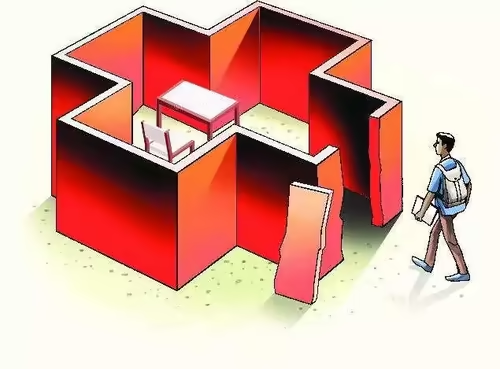
Something is deeply wrong with India’s most critical gateway to postgraduate medical education. The NEET PG 2025 cut-off crash—where qualifying scores plummeted to unprecedented lows—hasn’t just confused candidates; it’s triggered a full-blown crisis of confidence in the entire system. Resident doctors’ associations are now calling it not an admission process, but a “lottery,” accusing authorities of institutional collapse .
This isn’t just about numbers on a screen. It’s about the erosion of merit, the betrayal of years of grueling preparation, and the potential long-term damage to India’s healthcare system. When eligibility becomes decoupled from actual performance, who really suffers? The answer: every patient who will one day walk into a hospital.
Table of Contents
- What Happened? The NEET PG 2025 Cut-Off Crash Explained
- Symptoms of a Broken System: Opaque Processes & Arbitrary Actions
- Why the NEET PG 2025 Cut-Off Crash Matters for Indian Healthcare
- Resident Doctors Speak Out: A Crisis of Trust
- Comparing the Numbers: How Low Did the Cut-Off Go?
- What Needs to Change: Rebuilding a Merit-Based System
- Conclusion: Not an Admission, But a Lottery
- Sources
What Happened? The NEET PG 2025 Cut-Off Crash Explained
The National Eligibility cum Entrance Test for Postgraduate courses (NEET PG) is meant to be the gold standard for selecting India’s next generation of specialist doctors. But in 2025, the qualifying threshold—the minimum score needed to be eligible for counseling—crashed to shockingly low levels.
For context, in previous years, the general category cut-off hovered around the 50th percentile. In 2025, reports indicate it dropped dramatically, with some sources suggesting it fell below the 30th percentile . This means candidates who scored in the bottom third of all test-takers are now eligible for coveted PG seats—a direct contradiction of the exam’s purpose as a merit filter.
Symptoms of a Broken System: Opaque Processes & Arbitrary Actions
The cut-off crash is just the tip of the iceberg. Behind it lies a cascade of governance failures that have left candidates and professionals alike furious:
- Opaque Result Declaration: The National Board of Examinations in Medical Sciences (NBEMS) provided no clear rationale for the drastic cut-off change, leaving candidates in the dark.
- Arbitrary Disqualifications: Numerous high-scoring candidates were reportedly disqualified on technicalities or unclear grounds, with little avenue for appeal .
- Lack of Transparency: The normalization process and scoring methodology remain poorly explained, fueling suspicion of errors or manipulation.
- Institutional Silence: Despite widespread outcry, there has been minimal official communication from the National Medical Commission (NMC) or NBEMS to address concerns.
This lack of accountability has created a perception that the system is not just flawed, but actively rigged against genuine merit.
Why the NEET PG 2025 Cut-Off Crash Matters for Indian Healthcare
This controversy goes far beyond the frustration of a few thousand aspirants. It strikes at the heart of India’s public health future. [INTERNAL_LINK:india-doctor-shortage] When PG admissions are perceived as arbitrary or based on anything other than rigorous merit, it devalues the entire medical profession.
Specialist doctors handle the most complex cases in our hospitals. If their selection is compromised, patient outcomes will inevitably suffer. Furthermore, this crisis demoralizes current resident doctors—the backbone of hospital care—who see their hard work and dedication being undermined by a system that no longer seems to reward excellence.
Resident Doctors Speak Out: A Crisis of Trust
Organizations like the Federation of Resident Doctors’ Association (FORDA) have been vocal in their condemnation. They’ve labeled the current state of affairs as an “institutional collapse” and argue that the link between eligibility and actual performance has been severed .
One FORDA representative starkly summarized the sentiment: “This isn’t admission, it’s a lottery.” This powerful statement captures the collective despair of a generation of medical professionals who entered the field believing in a system of fairness and merit, only to find it crumbling before their eyes.
Comparing the Numbers: How Low Did the Cut-Off Go?
To understand the scale of the anomaly, consider this comparison:
| Year | General Category Cut-Off (Percentile) | Approx. Marks (Out of 800) |
|---|---|---|
| 2024 | 50th | ~290 |
| 2025 (Reported) | <30th | <200 |
A drop of this magnitude in a single year is statistically improbable without a fundamental change in either the exam’s difficulty or the evaluation process—neither of which has been officially acknowledged or explained.
What Needs to Change: Rebuilding a Merit-Based System
Restoring trust requires more than just a press release. It demands concrete, transparent action:
- Independent Audit: An impartial committee must review the entire NEET PG 2025 process, from question paper setting to result declaration.
- Transparent Communication: NBEMS and NMC must publish detailed reports on normalization, cut-off calculation, and disqualification criteria.
- Robust Grievance Redressal: A clear, accessible, and timely appeals process for disqualified candidates is non-negotiable.
- Stakeholder Involvement: Future policy decisions must include input from resident doctors, medical educators, and student representatives.
Without these steps, the integrity of India’s medical education system will continue to erode.
Conclusion: Not an Admission, But a Lottery
The NEET PG 2025 cut-off crash is a watershed moment. It’s exposed a system where opacity, arbitrary decisions, and a lack of accountability have replaced the principles of fairness and merit. For the sake of India’s future doctors and the millions of patients who depend on them, this cannot be allowed to stand. The medical community’s demand is clear: fix the system, or risk losing an entire generation’s faith in it.
Sources
- Times of India: ‘This isn’t admission, it’s a lottery’: FORDA on NEET PG 2025 cut-off crash
- National Board of Examinations in Medical Sciences (NBEMS): Official Website
- National Medical Commission (NMC): Official Website
- World Health Organization (WHO) on Health Workforce: Global Strategy on Human Resources for Health