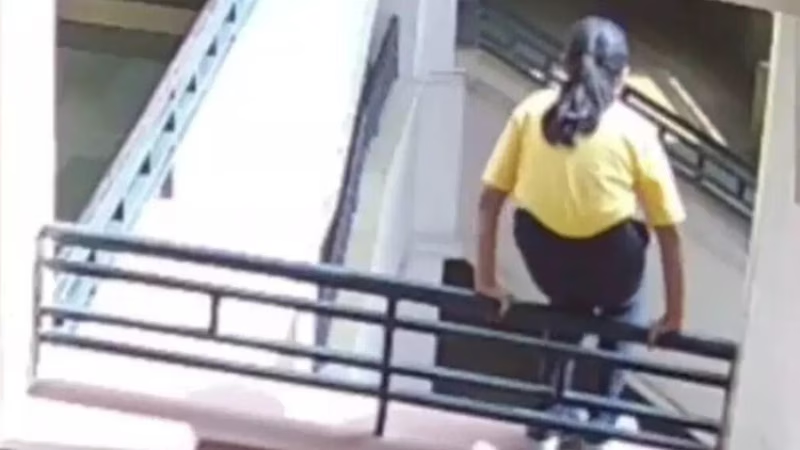
In a historic and sobering decision, the Central Board of Secondary Education (CBSE) has permanently withdrawn the affiliation of Neerja Modi School in Jaipur—up to the senior secondary level—following the death of a 9-year-old Class 9 student earlier this year. The board’s investigation uncovered what it described as “gross violations of child safety norms” and a “complete failure” of the school’s duty of care.
This isn’t just a bureaucratic penalty—it’s a damning indictment of a system that was supposed to protect one of its most vulnerable members. The case has reignited a nationwide conversation about accountability, mental health support in schools, and whether India’s educational institutions are truly safe spaces for children.
Here’s everything you need to know: what happened, why the CBSE took such a rare and severe step, and what parents, educators, and policymakers must do next to prevent another tragedy.
Table of Contents
- What Happened at Neerja Modi School?
- CBSE’s Investigation and Shocking Findings
- Why Affiliation Revocation Is Unprecedented
- Child Safety Norms Every School Must Follow
- Warning Signs Parents Should Never Ignore
- What This Case Means for Indian Education
What Happened at Neerja Modi School?
In early 2025, a 9-year-old student (misreported initially as Class 9 but later clarified to be younger, enrolled in upper primary) died by suicide under circumstances that immediately raised red flags. According to initial police and family accounts, the child had been subjected to persistent emotional distress, allegedly linked to in-school pressures and a lack of accessible support.
Despite repeated informal complaints from the family about the child’s deteriorating mental state, the school reportedly failed to activate its mandated counselling or child protection mechanisms. There was no documented intervention—no meeting with the designated counsellor, no escalation to the Internal Complaints Committee (ICC), and no follow-up with parents beyond perfunctory responses.
CBSE’s Investigation and Shocking Findings
Following public outcry, the CBSE launched an urgent inquiry under its Child Protection Policy and Affiliation Bye-Laws. The probe, conducted by an independent committee, revealed systemic failures:
- No functional counselling cell: The school had a counsellor on paper, but records showed no sessions conducted with students in distress over the past 18 months.
- Grievance redressal system was non-existent: The mandated Child Protection Officer (CPO) was unaware of their duties.
- Failure to implement POCSO protocols: Staff had not received mandatory child safety training since 2022.
- Toxic environment: Multiple students reported fear of speaking up due to punitive academic culture.
The CBSE concluded that the school had created an “unsafe and non-supportive environment,” directly violating Clause 13.2 of its affiliation guidelines, which mandates a “child-friendly and inclusive atmosphere.”
Why Affiliation Revocation Is Unprecedented
CBSE rarely revokes affiliation—especially for large, established institutions like Neerja Modi School, part of a well-known educational chain. Most penalties involve warnings, fines, or temporary probation.
This decision signals a major policy shift. As noted by education policy expert Dr. Anjali Sharma in a recent NCERT discussion paper, “The board is finally treating child safety not as an add-on, but as a non-negotiable condition for operation.”
Child Safety Norms Every School Must Follow
Under CBSE and national guidelines, all affiliated schools must implement:
- A trained **Child Protection Officer (CPO)** and **counsellor** available daily.
- Regular **POCSO and mental health training** for all staff (at least annually).
- A functional **grievance redressal cell** with a 72-hour response protocol.
- Clear, child-friendly **reporting channels** (e.g., suggestion boxes, anonymous helplines).
- Mandatory **parent workshops** on emotional well-being and digital safety.
For a full checklist, see our guide [INTERNAL_LINK:how-to-check-if-your-childs-school-is-safe].
Warning Signs Parents Should Never Ignore
If your child shows any of these, act immediately:
- Sudden reluctance to go to school
- Withdrawal, mood swings, or sleep disturbances
- Unexplained bruises or damaged belongings
- References to “no one cares” or “I can’t take it anymore”
Don’t assume it’s “just stress.” Document everything and formally request a meeting with the school’s CPO or principal—get it in writing.
What This Case Means for Indian Education
The Neerja Modi School case is a wake-up call. For too long, academic performance has overshadowed emotional well-being in India’s education system. But a school that can’t keep a child safe has failed its most basic mission.
Going forward, expect stricter CBSE audits, mandatory third-party safety certifications, and greater parental involvement in school governance. This tragedy must become the catalyst for systemic change—not just a headline.
Conclusion: Safety Is Not Optional
The revocation of Neerja Modi School’s CBSE affiliation is more than a punishment—it’s a declaration that child safety is non-negotiable. As parents, educators, and citizens, we must demand environments where every child feels seen, heard, and protected. Because no grade, trophy, or reputation is worth a single young life.
Sources
- Times of India: “Neerja Modi School suicide case: CBSE cites gross violations”
- CBSE Official: Child Protection Policy Guidelines
- National Council of Educational Research and Training (NCERT) – School Safety Framework
- POCSO Act, 2012 – Ministry of Women & Child Development