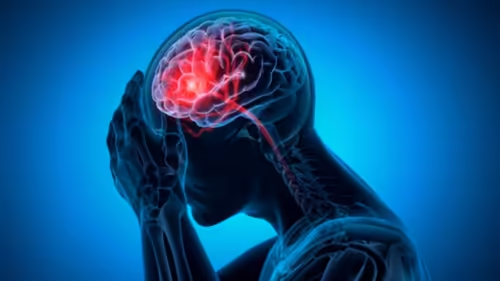
Imagine this: your partner complains of a stiff neck, nothing too unusual, right? But within minutes, they’re struggling to speak, their face is drooping, and they can’t lift an arm. This isn’t a scene from a medical drama—it’s the terrifying reality that unfolded for a Mumbai family. Their story is a stark, urgent lesson for everyone: sometimes, neck pain is far more than just a nuisance; it can be the first alarm bell of a catastrophic stroke.
Table of Contents
- The Mumbai Miracle: A Stroke Survival Story
- Why Neck Pain Can Be a Silent Stroke Killer
- Recognizing the Real Signs of a Stroke (Beyond Neck Pain)
- The Life-Saving Procedure: Mechanical Thrombectomy Explained
- What To Do If You Suspect a Stroke: Your Action Plan
- Conclusion: Don’t Ignore the Warning Signs
- Sources
The Mumbai Miracle: A Stroke Survival Story
In a remarkable case reported by the Times of India, a Mumbai man’s life was saved by a perfect storm of quick thinking, medical expertise, and cutting-edge science . It all began with what seemed like an ordinary complaint: neck pain. But his wife noticed something was terribly wrong when he started showing classic signs of a neurological emergency. Her immediate decision to rush him to the hospital proved to be the single most critical factor in his survival.
The medical team at the hospital acted with incredible speed, getting him into the procedure room within the golden window of just 20 minutes. This rapid response allowed them to perform a mechanical thrombectomy, a minimally invasive surgery to remove the blood clot blocking a major artery in his brain. The result? Blood flow was restored, his severe symptoms reversed, and he was given a second chance at life.
Why Neck Pain Can Be a Silent Stroke Killer
Most of us associate neck pain with poor posture, sleeping awkwardly, or stress. However, in rare but dangerous cases, it can signal a tear in one of the arteries in your neck—the carotid or vertebral arteries. This condition, known as a cervical artery dissection, can cause a blood clot to form. If that clot breaks loose and travels to the brain, it triggers an ischemic stroke, which accounts for about 87% of all strokes .
This connection is why any sudden, severe, or unusual neck pain—especially if it’s accompanied by a headache, dizziness, or other neurological symptoms—should never be ignored. It’s not just a muscle strain; it could be your body’s final warning before a major neurological event.
Recognizing the Real Signs of a Stroke (Beyond Neck Pain)
While neck pain can be a precursor, the definitive signs of a stroke are often more dramatic and require immediate action. The easiest way to remember them is with the acronym FAST :
- F – Face Drooping: Does one side of the face droop or feel numb? Ask the person to smile.
- A – Arm Weakness: Is one arm weak or numb? Ask the person to raise both arms. Does one drift downward?
- S – Speech Difficulty: Is their speech slurred, strange, or impossible? Ask them to repeat a simple sentence.
- T – Time to Call Emergency Services: If you see ANY of these signs, call for an ambulance immediately. Every second counts.
Some experts now recommend the updated BE-FAST acronym, which adds two more critical signs: B for a sudden loss of Balance and <E for blurred or double Eyesight . Being aware of these expanded symptoms can help catch a stroke even earlier.
The Life-Saving Procedure: Mechanical Thrombectomy Explained
The hero of the Mumbai man’s story was a procedure called a mechanical thrombectomy. This is a revolutionary endovascular technique where a neurointerventionalist threads a thin catheter through an artery in the groin all the way up to the blocked vessel in the brain . Using specialized tools under X-ray guidance, the doctor can then physically grab and remove the clot .
This procedure has dramatically changed the game for stroke treatment, especially for large vessel occlusions. Studies show it can significantly reduce disability and death rates compared to traditional drug-only therapies . Its success hinges entirely on speed—getting the patient to a capable hospital within the critical few hours after symptom onset is paramount.
What To Do If You Suspect a Stroke: Your Action Plan
If you or someone you’re with shows any signs of a stroke, follow these steps without hesitation:
- Call an ambulance immediately. Do not drive the person yourself. Paramedics can begin life-saving care en route.
- Note the exact time when the first symptom appeared. This information is crucial for doctors to determine the best treatment.
- Keep the person calm and still. Lay them on their side with their head slightly elevated if they are conscious.
- Do NOT give them anything to eat or drink, as they may have difficulty swallowing.
For those in India, knowing which hospitals in your city offer advanced stroke care, including mechanical thrombectomy, can be a vital piece of preparation. [INTERNAL_LINK:best-hospitals-for-stroke-treatment-in-india]
Conclusion: Don’t Ignore the Warning Signs
The story from Mumbai is more than just a medical marvel; it’s a public service announcement written in real life. It teaches us that seemingly benign symptoms like neck pain can mask a deadly threat. By understanding the FAST signs of a stroke and acting with lightning speed, you can be the hero in your own family’s story. Remember, in the world of stroke care, time is brain. Don’t wait. Don’t downplay it. Act fast.
Sources
- Times of India. “Stroke alert: How speed, skill, and science saved Mumbai man from a major stroke, triggered by common neck pain.” https://timesofindia.indiatimes.com/…
- National Heart, Lung, and Blood Institute (NHLBI). “Stroke – Symptoms.” https://www.nhlbi.nih.gov/health/stroke/symptoms
- American Stroke Association. “F.A.S.T. (Stroke).” https://www.stroke.org/en/about-stroke/stroke-symptoms
- StatPearls – NCBI Bookshelf. “Thrombectomy.” https://www.ncbi.nlm.nih.gov/books/NBK557545/