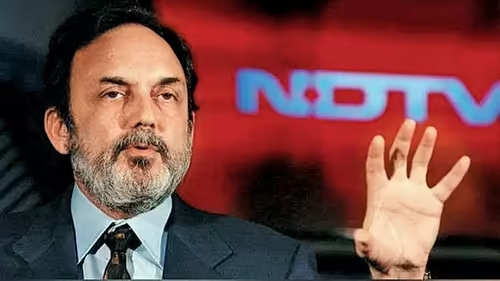
In a scathing rebuke to the Income Tax Department, the Delhi High Court has not only quashed a series of tax notices issued to NDTV founders Prannoy Roy and Radhika Roy but also imposed a hefty ₹2 lakh cost on the department for what it described as a clear case of “harassment” and “abuse of legal process.” The ruling, delivered this week, marks a significant moment in the long-standing legal tussle between India’s pioneering private news network and tax authorities.
The court’s strong language—calling the notices “baseless,” “mechanical,” and “without jurisdiction”—has reignited debates about the potential misuse of investigative agencies against media houses and dissenting voices. For years, the Roys have maintained that they were being unfairly targeted, and this judgment appears to validate their claims. This article unpacks the legal nuances, the court’s reasoning, and what this means for press freedom and administrative accountability in India.
Table of Contents
- Background: The Long Legal Battle Over NDTV Founders I-T Notices
- Delhi High Court’s Key Rulings and Strong Observations
- Why the Income Tax Notices Were Legally Flawed
- Broader Implications for Media Freedom and State Power
- What Happens Next for the Roys and the I-T Department?
- Conclusion: A Landmark Check on Administrative Overreach
- Sources
Background: The Long Legal Battle Over NDTV Founders I-T Notices
The controversy stems from a series of income tax notices issued to Prannoy and Radhika Roy over alleged discrepancies in their tax returns dating back several years. The I-T Department had initiated scrutiny proceedings under various sections of the Income Tax Act, demanding explanations and documents related to their personal finances and shareholding in NDTV.
The Roys challenged these notices in the Delhi High Court, arguing that the department was acting beyond its jurisdiction, re-opening matters already settled in prior assessments, and using repetitive, boilerplate allegations without fresh evidence. They contended that this was not a genuine tax inquiry but a form of institutional harassment aimed at intimidating them—a claim that has gained traction among press freedom advocates .
Delhi High Court’s Key Rulings and Strong Observations
Justice Amit Bansal, in a strongly worded order, did not mince words. He observed that the notices were “issued mechanically without application of mind” and constituted an “abuse of the process of law.” The court noted that many of the issues raised by the department had already been examined and closed in earlier assessment years, making the new notices legally unsustainable.
“The department cannot keep harassing assessees by issuing repetitive notices on the same set of facts,” the judge stated, emphasizing that such actions undermine public trust in governance .
Critically, the court held that the I-T Department failed to establish any “live link” or new material to justify reopening old cases. As a deterrent against such conduct, the bench imposed a cost of ₹2 lakh—₹1 lakh each on the department for the notices issued to Prannoy and Radhika Roy—and directed that the amount be deposited with the Delhi High Court Mediation and Conciliation Centre within four weeks.
Why the Income Tax Notices Were Legally Flawed
From a legal standpoint, the court’s decision rests on well-established principles of tax jurisprudence:
- Doctrine of Finality: Once an assessment is completed and not appealed, it attains finality. Reopening it without fresh, tangible evidence is impermissible.
- Res Judicata: Matters already decided cannot be litigated again between the same parties.
- Abuse of Process: Using legal machinery not for genuine inquiry but to exert pressure is a recognized ground for judicial intervention.
According to senior tax lawyer Aman Mathur, “This judgment reinforces that the I-T Department is not above the law. It must act with reason, not repetition.” The ruling aligns with previous Supreme Court decisions that have cautioned against using tax probes as tools of persecution .
Broader Implications for Media Freedom and State Power
Beyond the legal technicalities, this case has ignited a wider conversation about the relationship between independent media and state institutions in India. NDTV, co-founded by the Roys in 1988, has often been critical of government policies, leading to speculation that its editorial stance may have triggered administrative scrutiny.
International watchdogs like Committee to Protect Journalists (CPJ) have previously flagged concerns about regulatory pressure on Indian media. While the government denies any political motivation, judgments like this one lend credence to claims of systemic targeting.
As [INTERNAL_LINK:media-freedom-in-india-report] highlights, India’s press freedom ranking has declined in recent years, with legal and financial investigations frequently cited as indirect censorship tools.
What Happens Next for the Roys and the I-T Department?
With the notices quashed, the immediate legal threat to the Roys has subsided. However, the I-T Department could still appeal the decision in the Supreme Court, though legal experts consider this unlikely given the strength of the High Court’s reasoning.
For the Roys, this verdict is more than just a legal win—it’s a vindication of their decade-long fight against what they describe as “relentless bureaucratic siege.” It also sets a precedent that could empower other individuals and entities facing similar repetitive tax notices.
Conclusion: A Landmark Check on Administrative Overreach
The Delhi High Court’s decision to quash the NDTV founders I-T notices is a powerful reminder that no institution, not even the mighty tax department, is above due process. By imposing costs and using unequivocal language, the court has sent a clear message: administrative power must be exercised responsibly, not weaponized. In an era where legal processes are often blurred with political agendas, this judgment stands as a crucial safeguard for citizens’ rights and democratic accountability.
Sources
- Times of India: HC bins I-T notices to NDTV founders, imposes ₹2L cost
- Live Law: Delhi HC Quashes I-T Notices Against NDTV Founders, Imposes Costs
- Supreme Court of India: Judgments on Abuse of Process in Tax Matters
- Committee to Protect Journalists (CPJ): India’s Press Freedom Challenges – 2025 Report