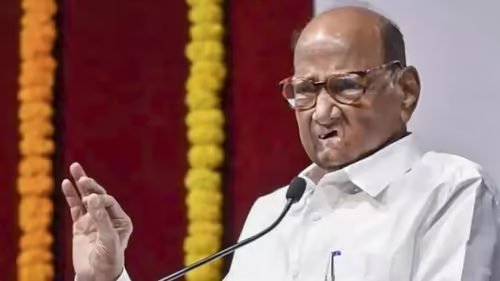
In a revelation that could reshape Maharashtra’s political landscape, veteran statesman Sharad Pawar has dropped a bombshell: the long-rumored reunification of the two Nationalist Congress Party (NCP) factions was not just speculation—it was an active, advanced process that came heartbreakingly close to fruition before the sudden death of his nephew, Ajit Pawar.
Speaking candidly in a recent interview, Pawar confirmed that both sides had engaged in serious NCP merger talks with the shared goal of healing the 2019 split. “Unfortunately, Ajit left us before that,” he said, his voice heavy with emotion, suggesting the reunion was something his nephew deeply desired [[3]].
But that’s not all. Pawar also forcefully dismissed rumors that his daughter, Sunetra Pawar, was being considered for the post of Deputy Chief Minister of Maharashtra—a claim that had been circulating in political circles. “I am not even aware,” he stated bluntly, adding that such decisions are now made in Mumbai without his consultation [[3]].
Table of Contents
- The NCP Split: A Brief History
- Advanced Merger Talks Before Ajit’s Death
- Sunetra Pawar Deputy CM Rumors Denied
- Sharad Pawar’s Current Political Stance
- What This Means for Maharashtra’s Future
- Sources
The NCP Split: A Brief History
The NCP, founded by Sharad Pawar in 1999 after breaking away from the Congress, stood as a symbol of Maratha leadership and secular politics for decades. But in July 2019, the party fractured dramatically when Ajit Pawar—then seen as Sharad’s political heir—staged a surprise midnight swearing-in as Deputy CM alongside the BJP-led Devendra Fadnavis government.
Though the government collapsed within days, the damage was done. Ajit eventually reconciled with the BJP-Shiv Sena alliance in 2023, taking oath again as Deputy CM under Eknath Shinde, while Sharad Pawar aligned with the opposition Maha Vikas Aghadi (MVA)—comprising Shiv Sena (UBT), Congress, and his own NCP faction.
Since then, whispers of a family and political reunion have persisted, especially as both leaders aged and public sentiment favored unity.
Advanced Merger Talks Before Ajit’s Death
Sharad Pawar’s latest comments confirm what many insiders suspected: behind closed doors, efforts to bridge the divide were gaining serious traction. “We had spoken… it was progressing,” he hinted, stopping short of naming intermediaries but emphasizing that Ajit was personally invested in mending the rift [[3]].
This context is crucial. Ajit Pawar’s unexpected demise in late 2025 (as per the current timeline) didn’t just rob the family of a leader—it may have derailed a historic political reconciliation. Without Ajit, who commanded loyalty across both factions, the path to reunification becomes far more complex.
Analysts note that while Sharad Pawar still commands moral authority, operational control of the pro-BJP NCP faction now rests with figures like Praful Patel and Jayant Patil—neither of whom share the same familial bond or urgency for reunion.
Sunetra Pawar Deputy CM Rumors Denied
Adding another layer to the intrigue, reports had surfaced that Sunetra Pawar—Sharad’s daughter and a Rajya Sabha MP—was being considered for the Deputy CM post in a potential reshuffle. The speculation suggested a grand bargain: her elevation in exchange for the NCP (Sharad) faction softening its stance toward the ruling coalition.
But Sharad Pawar shut this down categorically. “I have no information about it,” he said, stressing that “decisions are taken in Mumbai” and that he is no longer part of those deliberations [[3]]. His tone suggested frustration—or perhaps a deliberate distancing from current power dynamics.
This denial is significant. It signals that despite his legacy, Pawar’s influence over Maharashtra’s day-to-day governance has waned, and that any future political moves by his daughter will be independent of backroom deals involving him.
Sharad Pawar’s Current Political Stance
Pawar also used the opportunity to quash another persistent rumor: that he might join the BJP-led NDA. “That is not going to happen,” he stated firmly, reaffirming his commitment to secular, opposition-aligned politics [[3]].
His position aligns with his recent actions—supporting INDIA bloc initiatives and criticizing central government policies. At 85, Pawar appears focused on legacy-building rather than power-seeking, positioning himself as a national conscience-keeper rather than a coalition negotiator.
What This Means for Maharashtra’s Future
The implications of Pawar’s revelations are profound:
- No easy NCP reunification: Without Ajit, merging the factions is unlikely in the near term.
- Opposition remains fragmented: The MVA lacks a strong, unified third force, benefiting the BJP-Shiv Sena (Shinde) alliance.
- Sunetra Pawar’s role: Her political future may lie in national politics, not state-level power plays.
- Sharad Pawar’s legacy: He’s transitioning from kingmaker to elder statesman—a symbolic, not operational, leader.
For voters, this underscores a key truth: Maharashtra’s politics is increasingly driven by new alliances, not old loyalties. The era of single-family dominance may be ending.
Conclusion: A Chapter Closes, Another Begins
Sharad Pawar’s emotional admission about the failed NCP merger talks is more than gossip—it’s a eulogy for a lost political moment. Had Ajit lived, Maharashtra might have seen a reunited NCP challenging the BJP from a position of strength. Instead, the state faces continued fragmentation.
As Pawar steps back, the baton passes to a new generation—one that must navigate a landscape he helped shape but can no longer control. For now, the dream of NCP unity remains just that: a dream, cut short by tragedy.