NCERT Piracy Crackdown: A Wake-Up Call for Every Parent
Imagine your child studying from a textbook riddled with errors, missing entire chapters, or printed on paper so thin it’s translucent. This isn’t a hypothetical scenario—it’s the harsh reality of NCERT textbook piracy, a multi-crore industry that’s just been dealt a significant blow.
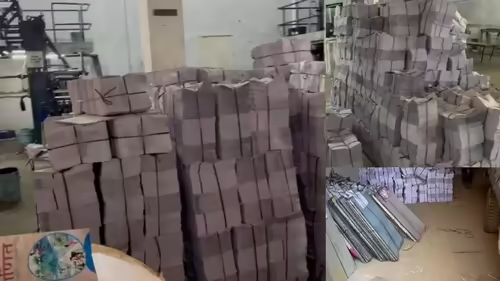
In a coordinated operation, the National Council of Educational Research and Training (NCERT) and the Delhi Police Crime Branch recently raided an illegal printing facility in Ghaziabad, Uttar Pradesh, seizing a staggering 32,000 fake NCERT textbooks . The haul wasn’t just limited to books; authorities also confiscated two industrial-grade printing machines, revealing the scale and organization behind this illicit trade .
Table of Contents
- The Ghaziabad Raid: What Went Down
- NCERT Textbook Piracy: Why It’s a National Crisis
- The Hidden Dangers of Pirated Books for Students
- The Legal Hammer: NCERT’s Stand Against Infringement
- How to Spot a Genuine NCERT Book
- Conclusion: Protecting India’s Future, One Book at a Time
The Ghaziabad Raid: What Went Down
The raid targeted a printing unit in Village Jawli, Loni area of Ghaziabad, a known hub for such illegal activities . Acting on a prior FIR filed for copyright violations, the joint team uncovered a sophisticated operation churning out counterfeit versions of NCERT textbooks across various classes and subjects . This isn’t an isolated incident but part of a larger, ongoing effort by NCERT to protect its intellectual property and, more importantly, the integrity of the educational content reaching millions of students.
NCERT Textbook Piracy: Why It’s a National Crisis
At first glance, textbook piracy might seem like a victimless crime—a way for cash-strapped families to access essential learning materials. However, the truth is far more sinister. This illegal trade creates a ripple effect that damages the entire educational ecosystem:
- Economic Damage: The publishing industry suffers massive financial losses, which can stifle investment in new, high-quality educational resources .
- Undermines Authorship: It disrespects the intellectual property rights of the educators, researchers, and authors who painstakingly create these curricula .
- Fuels Organized Crime: Large-scale operations like the one in Ghaziabad suggest a well-organized criminal network profiting from a basic educational need.
The Hidden Dangers of Pirated Books for Students
The most alarming consequence of NCERT textbook piracy is its direct impact on student learning. These fake books are not just cheap copies; they are often dangerously flawed.
According to experts, pirated textbooks are frequently printed on substandard, cheap paper and may contain content that is far from authentic . They can be filled with critical errors, have entire pages or diagrams missing, or be based on outdated editions that lack crucial curriculum updates . For a student preparing for board exams or competitive tests, relying on such material can lead to confusion, misinformation, and ultimately, poor academic performance. It’s a direct assault on their right to quality education.
The Legal Hammer: NCERT’s Stand Against Infringement
NCERT is not taking this threat lightly. The council has issued stern warnings that the unauthorized printing, distribution, or sale of its textbooks is a serious, punishable offence under the Copyright Act, 1957 .
Under this law, offenders can face severe penalties, including fines of up to Rs. 2 lakhs and potential imprisonment . This recent raid is a clear signal that NCERT is moving from warnings to decisive action. They are actively collaborating with law enforcement agencies and have even set up a dedicated email (pd.ncert@nic.in) for the public to report suspected pirated material .
How to Spot a Genuine NCERT Book
As a parent or guardian, you can be the first line of defense. Here’s how to ensure you’re buying the real deal:
- Buy from Authorized Sellers: Purchase directly from the official NCERT website (ncert.nic.in) or from authorized publishers and reputable bookstores. Be wary of street vendors or online sellers offering prices that seem too good to be true.
- Check the Price: Genuine NCERT books are priced affordably by design. An extremely low price is a major red flag for a counterfeit.
- Inspect the Quality: Look for crisp, clear printing, good quality paper, and a sturdy binding. Pirated copies often have blurry text, smudged images, and flimsy covers.
- Verify the ISBN: Every genuine book has a unique ISBN number. You can cross-check it on the official site.
Conclusion: Protecting India’s Future, One Book at a Time
The seizure of 32,000 fake books in Ghaziabad is more than just a law enforcement victory; it’s a crucial step in safeguarding the quality of education for millions of Indian students. NCERT textbook piracy is not a minor issue—it’s a direct threat to the accuracy of knowledge and the future prospects of our children. By understanding the dangers, knowing the law, and learning how to identify genuine books, we can all play a part in shutting down this harmful black market. After all, a nation’s future is built on the foundation of its education, and that foundation must be solid, authentic, and free from error.
Sources
- Times of India: NCERT cracks down on textbook piracy, seizes 32,000 fake books in major Delhi–NCR raid
- Official NCERT Website: National Council of Educational Research and Training
- Government of India: Copyright Act, 1957