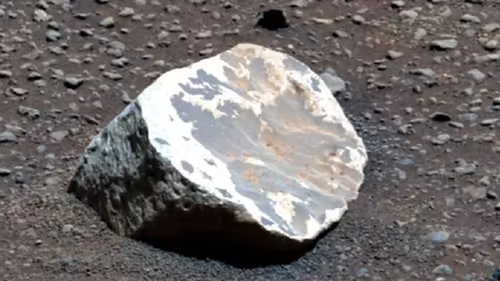
For decades, scientists have debated whether Mars was ever truly Earth-like—complete with rivers, lakes, and maybe even rain. Now, NASA’s Perseverance rover may have delivered the most compelling clue yet: white rocks rich in kaolinite, a clay mineral that doesn’t just hint at water—it points directly to prolonged exposure to rainfall and surface runoff.
This isn’t just another dusty rock. It’s a geological time capsule from a period over 3 billion years ago when Mars might have been warm enough, and wet enough, to support conditions friendly to life. The discovery, made in the ancient river delta of Jezero Crater, is reshaping our understanding of the Red Planet’s climatic past—and raising fresh hope in the search for fossilized microbial life.
Table of Contents
- What Are the White Rocks on Mars?
- Why Kaolinite Is a Game-Changer
- NASA Perseverance White Rocks Mars and the Rainfall Hypothesis
- How This Fits Into the Bigger Picture of Mars Exploration
- What Comes Next: The Search for Life
What Are the White Rocks on Mars?
During its latest survey of Jezero Crater’s delta region, Perseverance’s advanced instruments—including the SuperCam and SHERLOC spectrometers—detected unusually bright, fine-grained outcrops unlike anything seen before on Mars [[1]]. These “white rocks” stand out starkly against the planet’s typical rusty red terrain.
Initial analysis confirmed they are rich in kaolinite (Al₂Si₂O₅(OH)₄), a hydrated aluminum silicate clay. On Earth, kaolinite forms when feldspar-rich rocks weather under warm, humid conditions with consistent rainfall—like in tropical rainforests or monsoon regions [[3]].
Why Kaolinite Is a Game-Changer
Previous Mars missions found minerals like hematite or sulfates that suggest brief, episodic water activity—perhaps from groundwater or short-lived floods. But kaolinite is different. Its formation requires:
- Prolonged exposure to liquid water—not just a flash flood.
- Neutral to slightly acidic pH, which is more conducive to life.
- Surface weathering processes driven by atmospheric interaction—like rain or flowing streams.
“This isn’t just evidence of water,” explains Dr. Ken Farley, Perseverance project scientist at Caltech. “Kaolinite suggests a stable, long-term hydrological cycle—possibly including rainfall, evaporation, and re-infiltration over thousands or millions of years” [[2]].
NASA Perseverance White Rocks Mars and the Rainfall Hypothesis
The presence of kaolinite in layered sedimentary deposits within an ancient river delta strongly supports the idea that Mars once had a functioning water cycle. Scientists now believe that early Mars may have had a thicker atmosphere capable of sustaining clouds and precipitation.
Computer models from NASA’s Goddard Space Flight Center show that if Mars had surface temperatures above freezing—even intermittently—it could have supported seasonal rainstorms that fed rivers flowing into basins like Jezero Crater [[4]]. The white rocks may be the preserved remnants of soil altered by that very rain.
This shifts the narrative from “Mars had water” to “Mars had a climate.” And climate is the key ingredient for habitability.
How This Fits Into the Bigger Picture of Mars Exploration
Perseverance’s mission has always been twofold: understand Mars’ geologic history and search for signs of ancient life. The white rocks discovery advances both goals.
Crucially, these kaolinite-rich layers sit just above older volcanic bedrock, creating a perfect stratigraphic record. By drilling core samples here—as Perseverance has already begun to do—scientists can capture a timeline of environmental change: from dry volcanic activity to a wet, possibly habitable era, and back to the arid desert we see today.
These samples are destined for return to Earth in the early 2030s via the NASA-ESA Mars Sample Return mission, where they’ll be analyzed with lab equipment far more powerful than any rover can carry [[5]].
What Comes Next: The Search for Life
Kaolinite-rich environments on Earth are known to preserve organic molecules and microbial fossils exceptionally well. That makes these white rocks prime real estate in the hunt for biosignatures.
Perseverance is now prioritizing these zones for sample collection. If ancient Martian microbes ever existed, their chemical traces—or even fossilized structures—might be locked inside these very layers.
For more on how planetary geology informs the search for extraterrestrial life, explore our deep dive on [INTERNAL_LINK:mars-habitability-and-biosignatures].
Summary
The discovery of NASA Perseverance white rocks Mars—laden with kaolinite—marks a pivotal moment in planetary science. It provides the strongest evidence yet that Mars wasn’t just briefly wet, but experienced sustained rainfall and surface water cycles billions of years ago. This transforms our view of the planet from a barren wasteland to a once-dynamic world with the potential to host life. As Perseverance continues its mission, these white rocks may hold the key to answering humanity’s oldest question: Are we alone?