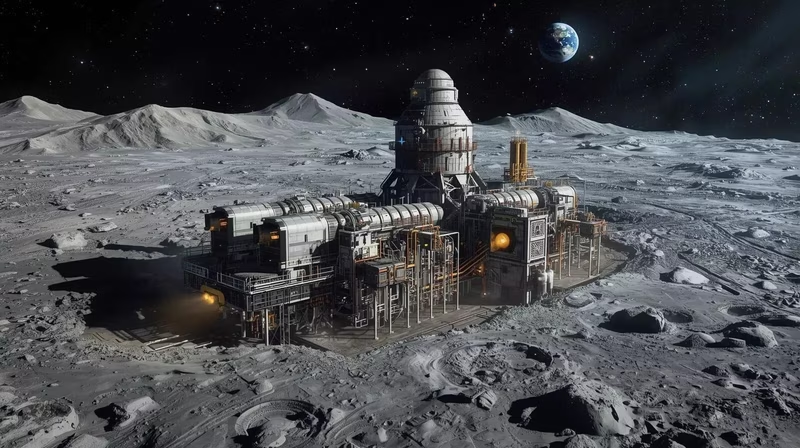
Imagine a small, suitcase-sized nuclear power plant humming steadily in the silent, airless expanse of the Moon’s south pole. No solar panels struggling through two-week-long nights. No batteries running dry. Just constant, reliable electricity—enough to run habitats, life-support systems, labs, and even fuel-producing factories. That’s not science fiction. It’s NASA’s very real plan to land a nuclear reactor on the Moon by 2030.
Table of Contents
- Why the Moon Needs Nuclear Power
- NASA’s Fission Surface Power Project Explained
- How the Lunar Reactor Works
- Nuclear Reactor on the Moon: Safety and Ethical Questions
- Global Race and Commercial Involvement
- Timeline and Next Steps Toward 2030
- Conclusion: A Giant Leap for Lunar Energy
- Sources
Why the Moon Needs Nuclear Power
Solar power—the go-to for most space missions—simply won’t cut it for sustained lunar habitation. The Moon experiences 14 Earth days of continuous sunlight followed by 14 days of total darkness. During that long night, temperatures plummet to -173°C (-280°F), and solar panels generate zero power.
For NASA’s Artemis program, which aims to establish a permanent human presence on the Moon, this is a dealbreaker. Astronauts will need uninterrupted power for oxygen generation, water recycling, communications, and scientific research. Enter nuclear fission: a compact, high-output energy source that works day and night, in shadowed craters or dusty plains.
NASA’s Fission Surface Power Project Explained
In collaboration with the U.S. Department of Energy (DOE), NASA launched the Fission Surface Power (FSP) project to develop a lunar-ready nuclear system. The goal? A reactor capable of delivering at least 40 kilowatts of electric power—enough to run about 30 average U.S. households—for over a decade without refueling.
Three U.S. companies—Lockheed Martin, Westinghouse, and IX (a joint venture of Intuitive Machines and X-Energy)—have been awarded contracts to design preliminary concepts. These aren’t theoretical sketches; they’re engineering blueprints meant to fly within this decade .
How the Lunar Reactor Works
Unlike massive terrestrial reactors, the lunar version will be modular, lightweight, and autonomous. Here’s the basic setup:
- Core: Uses low-enriched uranium (less than 20% U-235), making it proliferation-resistant.
- Cooling System: Heat from fission is transferred via liquid metal (like sodium-potassium alloy) to Stirling engines or thermoelectric converters that generate electricity.
- Radiators: Since there’s no air on the Moon, heat must be dissipated into space using large radiator panels.
- Autonomous Operation: The reactor will turn on automatically after landing, requiring no human intervention.
The entire system is designed to fit inside a lander and be deployed robotically—critical for missions before humans arrive.
Nuclear Reactor on the Moon: Safety and Ethical Questions
Launching nuclear material into space always sparks public concern. But NASA emphasizes multiple layers of safety:
- The reactor remains off during launch and transit. Fission only begins once it’s safely on the lunar surface.
- Low-enriched uranium cannot cause a nuclear explosion.
- In case of a launch failure, the fuel is encased in materials designed to survive re-entry and contain radiation.
Still, critics question the precedent. “Once we normalize nuclear reactors off-Earth, where do we draw the line?” asks Dr. Laura Grego of the Union of Concerned Scientists . Others worry about contaminating pristine lunar environments, especially near potential water ice deposits at the poles.
Global Race and Commercial Involvement
The U.S. isn’t alone. China has announced its own plans for a lunar nuclear power station by the 2030s. Russia has long experimented with space nuclear systems (like the old TOPAZ reactors). This emerging competition adds urgency to NASA’s timeline.
Meanwhile, private companies see opportunity. A reliable power source could enable commercial ventures—mining helium-3, manufacturing in microgravity, or even lunar tourism. [INTERNAL_LINK:lunar-economy-future] could hinge on who controls the plug.
Timeline and Next Steps Toward 2030
NASA’s roadmap is aggressive but structured:
- 2025–2026: Finalize reactor design and select a lead contractor.
- 2027–2028: Build and test full-scale prototypes on Earth.
- 2029: Integrate the system with a lunar lander.
- 2030: Launch and deploy the first operational nuclear reactor on the Moon.
Success would mark the first time humanity has used nuclear fission to generate power on another world—a milestone on par with the first Moon landing.
Conclusion: A Giant Leap for Lunar Energy
NASA’s plan to place a nuclear reactor on the Moon by 2030 isn’t just about keeping lights on. It’s about enabling a new era of deep-space exploration. With reliable power, the Moon becomes a proving ground for Mars missions, a hub for scientific discovery, and potentially, a new frontier for human civilization. The challenges are real—but so is the promise.
Sources
[1] NASA Fission Surface Power Project Overview – https://www.nasa.gov/directorates/stmd/fission-surface-power/
[2] Union of Concerned Scientists – Space Security and Nuclear Power Analysis
[3] Times of India: “Nasa wants to put a nuclear reactor on the Moon by 2030” – https://timesofindia.indiatimes.com/science/nasa-wants-to-put-a-nuclear-reactor-on-the-moon-by-2030/articleshow/126518875.cms
[4] U.S. Department of Energy – Space Nuclear Power Initiatives