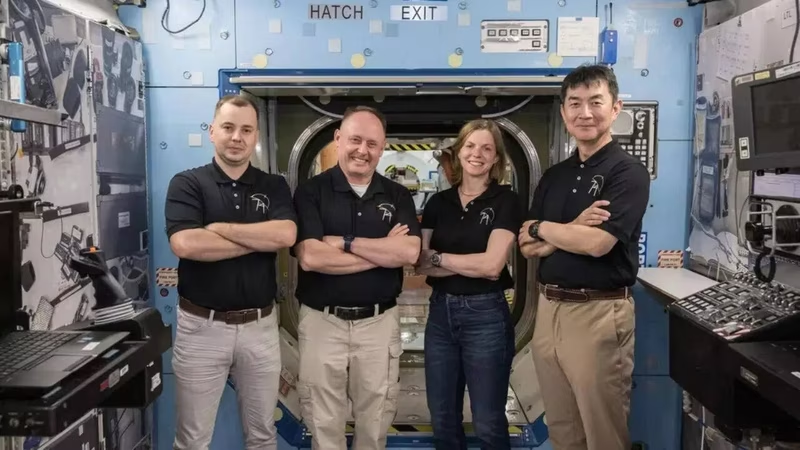
Space missions are meticulously planned down to the second—but sometimes, human health throws a wrench into even the most precise schedules. That’s exactly what’s happening right now as NASA makes the rare decision to bring four astronauts home from the International Space Station (ISS) **weeks ahead of their planned return**.
The reason? A medical issue involving one crew member. While NASA confirms the individual is stable and receiving care, the agency has chosen caution over calendar, triggering an emergency early departure via the SpaceX Crew-11 spacecraft. This move not only highlights the ever-present risks of long-duration spaceflight but also forces a strategic reshuffle to maintain America’s continuous presence in orbit—a streak that’s held since November 2000 .
This urgent scenario puts the phrase NASA astronauts return early at the center of a high-stakes space operation unfolding in real time.
Table of Contents
- The Crew-11 Mission and the Reason for Early Return
- NASA Astronauts Return Early: Details of the Departure
- Who Stays Behind—and Why US Presence Matters
- Medical Risks in Space: What We Know
- How NASA Handles In-Flight Health Emergencies
- Historical Precedents for Early Returns from ISS
- Conclusion: Balancing Safety and Mission Goals
- Sources
The Crew-11 Mission and the Reason for Early Return
Launched in late 2025, the SpaceX Crew-11 mission was designed to deliver a full complement of astronauts to the ISS for a standard six-month rotation. Everything appeared routine—until a medical concern arose that, while not life-threatening, was serious enough to warrant immediate evacuation.
NASA, prioritizing crew safety above all, made the call to cut the mission short. “The astronaut is stable and being monitored by flight surgeons,” a NASA spokesperson said, adding that “out of an abundance of caution, we’ve decided to return the Crew-11 team earlier than planned” . Notably, the agency has not disclosed the nature of the medical issue, citing medical privacy—a standard practice even in space.
NASA Astronauts Return Early: Details of the Departure
The Crew-11 Dragon capsule is now scheduled to undock from the ISS in the coming days. Unlike typical returns that splash down off the coast of Florida, this emergency return will target a landing zone **off the coast of California**—a contingency plan activated to ensure the fastest possible transit to advanced medical facilities if needed .
The timeline is tight. Once undocked, the spacecraft will perform a deorbit burn, re-enter Earth’s atmosphere, and deploy parachutes for a controlled ocean landing. Recovery teams from SpaceX and the Department of Defense will be on standby to retrieve the crew within minutes.
Who Stays Behind—and Why US Presence Matters
With four astronauts departing early, a critical question arises: who ensures the US maintains its operational foothold on the station?
The answer lies in mission redundancy. One American astronaut—originally part of a different crew rotation—will remain aboard the ISS beyond their scheduled stay. This isn’t just symbolic; it’s a strategic necessity. The **continuous US presence** on the ISS is vital for:
- Maintaining control over US-operated modules and experiments,
- Ensuring seamless handover to the next arriving crew,
- Upholding international agreements with partners like ESA, JAXA, and Roscosmos .
Losing that presence, even temporarily, could complicate operations and delay scientific research worth billions.
Medical Risks in Space: What We Know
Space is a hostile environment for the human body. Without gravity, astronauts experience muscle atrophy, bone density loss, fluid shifts, and weakened immune systems. According to NASA’s Human Research Program, common in-flight medical issues include:
- Urinary tract infections,
- Dental emergencies,
- Radiation exposure concerns,
- Cardiovascular irregularities .
While crews are trained in basic medical response and the ISS carries a robust medical kit, serious conditions often require evacuation. For more on space medicine, see this overview from the NASA Human Research Program.
How NASA Handles In-Flight Health Emergencies
NASA doesn’t take medical risks lightly. Every mission includes:
- Pre-flight screening: Astronauts undergo exhaustive health checks.
- Real-time monitoring: Vital signs are tracked continuously.
- Ground support: Flight surgeons on Earth consult 24/7.
- Contingency plans: Early return options are always on standby.
This layered approach has prevented disasters before. The current decision reflects that system working as intended—prioritizing life over schedule.
Historical Precedents for Early Returns from ISS
While rare, early returns have happened. In 2022, a Russian cosmonaut was evacuated due to a cardiac concern. In 2019, a Soyuz launch failure led to a compressed crew rotation. Each event reinforced the need for flexible, crew-centric protocols .
What makes this case unique is that it involves a **US commercial crew vehicle** (SpaceX Dragon) executing an unplanned return—a testament to the maturity of the public-private partnership model.
Conclusion: Balancing Safety and Mission Goals
The decision to bring astronauts home early is never taken lightly. It disrupts science timelines, strains logistics, and costs millions. But as the NASA astronauts return early from the ISS, it sends a powerful message: in space exploration, human life always comes first.
This incident also underscores a quiet truth: even with advanced technology, space remains unpredictable. The real heroism isn’t just in going to orbit—it’s in knowing when to come home. For more on how space agencies manage risk, explore our feature on [INTERNAL_LINK:space-mission-safety-protocols].
Sources
- Times of India: Lingering risk: Why NASA is bringing 4 astronauts home from ISS before scheduled return
- NASA Official Statement: NASA Adjusts Crew-11 Return Due to Medical Concern
- SpaceX Mission Updates: Crew-11 Mission Page
- NASA Human Research Program: The Human Body in Space